Costume rails
A low-poly rolling costume rail from a film studio wardrobe department: steel uprights on castored feet carry a rail of coats, jackets, gowns and cloaks on wooden hangers above a slatted shelf of paired shoes. A modular 2 m piece that snaps on a 1 m grid.
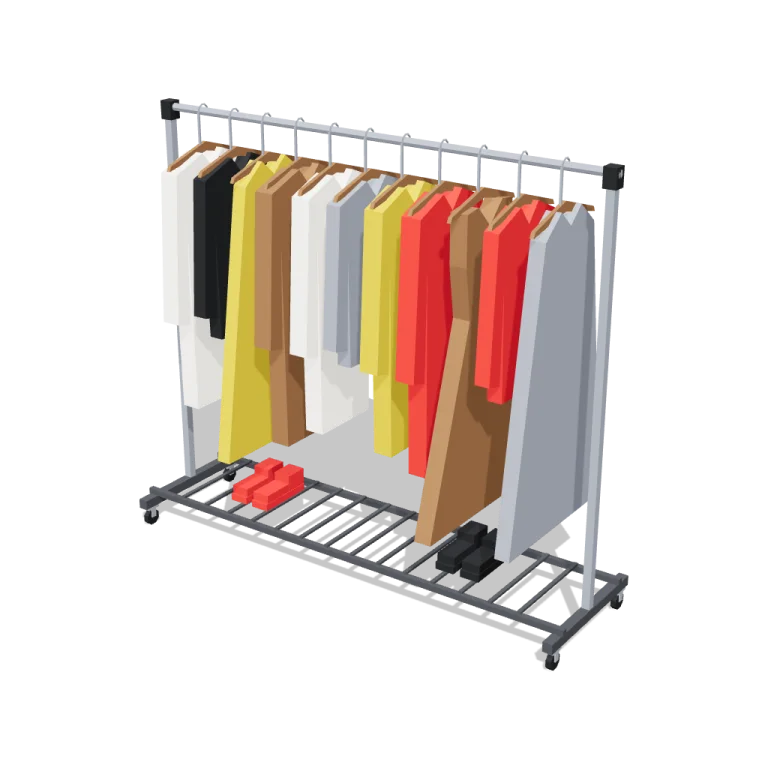
Left rail: colours and the 4 knobs the agent wrote into this model — they rebuild the geometry and go into your download. Right rail: looks for the viewer. Drag to orbit, scroll to zoom.
- Triangles
- 1,984
- Vertices
- 5,952
- Meshes · materials
- 17 · 17
- Size (W × H × D)
- 2.0 m × 1.8 m × 71 cm
- File
- GLB · 155 KB
- Animation
- Static
- Style
- Low-poly
- Collection
- Film Studio
Palette · named materials
- body#7d828c
- body#3a3c40
- trim#151619
- trim#7d5736
- accent#c32222
- accent#f2ede2
- accent#bda00f
Use it
import { GLTFLoader } from "three/addons/loaders/GLTFLoader.js";

const gltf = await new GLTFLoader().loadAsync(
  "https://assets.stoicsoft.com/1designtool/3d/models/film-studio-costume-rails/d30a61e1f6/model.glb"
);
scene.add(gltf.scene); // metres, +Y up, front faces +Z
How it was made
The brief given to 1DesignTool's “3D object” template:
Costume rails for the Film Studio kit. Design it as one clear asset at believable real-world scale for that setting (state the size in metres in meta.notes), with its main parts modelled and named, readable at thumbnail size and from every orbit angle. It is a modular piece that snaps on a 1 m grid: give it a length in whole metres and put the origin at its snapping end, stated in meta.notes. This is one part of the Film Studio kit (Low-poly style, flat-lowpoly direction): Sets, lights and fake walls. Use ONLY the kit palette, by name: black #151619, lamp yellow #eecd2b, wood #7d5736, red carpet #c32222, black dark #090a0b, lamp yellow dark #bda00f, black light #3a3c40, lamp yellow light #f0db75, soot black #1b1b22, warm white #f2ede2, mid grey #7d828c, dark wood #3d2a1c. Every material's `name` must be exactly the palette colour it uses — the GLB carries these names so the kit recolours as one; an unnamed material fails delivery. Kit knob: expose a param `filmGenreOnSet` (0–1, default 0.5) for the kit's "Film genre on set" setting wherever it makes sense on this part, and keep that id.
- Agent: Claude Code · Claude Opus 5.5 in 1DesignTool
- Direction: Low-poly · family products
- three-check PASS · glb-lint PASS
Named parts · 23
- Costume rails
- Castored feet
- Foot bars
- Castor forks
- Castor wheels
- Rail frame
- Uprights
- Rail connectors
- Hanging rail
- Shoe shelf
- Slatted shelf
- Shoes (red carpet)
- Shoes (black)
- Hangers
- Hanger bars
- Hanger hooks
- Costumes
- Costumes (warm white)
- Costumes (black)
- Costumes (lamp yellow dark)
- Costumes (wood)
- Costumes (mid grey)
- Costumes (red carpet)
Note: Real-world size at defaults: 2.0 m long x 1.78 m tall (hanging rail at 1.75 m), footprint about 2.0 x 0.7 m including the widest gown hems. Modular on a 1 m grid: length is a whole number of metres (1-3) and the origin is the snapping end, i.e. the left end seen from the front, on the rail centreline (z = 0) at floor level. The run goes along +X from x = 0 to x = length, and the top rail, shelf rails and foot bars are flush with both ends so butted copies line up; this replaces the library's usual bottom-centre origin. 1984 triangles at defaults (counted from the GLB), about 3.8k at length 3 / rail 2.0 m and still under 6000 at the densest setting. filmGenreOnSet dresses the wardrobe: 0 is a noir rail (black, grey and white coats and suits), around 0.5 a classic mix, and 1 a period drama (red, gold and wood-toned gowns and cloaks); colours switch at thirds while the coat/gown/cloak mix shifts smoothly, and garment draws are seeded so the rail never reshuffles when you change a knob. Garment mesh ids are per colour, so which garments.<colour> and shelf.shoes_<colour> parts exist depends on the params; the group ids (base, frame, shelf, hangers, garments) are stable. The glTF export writes one material per mesh, so several materials share a palette name such as 'mid grey'; recolour them by name. glb-lint reports 0 errors and 5 heuristic warnings: material count, duplicate materials, non-indexed flat-shaded geometry, nested boxes (rail through its connectors, garments overlapping in bounding boxes only), and the shelf and shoes flagged as detached although they rest on the foot bars and slats. plan-check was run on a copy with the hyphens removed, because its part-id regex rejects the hyphenated slug ids. Static: no animation clip.
About the Costume rails 3D model
Costume rails is a free low-poly 3D model from the Film Studio set. It measures 2.0 m × 1.8 m × 71 cm (W × H × D) at real-world scale and is built from 1,984 triangles across 17 meshes, with 23 named parts. Download the 155 KB GLB and drop it into three.js, React Three Fiber, Godot or Blender — free for commercial use, no attribution required.
- Is the Costume rails 3D model free for commercial use?
- Yes. It is free under the 1DesignTool 3D library license: use it in personal and commercial work — games, apps, websites, renders, ads and client projects — and modify it as you like, with no credit required. What you can't do is re-sell or re-distribute the file on its own or inside a model pack.
- What file format is it, and how big is it?
- A single binary glTF 2.0 file (.glb), 155 KB: 1,984 triangles, 5,952 vertices and 17 materials, modelled in metres at 2.0 m × 1.8 m × 71 cm.
- Can I animate Costume rails?
- It ships as a static mesh. Its 23 named parts are separate nodes, so you can move or animate each one in your engine.
- Which engines and tools can open it?
- Anything that reads glTF 2.0. three.js, React Three Fiber, Babylon.js, Godot 4 and Blender import the GLB directly; Unity and Unreal Engine load it through their glTF importers. The snippets above show the exact code for three.js, React Three Fiber, Godot and Blender.
- How was the Costume rails 3D model made?
- Claude Code (Claude Opus 5.5) generated it inside 1DesignTool's 3D template from a written brief, then the design kit's checks verified the geometry and the GLB before it was published. You can make your own the same way with 1DesignTool.
More like this
All of Film Studio →
Wind machine
Film Studio3,476 tris

Dolly on track
Film Studio2,100 tris

Camera crane
Film Studio1,964 tris

Golf cart
Film Studio2,112 tris

Prop racks
Film Studio2,276 tris

Cables
Film Studio4,000 tris

Clapperboards
Film Studio512 tris

Director chairs
Film Studio560 tris
Free under the 1DesignTool 3D library license. Model #12 of 1702.