Burial mound
A low-poly Viking burial mound: a faceted turf dome inside a ship-shaped ring of standing stones, with a dark lintelled passage door, a runestone with a painted red serpent band and an offering stone by the entrance.
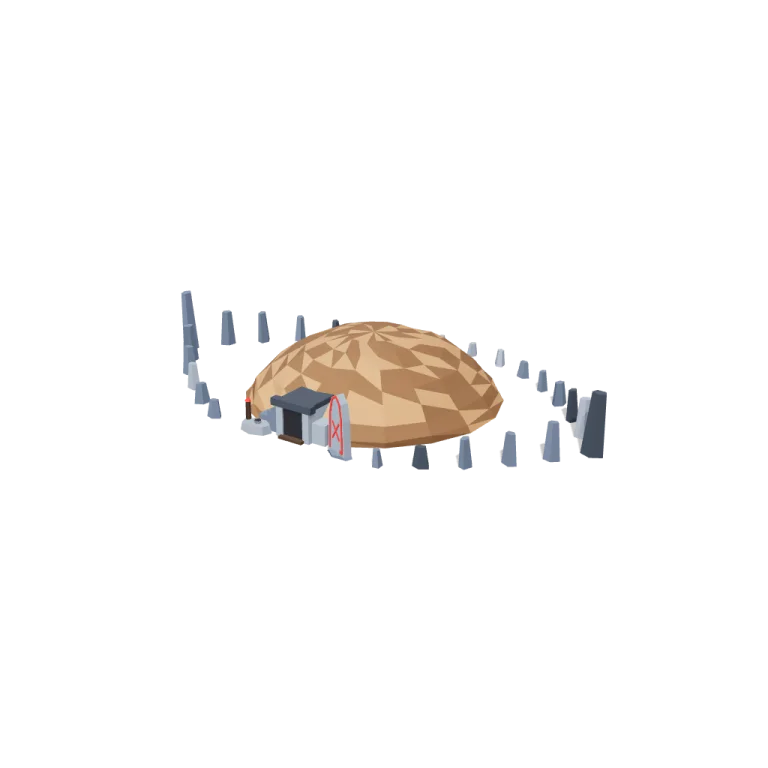
Left rail: colours and the 4 knobs the agent wrote into this model — they rebuild the geometry and go into your download. Right rail: looks for the viewer. Drag to orbit, scroll to zoom.
- Triangles
- 1,216
- Vertices
- 3,648
- Meshes · materials
- 18 · 18
- Size (W × H × D)
- 24 m × 3.2 m × 14 m
- File
- GLB · 101 KB
- Animation
- Static
- Style
- Low-poly
- Collection
- Viking Fjord Village
Palette · named materials
- timber brown — turf facets, mound underside (earth)#6b4a2e
- timber brown light — turf facets (earth)#9b704b
- slate — standing stones, wing walls, runestone base (stone)#525e6f
- slate light — standing stones, portal jambs, runestone (stone)#7b8593
- slate dark — standing stones, lintel, capstone (stone)#323943
- sea grey — offering slab (stone)#757e8a
- mid grey — iron offering bowl (metal)#7d828c
- rust red — runestone serpent band, marker post cap (accent)#c32222
- soot black — passage doorway, ash in the bowl (glass)#1b1b22
- dark wood — threshold beam, marker post (wood)#3d2a1c
- warm white — winter snow cap, season > 0.55 only (accent)#f2ede2
Use it
import { GLTFLoader } from "three/addons/loaders/GLTFLoader.js";

const gltf = await new GLTFLoader().loadAsync(
  "https://assets.stoicsoft.com/1designtool/3d/models/viking-fjord-village-burial-mound/db65912976/model.glb"
);
scene.add(gltf.scene); // metres, +Y up, front faces +Z
How it was made
The brief given to 1DesignTool's “3D object” template:
Burial mound for the Viking Fjord Village kit. Design it as one clear asset at believable real-world scale for that setting (state the size in metres in meta.notes), with its main parts modelled and named, readable at thumbnail size and from every orbit angle. This is one part of the Viking Fjord Village kit (Low-poly style, flat-lowpoly direction): Longhouses under steep cliffs. Use ONLY the kit palette, by name: timber brown #6b4a2e, slate #525e6f, sea grey #757e8a, rust red #c32222, timber brown dark #362517, slate dark #323943, timber brown light #9b704b, slate light #7b8593, soot black #1b1b22, warm white #f2ede2, mid grey #7d828c, dark wood #3d2a1c. Every material's `name` must be exactly the palette colour it uses — the GLB carries these names so the kit recolours as one; an unnamed material fails delivery. Kit knob: expose a param `season` (0–1, default 0.5) for the kit's "Season" setting wherever it makes sense on this part, and keep that id.
- Agent: Claude Code · Claude Opus 5.5 in 1DesignTool
- Direction: Low-poly · family scenes
- three-check PASS · glb-lint PASS
Named parts · 6
- Burial mound
- Turf mound
- Stone ship setting
- Passage entrance
- Runestone
- Offering stone
Note: Size at the defaults: 23.7 m long (x, stem stone to stern stone of the ship setting) × 14.3 m wide (z) × 3.2 m tall. The turf mound itself is 12 m across and 3.2 m high; the stem and stern stones stand 2.9 m and the runestone 2.8 m. Origin is at the bottom centre of the footprint, resting on y = 0; the passage door faces +Z through a gap in the stone ring. The GLB has 1,216 triangles in 18 meshes and no animation clip. Normals are baked flat (non-indexed). Every material is named exactly after a kit palette colour; 10 of the 12 are used at the default (warm white appears only in winter; timber brown dark is not used). The exporter writes one material per mesh, so names repeat: recolour by name. season (the kit's 'Season', 0 = high summer, 1 = deep winter) adds a snow cap on the dome above 0.55 that spreads down the slopes toward 1; below 0.55 it changes nothing. The runestone band is an abstract serpent loop, not readable runes. Params are baked into the GLB at their defaults and only change the geometry when the scene is rebuilt in the viewer. The defaults and the season = 1 winter state were rendered and passed three-check. glb-lint: 0 errors and 5 heuristic warnings, all expected: more than 10 materials and duplicate names (one material per mesh), non-indexed flat shading, overlapping sibling boxes (portal jambs and capstone bedded into the mound), and the scale check for a subject taller than 1 m. plan-check passes once the slug is de-hyphenated; its part-id regex rejects the hyphens in the slug-based ids this library requires. three-check accepts those ids, and all 6 survive the GLB reload. Fix rounds, both visual: (1) the sphere-fit framing left the flat subject small and the turf read as pale sand, so the views were tightened, the turf darkened and the ship setting given pointed ends with taller stem and stern stones; (2) a ring stone crowded the runestone, so the front opening was widened.
About the Burial mound 3D model
Burial mound is a free low-poly 3D model from the Viking Fjord Village set. It measures 24 m × 3.2 m × 14 m (W × H × D) at real-world scale and is built from 1,216 triangles across 18 meshes, with 6 named parts. Download the 101 KB GLB and drop it into three.js, React Three Fiber, Godot or Blender — free for commercial use, no attribution required.
- Is the Burial mound 3D model free for commercial use?
- Yes. It is free under the 1DesignTool 3D library license: use it in personal and commercial work — games, apps, websites, renders, ads and client projects — and modify it as you like, with no credit required. What you can't do is re-sell or re-distribute the file on its own or inside a model pack.
- What file format is it, and how big is it?
- A single binary glTF 2.0 file (.glb), 101 KB: 1,216 triangles, 3,648 vertices and 18 materials, modelled in metres at 24 m × 3.2 m × 14 m.
- Can I animate Burial mound?
- It ships as a static mesh. Its 6 named parts are separate nodes, so you can move or animate each one in your engine.
- Which engines and tools can open it?
- Anything that reads glTF 2.0. three.js, React Three Fiber, Babylon.js, Godot 4 and Blender import the GLB directly; Unity and Unreal Engine load it through their glTF importers. The snippets above show the exact code for three.js, React Three Fiber, Godot and Blender.
- How was the Burial mound 3D model made?
- Claude Code (Claude Opus 5.5) generated it inside 1DesignTool's 3D template from a written brief, then the design kit's checks verified the geometry and the GLB before it was published. You can make your own the same way with 1DesignTool.
More like this
All of Viking Fjord Village →
Runestones
Viking Fjord Village1,140 tris

Looms
Viking Fjord Village2,420 tris

Barrels
Viking Fjord Village3,144 tris

Fish racks
Viking Fjord Village3,338 tris

Shields
Viking Fjord Village2,174 tris

Fjord cliff and water tiles
Viking Fjord Village7,364 tris

Jetty
Viking Fjord Village4,048 tris

Watchtower
Viking Fjord Village3,380 tris
Free under the 1DesignTool 3D library license. Model #4 of 1157.