Realistic Capybara
An adult capybara stands calmly with a mandarin balanced on its crown. Generated anatomy, coarse directional fur and webbed feet give Mochi the familiar unbothered look.
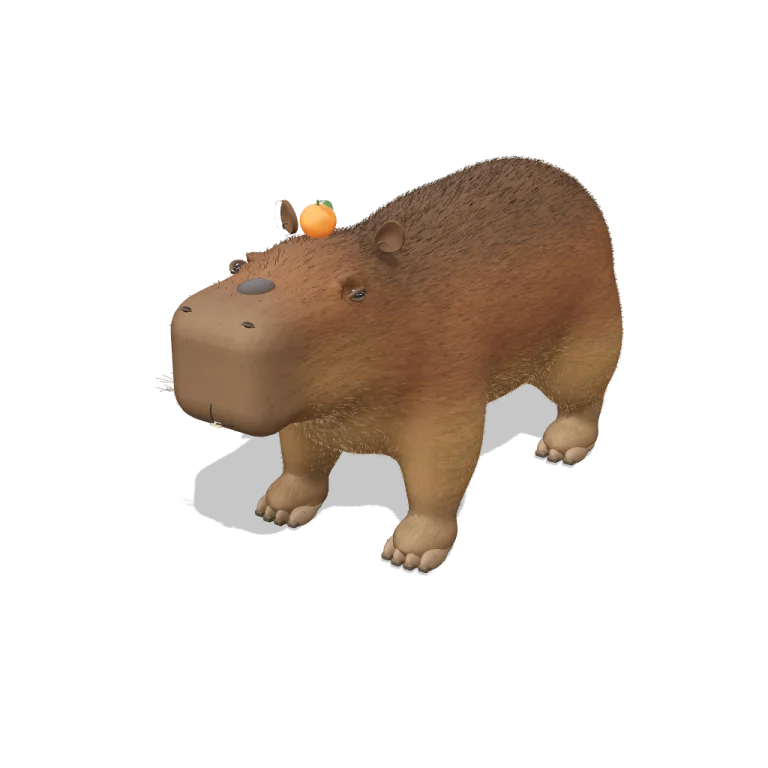
Left rail: colours and the 3 knobs the agent wrote into this model — they rebuild the geometry and go into your download. Right rail: looks for the viewer. Drag to orbit, scroll to zoom.
- Triangles
- 171,722
- Vertices
- 175,548
- Meshes · materials
- 79 · 15
- Size (W × H × D)
- 49 cm × 66 cm × 1.2 m
- File
- GLB · 10.6 MB
- Animation
- Static
- Style
- Realistic
- Collection
- Animals
Palette · named materials
- fur#95734e
- skin#807365
- eye#17120f
- claw#534a3d
- orange#e87516
- leaf#345b23
Use it
import { GLTFLoader } from "three/addons/loaders/GLTFLoader.js";

const gltf = await new GLTFLoader().loadAsync(
  "https://assets.stoicsoft.com/1designtool/3d/models/realistic-capybara/198a8a66a0/model.glb"
);
scene.add(gltf.scene); // metres, +Y up, front faces +Z
How it was made
The brief given to 1DesignTool's “3D object” template:
A realistic adult capybara (Hydrochoerus hydrochaeris) standing calmly, with a small mandarin orange balanced on top of its head — the studio's mascot Mochi, done as the real animal. Anatomy (real proportions): about 1.15 m nose to rump, 0.55 m at the shoulder, a heavy barrel-shaped body with a deep chest and no visible tail. A large, blunt, almost rectangular head with a deep square muzzle and a slightly convex nose bridge; nostrils, eyes and ears all set high on the head (a semi-aquatic animal). Small dark eyes with a wet highlight and heavy upper lids; small rounded, nearly hairless ears; a dark, bare morrillo scent gland on top of the snout; a split upper lip and visible chisel incisors just showing. Short, sturdy legs; front feet with four toes and hind feet with three, partially webbed, with blunt hoof-like nails. Coat: coarse, sparse reddish-brown to brown hair, longer and darker along the back, lighter and yellow-brown on the belly and cheeks, thin enough that greyish skin shows through on the muzzle, ears, feet and around the eyes. Visible hair direction (lying back along the body) and clumping. The mandarin: about 6 cm, dimpled peel, a short stem and one glossy leaf, resting naturally on the flat crown between the ears. Required GLB node names and pivots (the 1designtool.com home page animates these by name — set obj.name exactly): - eyes: `capy_eye-1` (left) and `capy_eye1` (right), each a separate mesh whose origin is at the eye's centre, so scaling y around it reads as a blink; - ears: `capy_ear-1` (left) and `capy_ear1` (right), each a separate mesh with its origin at the ear base, so rotating z twitches the ear; - the mandarin as `capy_orange`, its stem `capy_stem` and leaf `capy_leaf`, with origins at the bottom of the orange where it touches the head, so rotating z wobbles it in place. Pose: four-square, calm, head slightly lowered and eyes half-lidded (the famously unbothered capybara look), mouth closed.
- Agent: Codex · GPT-6-Astra in 1DesignTool
- Generation: 5.49M tokens (96% cached) · weekly plan +1%
- Direction: Realistic · family characters
- three-check PASS · glb-lint PASS
Named parts · 86
- Mochi
- Continuous body sculpt
- Coarse guard hairs
- Facial anatomy
- Heavy upper eyelid
- Lower eyelid
- High nostril
- Nostril rim
- Upper lip pad
- Closed mouth crease
- Heavy upper eyelid
- Lower eyelid
- High nostril
- Nostril rim
- Upper lip pad
- Closed mouth crease
- Bare morrillo scent gland
- Split upper lip
- Chisel incisor
- Chisel incisor
- Muzzle follicles
- Sparse whiskers
- Webbed feet and nails
- Front right foot
- Partial webbing
- Toe 1
- Blunt hoof-like nail 1
- Toe skin crease
- Toe 2
- Blunt hoof-like nail 2
- Toe skin crease
- Toe 3
- Blunt hoof-like nail 3
- Toe skin crease
- Toe 4
- Blunt hoof-like nail 4
- Toe skin crease
- Hind right foot
- Partial webbing
- Toe 1
- +46 more
Note: Procedural sculpt approaching realistic animal anatomy, not scan fidelity. Photographic coat and soft-tissue fidelity were not reached: the close view retains a somewhat stylized sculpted appearance (material identity and style fidelity scored 2/4 after five refinement rounds). Facial folds, eyelids and feet remain simplified at close range; tapered polygon ribbons approximate coarse sparse hair without strand volume, dynamics or a deforming face rig. 171,722 exported triangles; 11,101,284 bytes (11.10 MB). Coat atlas: 2048×2048 colour, normal and roughness; skin and mandarin: 512×512 colour, normal and roughness. All embedded maps are JPEG. Seven direction/heuristic warnings were inspected: soft-clay defaults are explicitly overridden; fur/body and fitted facial parts deliberately overlap; the morrillo and leaf veins attach to meshes outside their sibling-only heuristic. Actual node pivots, texture dimensions, zero clips, fourteen toes and ground contact pass the independent delivery audit. Registry uses capybara.* because the supplied checker rejects hyphens in part ids; required capy_* GLB names are exact.
About the Realistic Capybara 3D model
Realistic Capybara is a free realistic 3D model from the Animals set. It measures 49 cm × 66 cm × 1.2 m (W × H × D) at real-world scale and is built from 171,722 triangles across 79 meshes, with 86 named parts. Download the 10.6 MB GLB and drop it into three.js, React Three Fiber, Godot or Blender — free for commercial use, no attribution required.
- Is the Realistic Capybara 3D model free for commercial use?
- Yes. It is free under the 1DesignTool 3D library license: use it in personal and commercial work — games, apps, websites, renders, ads and client projects — and modify it as you like, with no credit required. What you can't do is re-sell or re-distribute the file on its own or inside a model pack.
- What file format is it, and how big is it?
- A single binary glTF 2.0 file (.glb), 10.6 MB: 171,722 triangles, 175,548 vertices and 15 materials, modelled in metres at 49 cm × 66 cm × 1.2 m.
- Can I animate Realistic Capybara?
- It ships as a static mesh. Its 86 named parts are separate nodes, so you can move or animate each one in your engine.
- Which engines and tools can open it?
- Anything that reads glTF 2.0. three.js, React Three Fiber, Babylon.js, Godot 4 and Blender import the GLB directly; Unity and Unreal Engine load it through their glTF importers. The snippets above show the exact code for three.js, React Three Fiber, Godot and Blender.
- How was the Realistic Capybara 3D model made?
- Codex (GPT-6-Astra) generated it inside 1DesignTool's 3D template from a written brief, then the design kit's checks verified the geometry and the GLB before it was published. You can make your own the same way with 1DesignTool.
More like this
All of Animals →


Free under the 1DesignTool 3D library license. Model #484 of 597.