Plains Zebra
An adult plains zebra standing with its head lowered to graze, sculpted as one continuous body with a procedurally baked striped coat. Stripes run vertically on the flank, arc around the haunch into horizontal leg bands and follow the neck and face.
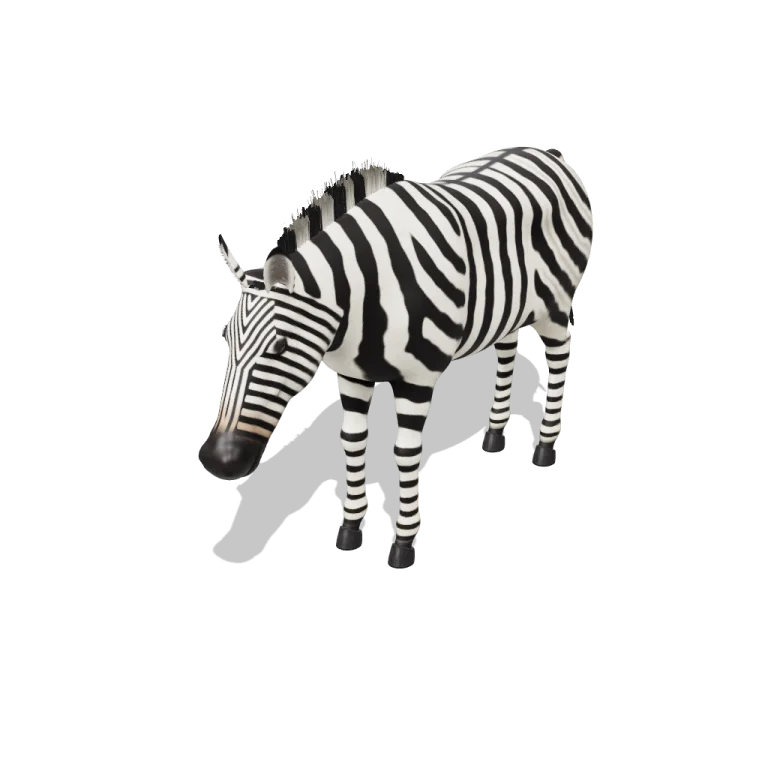
Left rail: colours and the 4 knobs the agent wrote into this model — they rebuild the geometry and go into your download. Right rail: looks for the viewer. Drag to orbit, scroll to zoom.
- Triangles
- 93,816
- Vertices
- 96,436
- Meshes · materials
- 14 · 5
- Size (W × H × D)
- 49 cm × 1.4 m × 2.2 m
- File
- GLB · 4.8 MB
- Animation
- Static
- Style
- Realistic
- Collection
- Animals
Palette · named materials
- fur#ECE7DC
- fur-stripe#161312
- fur-shadow-stripe#8E7A63
- fur-nose#8F6D50
- skin#1D1817
- skin-inner-ear#6B5F5A
- eye#1B120D
- hoof#242222
Use it
import { GLTFLoader } from "three/addons/loaders/GLTFLoader.js";

const gltf = await new GLTFLoader().loadAsync(
  "https://assets.stoicsoft.com/1designtool/3d/models/plains-zebra/5a3fc109e4/model.glb"
);
scene.add(gltf.scene); // metres, +Y up, front faces +Z
How it was made
The brief given to 1DesignTool's “3D object” template:
A realistic adult plains zebra (Equus quagga) standing, head slightly lowered as if grazing. Anatomy: about 1.3 m at the shoulder, compact horse-like body, upright stiff striped mane, rounded ears with dark tips, dark muzzle, single hooves, a tail with a black tassel. Coat: bold black and white stripes — vertical on the body, bending horizontal on the haunches and legs, with faint grey 'shadow stripes' between the black ones on the rump; the stripes follow the anatomy around the neck and face. Hard requirement: the exported GLB must contain more than 20,000 triangles — measure it before delivering; a lighter model is rejected.
- Agent: Cursor Agent · Auto in 1DesignTool
- Direction: Realistic · family characters
- three-check PASS · glb-lint PASS (0 errors, 3 heuristic warnings; tool verdict UNVERIFIED because no requirements contract was supplied)
Named parts · 13
- Body
- Left ear
- Right ear
- Left eye
- Right eye
- Front left hoof
- Front right hoof
- Hind left hoof
- Hind right hoof
- Mane
- Tail tassel
- Ear hair
- Eyelashes
Note: Real triangle count 91,656 (body 70,632 as one continuous SDF surface-nets mesh refined toward the face, eyes, nostrils and feet; ears 2 × 2,280; eyes 2 × 2,160; hooves 4 × 1,456; mane and forelock cards 5,808; tail tassel 1,920; ear fringe 528; lashes 224). GLB 5.0 MB. Textures, all generated in JS at build time: one shared 2048² atlas for body, ears and hooves (base colour JPEG, tangent-space normal JPEG, ORM JPEG with AO in R, roughness in G and metalness 0 in B) plus a 512² RGBA PNG strand texture for the alpha-tested hair cards. The base colour holds no lighting; occlusion lives only in the AO channel. Withers sit at about 1.34 m; 1.45 m is the full height to the ear tips. Limits: the body coat has no fur shells, so its hair direction, clumping and fuzzy stripe edges come from the normal map and colour variation, and the silhouette is smooth. Hair cards are used only for the mane, forelock, tail tassel, inner-ear fringe and lashes. The stripe pattern is a procedural anatomical field (trunk bands, haunch and shoulder arcs, leg rings, neck and face bands, forehead arches, faint rump shadow stripes), not a copy of any individual zebra. Eyes are glossy dark globes with no modelled iris or pupil. Nostrils are shallow dents and the mouth is closed. Static sculpt: no rig, no clip, evaluatePose is a no-op. Each mesh keeps its library id (plains-zebra.*) inside a wrapper group carrying the kit's hyphen-free plan id (zebra.*). glb-lint warnings explained: the triangle-budget warning (60,000) and the scale warning (expected 0.2 m) both come from the soft-clay base direction; the plan overrides them (budget 120,000, reference height 1.30 m) but glb-lint does not read overrides. The detached-parts warning lists ears, eyes, mane and tail tassel, which rest on the body mesh rather than on a sibling part.
More like this
All of Animals →


Free under the 1DesignTool 3D library license. Model #7 of 138.