Axolotl
A life-size leucistic axolotl resting on the aquarium floor, with coral-red feathery gills, a broad smiling head and a translucent tail fin. Fully procedural geometry and PBR textures.
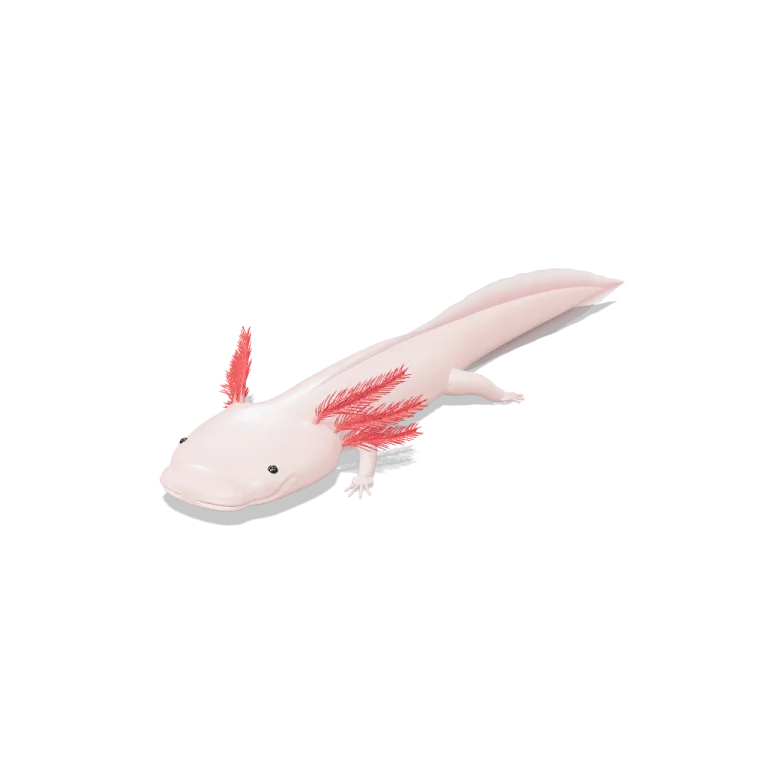
Left rail: colours and the 4 knobs the agent wrote into this model — they rebuild the geometry and go into your download. Bottom: what the model does — the one you pick plays here and is baked into the download. Right rail: looks for the viewer. Drag to orbit, scroll to zoom. On a desktop, Open in 1DesignTool turns it into a project you can keep editing with your agent.
- Triangles
- 107,718
- Vertices
- 61,100
- Meshes · materials
- 11 · 4
- Size (W × H × D)
- 8 cm × 4 cm × 26 cm
- File
- GLB · 4.5 MB
- Animation
- Static
- Style
- Realistic
- Collection
- Animals
Palette · named materials
- skin#EFBAB5
- gill#C9333F
- fin#E7A2A2
- eye#141011
Use it
import { GLTFLoader } from "three/addons/loaders/GLTFLoader.js";

const gltf = await new GLTFLoader().loadAsync(
  "https://assets.stoicsoft.com/1designtool/3d/models/axolotl/7843338603/model.glb"
);
scene.add(gltf.scene); // metres, +Y up, front faces +Z
How it was made
The brief given to 1DesignTool's “3D object” template:
A realistic adult leucistic axolotl (Ambystoma mexicanum) resting on the bottom as if in an aquarium, front legs splayed. Anatomy: about 0.25 m long, a broad flat head with a wide smiling mouth, tiny dark eyes, three pairs of feathery external gills (rami with fine filaments) sweeping back behind the head, four short legs with thin delicate toes, a long tail with a translucent fin running along the top of the back and tail. Skin: pale pink, smooth and slightly glossy and translucent; the gills deep coral red. Hard requirement: the exported GLB must contain more than 20,000 triangles — measure it before delivering; a lighter model is rejected.
- Agent: Cursor Agent · Auto in 1DesignTool
- Direction: Realistic · family characters
- three-check PASS · glb-lint PASS
Named parts · 12
- Axolotl
- Body (head, trunk, tail)
- Left eye
- Right eye
- Left gills
- Right gills
- Front left leg
- Front right leg
- Hind left leg
- Hind right leg
- Dorsal fin
- Ventral fin
Note: Measured from the exported GLB: 107,718 triangles in 11 meshes and 4 materials, 4.5 MB. Bounds are 0.083 × 0.040 × 0.265 m. That is 0.25 m from snout to tail tip, plus 15 mm of fin past the tip; height is set by the gill tops; toes rest on y = 0. Textures, all generated in code at build time: skin base colour 2048×1024 JPEG, skin normal 2048×1024 JPEG, roughness (metalness = 0) 1024×512 JPEG, fin colour + alpha 1024×256 PNG (PNG because the fin needs alpha), iris 256×256 JPEG. Gill colour is stored as vertex colours. Honest limits: (1) Skin translucency is faked with sheen plus a warm tint; glTF core has no subsurface scattering, so the skin does not glow when lit from behind. (2) Gill filaments are thin tapered tubes, about 110 per ramus. Real gills have far more and finer filaments, so up close the fringe looks like a comb rather than a soft plume. (3) Legs, palms, toes, gills and fins are separate meshes pushed into the body, not one welded surface, so a soft crease shows where each meets the skin. (4) The eyes are lidless glossy spheres with a painted iris; there is no modelled cornea or wet film. (5) The mouth is a sculpted crease and does not open; there is no rig, morphs or animation (static specimen). (6) The fin is one double-sided alpha-blended sheet with no thickness, so sort order can vary in other viewers. (7) The direction base is soft-clay with recorded overrides (realistic proportions, gloss/clearcoat, PBR maps, thin toes and filaments, translucent fin). glb-lint warns that this exceeds soft-clay's 60k triangle budget (intended, per the brief's 25k–120k target), that the eyes and leg roots overlap the body (intended embedding), and that the 0.04 m height differs from the direction's 0.2 m reference (real species scale).
About the Axolotl 3D model
Axolotl is a free realistic 3D model from the Animals set. It measures 8 cm × 4 cm × 26 cm (W × H × D) at real-world scale and is built from 107,718 triangles across 11 meshes, with 12 named parts. Download the 4.5 MB GLB and drop it into three.js, React Three Fiber, Godot or Blender — free for commercial use, no attribution required.
- Is the Axolotl 3D model free for commercial use?
- Yes. It is free under the 1DesignTool 3D library license: use it in personal and commercial work — games, apps, websites, renders, ads and client projects — and modify it as you like, with no credit required. What you can't do is re-sell or re-distribute the file on its own or inside a model pack.
- What file format is it, and how big is it?
- A single binary glTF 2.0 file (.glb), 4.5 MB: 107,718 triangles, 61,100 vertices and 4 materials, modelled in metres at 8 cm × 4 cm × 26 cm.
- Can I animate Axolotl?
- It ships as a static mesh. Its 12 named parts are separate nodes, so you can move or animate each one in your engine.
- Which engines and tools can open it?
- Anything that reads glTF 2.0. three.js, React Three Fiber, Babylon.js, Godot 4 and Blender import the GLB directly; Unity and Unreal Engine load it through their glTF importers. The snippets above show the exact code for three.js, React Three Fiber, Godot and Blender.
- How was the Axolotl 3D model made?
- Cursor Agent (Auto) generated it inside 1DesignTool's 3D template from a written brief, then the design kit's checks verified the geometry and the GLB before it was published. You can make your own the same way with 1DesignTool.
More like this
All of Animals →


Free under the 1DesignTool 3D library license. Model #2228 of 2361.