Port gates
A modular 4 m section of circuit-board city wall pierced by two port gates, each framed by a raised black bezel and hung with a warm-white connector tongue over gold contact fingers. Chip merlons run the crest, end pylons mark the snapping ends, and gold trace roads leave each mouth across the green board deck.
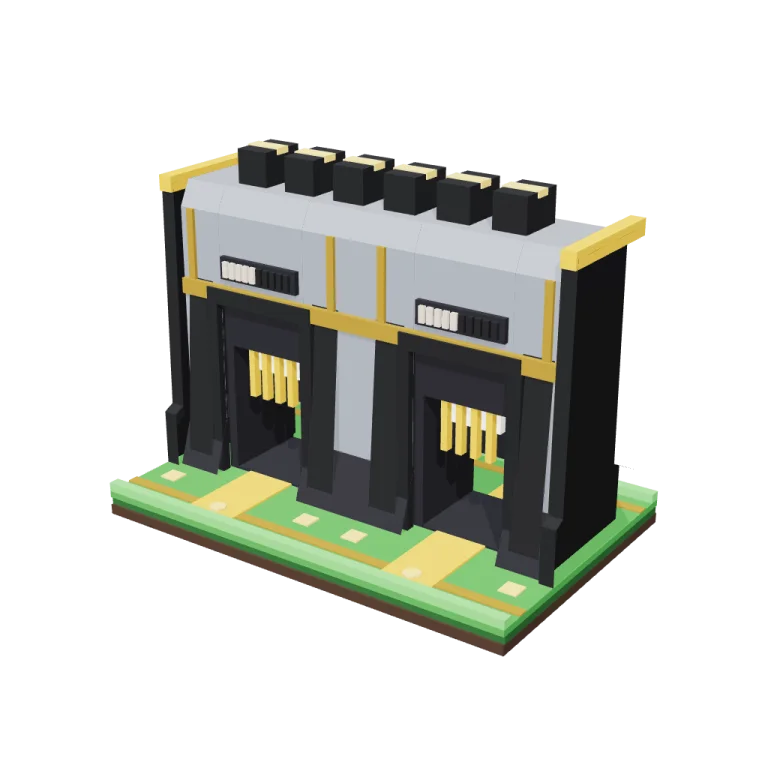
Left rail: colours and the 4 knobs the agent wrote into this model — they rebuild the geometry and go into your download. Right rail: looks for the viewer. Drag to orbit, scroll to zoom.
- Triangles
- 1,844
- Vertices
- 3,564
- Meshes · materials
- 22 · 22
- Size (W × H × D)
- 4.0 m × 3.1 m × 2.6 m
- File
- GLB · 117 KB
- Animation
- Static
- Style
- Low-poly
- Collection
- Circuit City
Palette · named materials
- wall#7d828c
- base#1b1b22
- trim#151619
- deck#3a883a
- plinth#235223
- kerb#5db15d
- accent#d0a225
- cornice#8f7019
- highlight#debd63
- tongue#f2ede2
- led#988e81
- substrate#3d2a1c
Use it
import { GLTFLoader } from "three/addons/loaders/GLTFLoader.js";

const gltf = await new GLTFLoader().loadAsync(
  "https://assets.stoicsoft.com/1designtool/3d/models/circuit-city-port-gates/be4b20d957/model.glb"
);
scene.add(gltf.scene); // metres, +Y up, front faces +Z
How it was made
The brief given to 1DesignTool's “3D object” template:
Port gates for the Circuit City kit. Design it as one clear asset at believable real-world scale for that setting (state the size in metres in meta.notes), with its main parts modelled and named, readable at thumbnail size and from every orbit angle. It is a modular piece that snaps on a 1 m grid: give it a length in whole metres and put the origin at its snapping end, stated in meta.notes. This is one part of the Circuit City kit (Low-poly style, flat-lowpoly direction): The inside of a computer as a city. Use ONLY the kit palette, by name: board green #3a883a, gold traces #d0a225, black chips #151619, led colours #988e81, board green dark #235223, gold traces dark #8f7019, board green light #5db15d, gold traces light #debd63, soot black #1b1b22, warm white #f2ede2, mid grey #7d828c, dark wood #3d2a1c. Every material's `name` must be exactly the palette colour it uses — the GLB carries these names so the kit recolours as one; an unnamed material fails delivery. Kit knob: expose a param `ledColours` (0–1, default 0.5) for the kit's "LED colours" setting wherever it makes sense on this part, and keep that id.
- Agent: Claude Code · Claude Opus 5 in 1DesignTool
- Generation: 18.83M tokens (98% cached) · ≈ $15.79 at API prices · 5-hour plan +29%
- Direction: Low-poly · family scenes
- three-check PASS · glb-lint PASS
Named parts · 28
- Port gates (root)
- Board deck assembly
- Shield wall assembly
- Gate fittings assembly
- Crest and merlons assembly
- Trace roads assembly
- Board substrate
- Plinth course
- Board deck
- Deck kerbs
- Battered base course
- Shield wall panel
- Trace cornice
- Wall trace stubs
- Gate buttresses and end pylons
- End pylon caps
- Port bezels
- Port shells and thresholds
- Connector tongues
- Contact fingers
- Status bar housings
- Lit status LEDs
- Unlit status LEDs
- Chip merlons
- Merlon caps
- Trace roads
- Trace bus lines
- Solder pads and vias
Note: Real-world scale at the default parameters: 4.0 m long (X) x 3.132 m tall (Y) x 2.6 m deep (Z), with the board deck resting exactly on y = 0. It is a modular piece on a 1 m grid: the origin is at the -X snapping end (x = 0, y = 0, centred in depth, z = 0), the wall runs along +X, and the length parameter is in whole metres, so copies tile end to end. The front — the face with the LED status bars and the solder-pad row — faces +Z. Every full-length element (plinth, kerbs, base course, wall panel, cornice, trace stubs, bus lines) dies into the inner face of a half-width end pylon, and two abutting segments' half-pylons meet as one whole pylon, so the seam reads as a solid end tower. The merlon and solder-pad lattice is pitched at 0.5 m and held clear of both ends for the same reason. Assembly groups use plain dotted ids (portgates, portgates.wall, ...) because the kit's plan grammar has no hyphens; every mesh carries a circuit-city-port-gates.* id. Materials are named exactly after their Circuit City palette colour, and all twelve kit colours are used, so the GLB recolours as one; glb-lint reports 22 materials only because the runtime export path writes one material per mesh. ledColours (default 0.5) sets how many of the ten pips in each gate's status bar are lit: the lit ones take the emissive 'led colours' material, the rest stay 'black chips'. At 0 the bar is dark and the 'led colours' material is absent from the GLB; at 1 every pip is lit. length, wallHeight and gateCount rebuild the geometry in the viewer (1466 triangles at the smallest settings, 2970 at the largest), but the GLB holds the default values only. gateCount is clamped to what the segment can hold -- a gate bay needs a 1.8 m pitch, so a 3 m segment gets one gate whatever the knob says, a 4-5 m segment at most two, and three gates need the full 6 m. The exported model is 1844 triangles across 22 meshes, static (no animation clip), with no textures and flat normals baked into the geometry. glb-lint: 0 errors. Its overall verdict prints UNVERIFIED only because no requirements contract exists; the five heuristic warnings were reviewed and accepted -- the per-mesh duplicated materials from the export path, the deliberate nesting of bezels/buttresses/cornice into the wall, the deck and kerbs flagged as detached (they bed into the plinth below them), and the expected-1 m scale heuristic against a true 3.13 m wall. OBJ export is geometry only.
More like this
All of Circuit City →
Resistors
Circuit City2,116 tris

Board tiles
Circuit City3,776 tris

Heat-sink skyline
Circuit City3,132 tris

Trace roads
Circuit City3,752 tris

Capacitor silos
Circuit City3,680 tris

Chip towers
Circuit City4,100 tris

Bus tram
Circuit City3,272 tris

Blinking LEDs
Circuit City2,804 tris
Free under the 1DesignTool 3D library license. Model #70 of 485.