Board tiles
A seamless 4 x 4 m circuit-board floor tile for the Circuit City kit: a green solder-mask deck over a dark substrate, two crossing layers of gold lanes that run clean off every edge, and chips, capacitor cans, resistors and LED studs standing on it as street furniture. Copies butt together in all four directions with no visible seam.
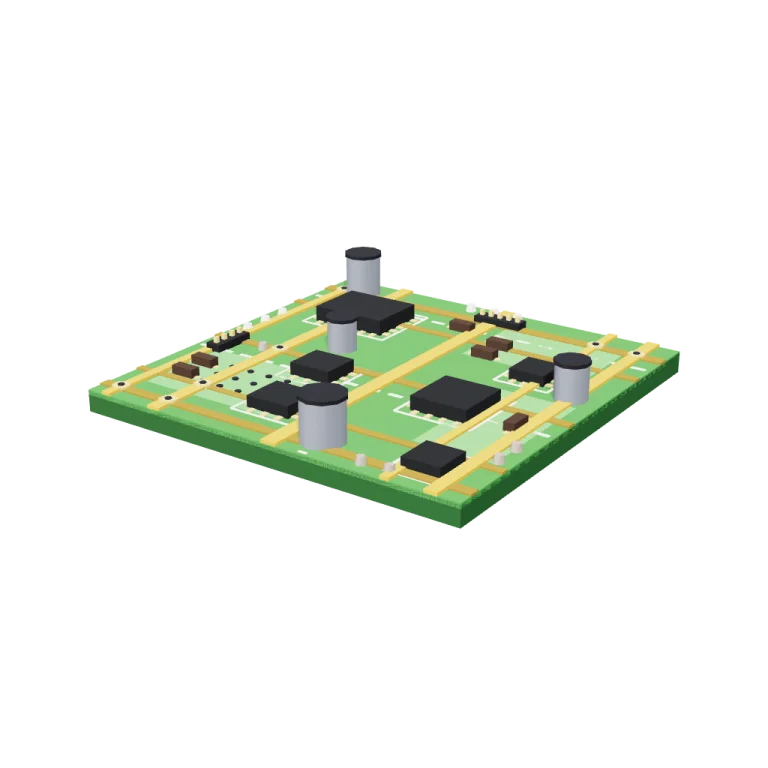
Left rail: colours and the 4 knobs the agent wrote into this model — they rebuild the geometry and go into your download. Right rail: looks for the viewer. Drag to orbit, scroll to zoom.
- Triangles
- 3,776
- Vertices
- 7,080
- Meshes · materials
- 16 · 16
- Size (W × H × D)
- 4.0 m × 68 cm × 4.0 m
- File
- GLB · 263 KB
- Animation
- Static
- Style
- Low-poly
- Collection
- Circuit City
Palette · named materials
- substrate#235223
- deck#3a883a
- pour#5db15d
- laneUnder#8f7019
- lane#d0a225
- pad#debd63
- hole#1b1b22
- chip#151619
- can#7d828c
- resistor#3d2a1c
- led#988e81
- lit#f2ede2
Use it
import { GLTFLoader } from "three/addons/loaders/GLTFLoader.js";

const gltf = await new GLTFLoader().loadAsync(
  "https://assets.stoicsoft.com/1designtool/3d/models/circuit-city-board-tiles/f5e046eed4/model.glb"
);
scene.add(gltf.scene); // metres, +Y up, front faces +Z
How it was made
The brief given to 1DesignTool's “3D object” template:
Board tiles for the Circuit City kit. Design it as one clear asset at believable real-world scale for that setting (state the size in metres in meta.notes), with its main parts modelled and named, readable at thumbnail size and from every orbit angle. Make it a ground piece on an exact 4 × 4 m footprint with flat edges at y = 0 that tile seamlessly with its neighbours in every direction; origin at the tile centre. This is one part of the Circuit City kit (Low-poly style, flat-lowpoly direction): The inside of a computer as a city. Use ONLY the kit palette, by name: board green #3a883a, gold traces #d0a225, black chips #151619, led colours #988e81, board green dark #235223, gold traces dark #8f7019, board green light #5db15d, gold traces light #debd63, soot black #1b1b22, warm white #f2ede2, mid grey #7d828c, dark wood #3d2a1c. Every material's `name` must be exactly the palette colour it uses — the GLB carries these names so the kit recolours as one; an unnamed material fails delivery. Kit knob: expose a param `ledColours` (0–1, default 0.5) for the kit's "LED colours" setting wherever it makes sense on this part, and keep that id.
- Agent: Claude Code · Claude Opus 5 in 1DesignTool
- Generation: 10.88M tokens (97% cached) · ≈ $9.32 at API prices · 5-hour plan +15%
- Direction: Low-poly · family scenes
- three-check PASS · glb-lint PASS
Named parts · 17
- Board tile
- Substrate
- Solder mask deck
- Copper pour zones
- Lower lanes
- Upper lanes
- Pads
- Vias
- Chip packages
- Pin combs
- Capacitor cans
- Capacitor tops
- Resistors
- Resistor leads
- LED studs
- Lit LED studs
- Silkscreen
Note: Physical size: an exact 4 x 4 m footprint, 0.678 m tall to the top of the tallest capacitor, bottom face on y = 0 with the origin at the tile centre (which is also the bottom centre). Tiling was verified numerically against the exported GLB: nothing overhangs the footprint, and every vertex on an x = -2 face has a twin at x = +2 with the same (y, z) — and likewise for z — so copies placed 4 m apart butt together with no gap, no overlap and no z-fighting. The gold lanes cross the whole tile at fixed offsets and the silkscreen dashes run on a 0.25 m period started half a gap in from the edge, so both patterns continue into the neighbour; everything else stays strictly inside the footprint. All four params were re-run through three-check at both ends of their range and the model stays valid: no part ever becomes an empty mesh, and the tiling test still passes at maximum density. ledColours drives both how many LED studs are lit and how strongly the warm-white material glows; because the silkscreen shares that material (so the GLB carries exactly one material per palette colour), the white board markings brighten slightly with it. Part ids use the compact root `boardtile` rather than the full slug because the kit's part-id grammar does not allow hyphens. The GLB reports 16 materials rather than 12: the runtime clones a material per mesh on export, so the four palette colours shared by more than one part appear more than once — every name is still exactly its palette colour. glb-lint also reports a sibling-overlap warning: the board stack is deliberately layered and every component is sunk a few millimetres into the deck so nothing floats. Named views are framed for a landscape viewer; in a narrow portrait frame they crop, and the runtime's own fit (Reset view) is the one to use there.
More like this
All of Circuit City →
Port gates
Circuit City1,844 tris

Resistors
Circuit City2,116 tris

Heat-sink skyline
Circuit City3,132 tris

Trace roads
Circuit City3,752 tris

Capacitor silos
Circuit City3,680 tris

Chip towers
Circuit City4,100 tris

Bus tram
Circuit City3,272 tris

Blinking LEDs
Circuit City2,804 tris
Free under the 1DesignTool 3D library license. Model #72 of 485.