Chip towers
A city block built from computer parts: five stepped black chip stacks rise out of a green circuit-board plaza laced with gold traces, each tower standing on rows of gold DIP legs. Two capacitor silos and LED window studs fill out the skyline.
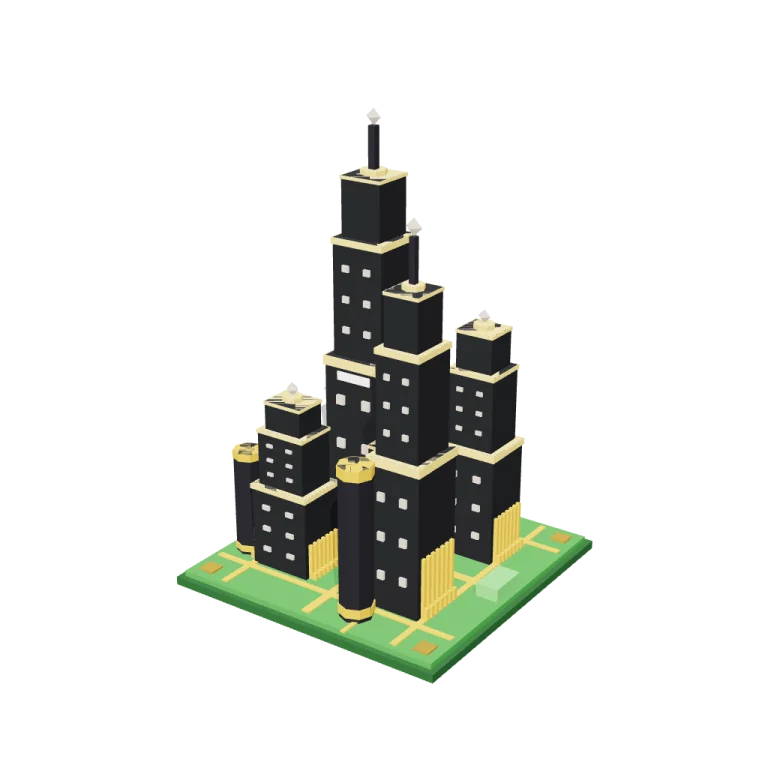
Left rail: colours and the 4 knobs the agent wrote into this model — they rebuild the geometry and go into your download. Right rail: looks for the viewer. Drag to orbit, scroll to zoom.
- Triangles
- 4,100
- Vertices
- 12,300
- Meshes · materials
- 37 · 37
- Size (W × H × D)
- 36 cm × 53 cm × 36 cm
- File
- GLB · 427 KB
- Animation
- Static
- Style
- Low-poly
- Collection
- Circuit City
Palette · named materials
- board green#3a883a
- board green dark#235223
- board green light#5db15d
- gold traces#d0a225
- gold traces light#debd63
- gold traces dark#8f7019
- black chips#151619
- soot black#1b1b22
- led colours#988e81
- warm white#f2ede2
Use it
import { GLTFLoader } from "three/addons/loaders/GLTFLoader.js";

const gltf = await new GLTFLoader().loadAsync(
  "https://assets.stoicsoft.com/1designtool/3d/models/circuit-city-chip-towers/4a7b691de3/model.glb"
);
scene.add(gltf.scene); // metres, +Y up, front faces +Z
How it was made
The brief given to 1DesignTool's “3D object” template:
Chip towers for the Circuit City kit. Design it as one clear asset at believable real-world scale for that setting (state the size in metres in meta.notes), with its main parts modelled and named, readable at thumbnail size and from every orbit angle. This is one part of the Circuit City kit (Low-poly style, flat-lowpoly direction): The inside of a computer as a city. Use ONLY the kit palette, by name: board green #3a883a, gold traces #d0a225, black chips #151619, led colours #988e81, board green dark #235223, gold traces dark #8f7019, board green light #5db15d, gold traces light #debd63, soot black #1b1b22, warm white #f2ede2, mid grey #7d828c, dark wood #3d2a1c. Every material's `name` must be exactly the palette colour it uses — the GLB carries these names so the kit recolours as one; an unnamed material fails delivery. Kit knob: expose a param `ledColours` (0–1, default 0.5) for the kit's "LED colours" setting wherever it makes sense on this part, and keep that id.
- Agent: Claude Code · Claude Opus 5 in 1DesignTool
- Generation: 9.13M tokens (97% cached) · ≈ $8.01 at API prices · 5-hour plan +26%
- Direction: Low-poly · family scenes
- three-check PASS · glb-lint PASS (0 errors, 5 heuristic warnings; glb-lint prints verdict UNVERIFIED because no requirements contract was supplied)
Named parts · 41
- Chip towers
- Board plaza
- Substrate
- Board deck
- Gold traces
- Solder pads
- Low components
- Tower cluster
- Tower A
- Tower A stack
- Tower A cornices
- Tower A legs
- Tower A LED windows
- Tower A crown
- Tower B
- Tower B stack
- Tower B cornices
- Tower B legs
- Tower B LED windows
- Tower B crown
- Tower C
- Tower C stack
- Tower C cornices
- Tower C legs
- Tower C LED windows
- Tower C crown
- Tower D
- Tower D stack
- Tower D cornices
- Tower D legs
- Tower D LED windows
- Tower D crown
- Tower E
- Tower E stack
- Tower E cornices
- Tower E legs
- Tower E LED windows
- Tower E crown
- Capacitor silos
- Silo A
- +1 more
Note: Size 0.36 x 0.534 x 0.36 m — desk-diorama scale: the board tile is a real motherboard's footprint and the chip stacks are the city fiction rising from it. Origin is bottom-centre, the board rests exactly on y = 0 and the long board edge faces +Z. Static: no animation clip is in the GLB. Material names are the Circuit City palette colour names verbatim, which is how the kit recolours as one set — but the exporter writes one material instance per mesh, so the GLB holds 37 materials sharing those 10 names (Blender will show 'gold traces.001' and so on); recolour by name, not by count. ledColours (0-1) sets how many LED window rows light each tower's faces, the beacon size, and the emissive strength of the 'led colours' material; it changes the model, not just the viewer. Part ids use the root 'chiptowers' rather than the hyphenated slug because the kit's part-id grammar allows only [a-z0-9] in the first segment. Two glb-lint heuristics fire by design: every primitive is non-indexed because flat normals are baked in so the faceted look survives export, and the masts and beacons read as 'detached' only because their sibling test cannot see the tower stack they sit on.
More like this
All of Circuit City →
Port gates
Circuit City1,844 tris

Resistors
Circuit City2,116 tris

Board tiles
Circuit City3,776 tris

Heat-sink skyline
Circuit City3,132 tris

Trace roads
Circuit City3,752 tris

Capacitor silos
Circuit City3,680 tris

Bus tram
Circuit City3,272 tris

Blinking LEDs
Circuit City2,804 tris
Free under the 1DesignTool 3D library license. Model #79 of 485.