Data packets on traces
A 4 m circuit-board road tile from the Circuit City kit: three gold traces jog 45° across a green board while chunky data packets rise out of the back vias, ride the traces and sink into the front vias on a seamless 6-second loop.
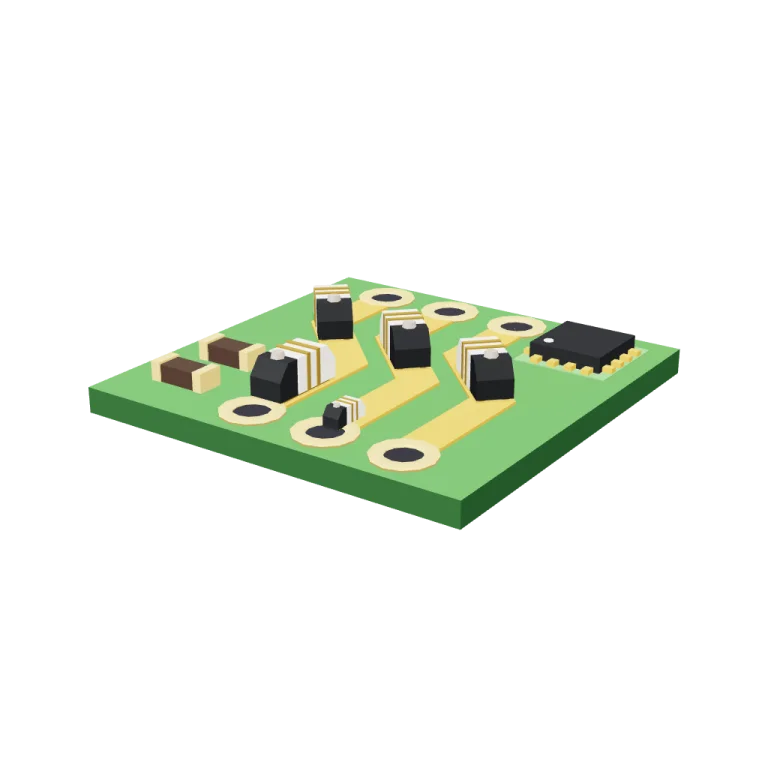
Left rail: colours and the 3 knobs the agent wrote into this model — they rebuild the geometry and go into your download. Right rail: looks for the viewer. Drag to orbit, scroll to zoom.
- Triangles
- 1,904
- Vertices
- 3,262
- Meshes · materials
- 59 · 59
- Size (W × H × D)
- 4.0 m × 70 cm × 4.0 m
- File
- GLB · 297 KB
- Animation
- scene-motion · 6.0s
- Style
- Low-poly
- Collection
- Circuit City
Palette · named materials
- base#3a883a
- base-edge#235223
- accent#5db15d
- trim#d0a225
- trim-light#debd63
- trim-dark#8f7019
- body-dark#151619
- hole#1b1b22
- body#f2ede2
- light#988e81
- earth#3d2a1c
Use it
import { GLTFLoader } from "three/addons/loaders/GLTFLoader.js";

const gltf = await new GLTFLoader().loadAsync(
  "https://assets.stoicsoft.com/1designtool/3d/models/circuit-city-data-packets-on-traces/9d479c2c71/model.glb"
);
scene.add(gltf.scene); // metres, +Y up, front faces +Z

const mixer = new THREE.AnimationMixer(gltf.scene);
gltf.animations.forEach((clip) => mixer.clipAction(clip).play());
// in your loop: mixer.update(delta)
How it was made
The brief given to 1DesignTool's “3D object” template:
Data packets on traces for the Circuit City kit. Design it as one clear asset at believable real-world scale for that setting (state the size in metres in meta.notes), with its main parts modelled and named, readable at thumbnail size and from every orbit angle. It moves: author a seamless baked loop (2–12 s) with every pivot exactly at its hinge, axle or swivel, and keep the base still. This is one part of the Circuit City kit (Low-poly style, flat-lowpoly direction): The inside of a computer as a city. Use ONLY the kit palette, by name: board green #3a883a, gold traces #d0a225, black chips #151619, led colours #988e81, board green dark #235223, gold traces dark #8f7019, board green light #5db15d, gold traces light #debd63, soot black #1b1b22, warm white #f2ede2, mid grey #7d828c, dark wood #3d2a1c. Every material's `name` must be exactly the palette colour it uses — the GLB carries these names so the kit recolours as one; an unnamed material fails delivery. Kit knob: expose a param `ledColours` (0–1, default 0.5) for the kit's "LED colours" setting wherever it makes sense on this part, and keep that id.
- Agent: Claude Code · Claude Opus 5.5 in 1DesignTool
- Generation: 4.74M tokens (95% cached) · ≈ $3.44 at API prices · 5-hour plan +3%, weekly plan +1%
- Direction: Low-poly · family abstract-kinetic
- three-check PASS · glb-lint PASS
Named parts · 19
- Board
- Trace A
- Trace B
- Trace C
- Via A in (pad + hole)
- Via A out (pad + hole)
- Via B in (pad + hole)
- Via B out (pad + hole)
- Via C in (pad + hole)
- Via C out (pad + hole)
- Chip (footprint, body, pins, pin-1 dot)
- Capacitor 1 (body, terminals)
- Capacitor 2 (body, terminals)
- Packet A1 (header, payload, skids, bit bands, LED)
- Packet A2
- Packet B1
- Packet B2
- Packet C1
- Packet C2
Note: Scale: the tile is 4.0 × 4.0 m with a 0.25 m board, 0.38 m traces and 0.8 m packets; it stands 0.70 m tall. Origin is at the bottom centre on y = 0, front faces +Z. The 1,904-triangle model uses 11 of the 12 kit colours (mid grey is unused), and every material is named after its palette colour. The exporter writes one material copy per mesh, so the same name appears on several materials (e.g. 'gold traces dark' ×12); they are identical, so recolour by name. Animation: the 'scene-motion' clip (6 s, seamless) moves only the packet groups. Each packet pivots at its bottom centre on the trace, yaws through the jog and scales from ~0 to 1 out of and back into the via holes. The board, traces, vias and components never move. Params: ledColours sets the LED lamps' emissive strength (0 = unlit, 1 = full) and is stored in the GLB's emissive factor. packetCount and packetLength rebuild the geometry and re-bake the clip in the viewer; the GLB carries the defaults (2 packets per trace, 0.8 m). glb-lint finds no blocking errors, so it is listed as PASS here, although the tool itself prints UNVERIFIED because no requirements contract was supplied. Its 4 warnings are heuristic: duplicate materials (from the exporter), non-indexed extrusions (intended flat shading) and designed nesting (via holes in pads, bands around payloads). The model root's registry id is 'circuitcity' because the kit's plan pattern forbids hyphens. Its node name and every child id use circuit-city-data-packets-on-traces.*.
More like this
All of Circuit City →
Bus tram
Circuit City3,272 tris

Blinking LEDs
Circuit City2,804 tris

Spinning fan
Circuit City2,724 tris

Jumper cables
Circuit City4,496 tris

Data crates
Circuit City3,168 tris

Antenna pins
Circuit City1,000 tris

Fans
Circuit City1,588 tris

LEDs
Circuit City1,920 tris
Free under the 1DesignTool 3D library license. Model #47 of 379.