River and dune tiles
A low-poly 4 × 4 m Ancient Egypt ground tile: a lapis-blue stretch of the Nile winds between papyrus banks and a green strip with date palms, beside a crescent sand dune with a dark slipface. A stone landing holds a sledge of limestone blocks bound for the pyramid, with a papyrus skiff moored alongside.
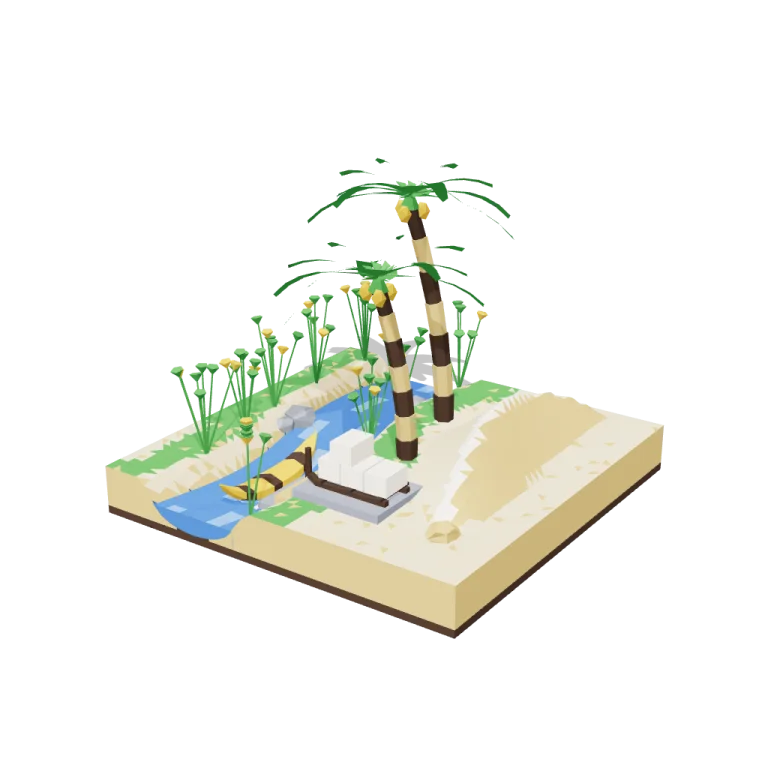
Left rail: colours and the 5 knobs the agent wrote into this model — they rebuild the geometry and go into your download. Right rail: looks for the viewer. Drag to orbit, scroll to zoom.
- Triangles
- 8,484
- Vertices
- 25,452
- Meshes · materials
- 23 · 23
- Size (W × H × D)
- 4.0 m × 3.1 m × 4.0 m
- File
- GLB · 617 KB
- Animation
- Static
- Style
- Low-poly
- Collection
- Ancient Egypt
Palette · named materials
- bank and dune sand (sand)#d1bd94
- wet sand band, dune slipface, cut faces, trunk rings, quay middle step (sand dark)#ba9c5e
- dune crest, limestone blocks (sand light)#e6ddcb
- river water (lapis blue)#2e67b8
- river bed (lapis blue dark)#1f457a
- current streaks on the water (lapis blue light)#6190d1
- cultivated strip, papyrus, palm fronds (palm green)#3a883a
- papyrus skiff, flowering papyrus heads, dates (gold)#d0a225
- stone quay, bank stones (mid grey)#7d828c
- soil band and tile bottom, sledge, mooring post, skiff lashings, palm trunks (dark wood)#3d2a1c
- foam rings at the waterline (warm white)#f2ede2
Use it
import { GLTFLoader } from "three/addons/loaders/GLTFLoader.js";

const gltf = await new GLTFLoader().loadAsync(
  "https://assets.stoicsoft.com/1designtool/3d/models/ancient-egypt-river-and-dune-tiles/802f29dd12/model.glb"
);
scene.add(gltf.scene); // metres, +Y up, front faces +Z
How it was made
The brief given to 1DesignTool's “3D object” template:
River and dune tiles for the Ancient Egypt kit. Design it as one clear asset at believable real-world scale for that setting (state the size in metres in meta.notes), with its main parts modelled and named, readable at thumbnail size and from every orbit angle. Make it a ground piece on an exact 4 × 4 m footprint with flat edges at y = 0 that tile seamlessly with its neighbours in every direction; origin at the tile centre. This is one part of the Ancient Egypt kit (Low-poly style, flat-lowpoly direction): Temples and work camps by the river. Use ONLY the kit palette, by name: sand #d1bd94, lapis blue #2e67b8, gold #d0a225, palm green #3a883a, sand dark #ba9c5e, lapis blue dark #1f457a, sand light #e6ddcb, lapis blue light #6190d1, soot black #1b1b22, warm white #f2ede2, mid grey #7d828c, dark wood #3d2a1c. Every material's `name` must be exactly the palette colour it uses — the GLB carries these names so the kit recolours as one; an unnamed material fails delivery. Kit knob: expose a param `pyramidSizeAndCompletion` (0–1, default 0.5) for the kit's "Pyramid size and completion" setting wherever it makes sense on this part, and keep that id.
- Agent: Claude Code · Claude Opus 5.5 in 1DesignTool
- Direction: Low-poly · family scenes
- three-check PASS · glb-lint PASS
Named parts · 8
- River and dune tile
- Sand banks and dune
- River water
- Stone landing and limestone blocks
- Moored papyrus skiff
- Bank stones
- Papyrus clumps
- Date palms
Note: Size: an exact 4 × 4 m footprint (x and z from −2 to +2) and 3.08 m tall to the top of the tallest date palm. The origin is at the tile centre on the bottom, the slab rests on y = 0 and the front faces +Z. The bank tops are 0.5 m high; the default river is 1.4 m wide bank to bank, its bed is 0.08 m above the base, and the water stands 0.27 m high. The dune crest rises 0.6 m above the bank, to 1.1 m. Tiling: the river centreline is x = −0.9 + 0.15·sin(πz/2), so the channel cross-section is identical on the front and back edges and river tiles chain front to back. The dune and bank relief fade to zero before every border, so all four edges are flat at 0.5 m and meet any neighbour flush. Neighbours must use the same riverWidth and waterLevel. Nothing overhangs the footprint (GLB bounds are exactly ±2 m in x and z). The kit knob pyramidSizeAndCompletion sets how many dressed limestone blocks wait on the sledge at the landing: 1 block at 0, a full 3-2-1 stack of 6 at 1, and 4 at the default 0.5. A river tile carries no pyramid, so the knob stands for how far the building work has got. duneHeight sets the crest height (0.25–0.65 m), riverWidth sets the channel width (1.2–1.7 m), waterLevel moves the surface from 0.18 to 0.36 m (the wet-sand band follows), and palms sets 0–3 date palms. Params are baked into the GLB at their defaults. The GLB has 8,484 triangles in 23 meshes; three-check's 9.0k figure includes the viewer's staging ground, which is not exported. It is static and carries no animation clip. Every material is named exactly after a kit palette colour (11 of the 12; soot black is unused). The exporter writes one material per mesh, so some names appear more than once; recolour by name. The water is an opaque closed body, not a transparent plane. glb-lint reports 0 errors and only heuristic warnings: non-indexed flat-shaded primitives, overlapping ground colour meshes from the same slab, the stones flagged as detached even though they are sunk into the sand, and a height-vs-1 m scale hint. plan-check rejects the hyphenated slug part ids that the library requires; a copy with the ids de-hyphenated passes, and three-check accepts the hyphenated ids.
About the River and dune tiles 3D model
River and dune tiles is a free low-poly 3D model from the Ancient Egypt set. It measures 4.0 m × 3.1 m × 4.0 m (W × H × D) at real-world scale and is built from 8,484 triangles across 23 meshes, with 8 named parts. Download the 617 KB GLB and drop it into three.js, React Three Fiber, Godot or Blender — free for commercial use, no attribution required.
- Is the River and dune tiles 3D model free for commercial use?
- Yes. It is free under the 1DesignTool 3D library license: use it in personal and commercial work — games, apps, websites, renders, ads and client projects — and modify it as you like, with no credit required. What you can't do is re-sell or re-distribute the file on its own or inside a model pack.
- What file format is it, and how big is it?
- A single binary glTF 2.0 file (.glb), 617 KB: 8,484 triangles, 25,452 vertices and 23 materials, modelled in metres at 4.0 m × 3.1 m × 4.0 m.
- Can I animate River and dune tiles?
- It ships as a static mesh. Its 8 named parts are separate nodes, so you can move or animate each one in your engine.
- Which engines and tools can open it?
- Anything that reads glTF 2.0. three.js, React Three Fiber, Babylon.js, Godot 4 and Blender import the GLB directly; Unity and Unreal Engine load it through their glTF importers. The snippets above show the exact code for three.js, React Three Fiber, Godot and Blender.
- How was the River and dune tiles 3D model made?
- Claude Code (Claude Opus 5.5) generated it inside 1DesignTool's 3D template from a written brief, then the design kit's checks verified the geometry and the GLB before it was published. You can make your own the same way with 1DesignTool.
More like this
All of Ancient Egypt →
Shaduf water lift
Ancient Egypt824 tris

Chariot
Ancient Egypt3,244 tris

Stone sledge
Ancient Egypt2,164 tris

Reed boat
Ancient Egypt2,468 tris

Reed baskets
Ancient Egypt2,568 tris

Torches
Ancient Egypt1,182 tris

Sarcophagus
Ancient Egypt1,136 tris

Offering tables
Ancient Egypt1,949 tris
Free under the 1DesignTool 3D library license. Model #10 of 1125.