Longship
A low-poly Viking longship with a dragon-headed stem, a curled stern post, a striped red and white square sail and rows of painted shields along its gunwales. Its oars row on a seamless 6 s loop while the steering oar and masthead vane swing gently.
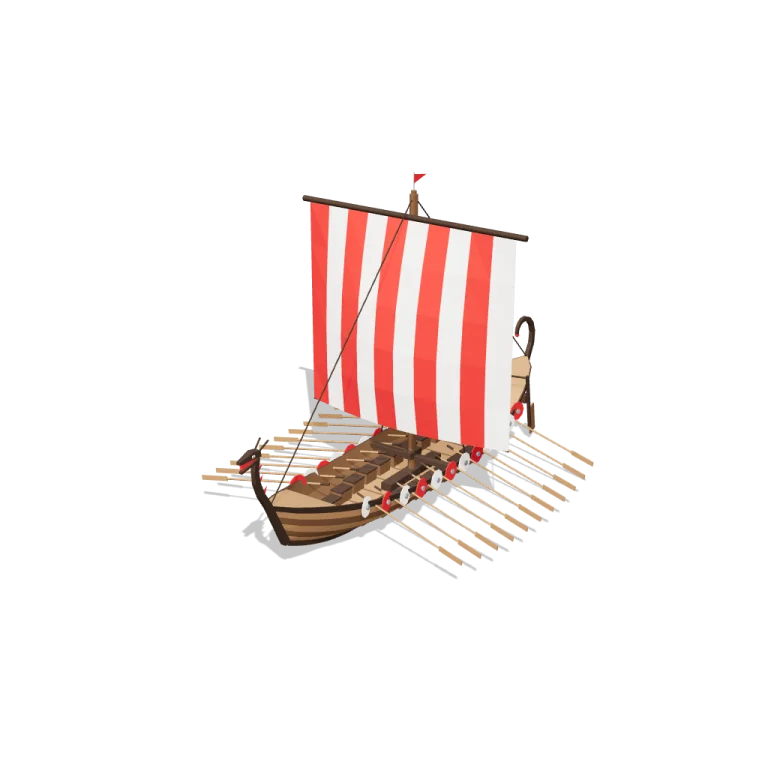
Left rail: colours and the 4 knobs the agent wrote into this model — they rebuild the geometry and go into your download. Right rail: looks for the viewer. Drag to orbit, scroll to zoom.
- Triangles
- 5,890
- Vertices
- 10,888
- Meshes · materials
- 70 · 70
- Size (W × H × D)
- 11 m × 12 m × 18 m
- File
- GLB · 578 KB
- Animation
- scene-motion · 6.0s
- Style
- Low-poly
- Collection
- Viking Fjord Village
Palette · named materials
- timber brown — hull strakes, inner skin, mast, sea chests, steering-oar blade#6b4a2e
- timber brown light — hull strakes, floor and end decks, oars#9b704b
- timber brown dark — sheer strake, keel, stem and stern posts, dragon head, yard, rigging, tiller#362517
- dark wood — gunwale caps, mast fish and partner, chest lids, oar grips, withy boss#3d2a1c
- rust red — sail cloths, shields, dragon mouth and crest, stern-curl tip, vane#c32222
- warm white — sail cloths, shields, dragon eyes, winter snow#f2ede2
- mid grey — shield bosses, vane spindle#7d828c
- soot black — dragon pupils#1b1b22
Use it
import { GLTFLoader } from "three/addons/loaders/GLTFLoader.js";

const gltf = await new GLTFLoader().loadAsync(
  "https://assets.stoicsoft.com/1designtool/3d/models/viking-fjord-village-longship/c23a8ea138/model.glb"
);
scene.add(gltf.scene); // metres, +Y up, front faces +Z

const mixer = new THREE.AnimationMixer(gltf.scene);
gltf.animations.forEach((clip) => mixer.clipAction(clip).play());
// in your loop: mixer.update(delta)
How it was made
The brief given to 1DesignTool's “3D object” template:
Longship for the Viking Fjord Village kit. Design it as one clear asset at believable real-world scale for that setting (state the size in metres in meta.notes), with its main parts modelled and named, readable at thumbnail size and from every orbit angle. It moves: author a seamless baked loop (2–12 s) with every pivot exactly at its hinge, axle or swivel, and keep the base still. This is one part of the Viking Fjord Village kit (Low-poly style, flat-lowpoly direction): Longhouses under steep cliffs. Use ONLY the kit palette, by name: timber brown #6b4a2e, slate #525e6f, sea grey #757e8a, rust red #c32222, timber brown dark #362517, slate dark #323943, timber brown light #9b704b, slate light #7b8593, soot black #1b1b22, warm white #f2ede2, mid grey #7d828c, dark wood #3d2a1c. Every material's `name` must be exactly the palette colour it uses — the GLB carries these names so the kit recolours as one; an unnamed material fails delivery. Kit knob: expose a param `season` (0–1, default 0.5) for the kit's "Season" setting wherever it makes sense on this part, and keep that id.
- Agent: Claude Code · Claude Opus 5.5 in 1DesignTool
- Direction: Low-poly · family vehicles
- three-check PASS · glb-lint PASS
Named parts · 33
- Longship
- Hull
- Keel and stem posts
- Dragon figurehead
- Mast and yard
- Sail
- Shrouds, stays and sheets
- Shield rows
- Sea chests
- Oar, starboard 1
- Oar, starboard 2
- Oar, starboard 3
- Oar, starboard 4
- Oar, starboard 5
- Oar, starboard 6
- Oar, starboard 7
- Oar, starboard 8
- Oar, starboard 9
- Oar, starboard 10
- Oar, starboard 11
- Oar, port 1
- Oar, port 2
- Oar, port 3
- Oar, port 4
- Oar, port 5
- Oar, port 6
- Oar, port 7
- Oar, port 8
- Oar, port 9
- Oar, port 10
- Oar, port 11
- Steering oar and tiller
- Masthead vane
Note: Size: the ship is 17.9 m long overall from the stern curl to the dragon snout (the hull itself is 16.1 m at the gunwale ends), 3.7 m in beam, and 11.4 m across the oar blades. The gunwale is 1.57 m above the keel bottom amidships and rises to 2.67 m at the ends. The dragon head stands about 4.7 m and the vane tip 11.62 m. Origin: x is centred on the centreline, y = 0 is the keel bottom amidships, and z is centred on the overall length. The bow faces +Z. The ship rests on its keel with no water included; a waterline about 0.8 m up suits it, and the oar blades dip to about 0.3 m. The GLB has 5,890 triangles in 70 meshes, merged per part and colour, across 33 named parts (hull, keel and stem posts, dragon figurehead, mast and yard, sail, rigging, shield rows, sea chests, 22 oars, steering oar, vane). It holds one baked 6 s clip, scene-motion, with two rowing strokes. Each oar node sits at its oar port and turns there (Euler YZX: droop about the fore-aft axis, sweep about the vertical), dipping its blade on the pull. The steering oar node sits at the withy on the starboard quarter, and its local +Y is the shaft axis it turns about. The vane turns on its spindle at the masthead. The hull, keel, figurehead, mast, sail, rigging, shields and chests never move. All angles are whole-cycle sines, so the loop closes exactly. The exporter writes the static node pose at the t = 2 s frame, so un-animated imports show the oars mid-stroke. Every material is named exactly after a kit palette colour. The exporter writes one material per mesh, so names repeat: recolour by name. Params are baked at their defaults and only change geometry when the scene is rebuilt in the viewer. season (the kit Season knob) brails the sail up toward the yard from about 0.55 (fully up by 0.92) and adds snow on the end decks and yard from 0.72; at the 0.5 default the sail is full and there is no snow. shipLength scales the whole ship, oarsPerSide sets the oar, shield and chest count, and stroke sets the rowing amplitude (0 holds the oars still). Only the defaults were rendered by three-check; the param extremes were reasoned through in code but not captured. Fix rounds: (1) the dragon crest fins floated behind the neck, so they were reseated on its aft face, and the hero was tightened; (2) the tighter hero cropped the oar tips under the toolbar, so it was eased to margin 0.74. glb-lint: 0 errors and 5 heuristic warnings. Two cover the material count and duplicate materials, both caused by per-mesh materials. One flags overlaps where the hull layers, gunwale caps and keel are deliberately nested. One flags rigging and chests as detached, but they rest on the mast, gunwale and floor, which belong to other parts. One flags the 11.6 m height against a 1 m reference, which is the real scale of the ship. The verdict reads UNVERIFIED only because no host requirements contract was supplied. plan-check passes except for its part-id regex, which rejects the hyphens in the slug-based ids this library requires (a de-hyphenated copy passes). three-check accepts those ids, and the GLB reload preserved every part id.
About the Longship 3D model
Longship is a free animated low-poly 3D model from the Viking Fjord Village set. It measures 11 m × 12 m × 18 m (W × H × D) at real-world scale and is built from 5,890 triangles across 70 meshes, with 33 named parts and a baked animation (6.0 s). Download the 578 KB GLB and drop it into three.js, React Three Fiber, Godot or Blender — free for commercial use, no attribution required.
- Is the Longship 3D model free for commercial use?
- Yes. It is free under the 1DesignTool 3D library license: use it in personal and commercial work — games, apps, websites, renders, ads and client projects — and modify it as you like, with no credit required. What you can't do is re-sell or re-distribute the file on its own or inside a model pack.
- What file format is it, and how big is it?
- A single binary glTF 2.0 file (.glb), 578 KB: 5,890 triangles, 10,888 vertices and 70 materials, modelled in metres at 11 m × 12 m × 18 m.
- Is Longship animated?
- Yes — the GLB carries a baked animation (6.0 s), ready to play with any glTF animation mixer.
- Which engines and tools can open it?
- Anything that reads glTF 2.0. three.js, React Three Fiber, Babylon.js, Godot 4 and Blender import the GLB directly; Unity and Unreal Engine load it through their glTF importers. The snippets above show the exact code for three.js, React Three Fiber, Godot and Blender.
- How was the Longship 3D model made?
- Claude Code (Claude Opus 5.5) generated it inside 1DesignTool's 3D template from a written brief, then the design kit's checks verified the geometry and the GLB before it was published. You can make your own the same way with 1DesignTool.
More like this
All of Viking Fjord Village →
Turning spit
Viking Fjord Village3,556 tris

Sled
Viking Fjord Village1,700 tris

Rowing boat
Viking Fjord Village2,628 tris

Fur piles
Viking Fjord Village4,060 tris

Fire pits
Viking Fjord Village2,914 tris

Runestones
Viking Fjord Village1,140 tris

Looms
Viking Fjord Village2,420 tris

Barrels
Viking Fjord Village3,144 tris
Free under the 1DesignTool 3D library license. Model #27 of 1186.