Camel train
A low-poly Silk Road caravan of three two-humped Bactrian camels walking in single file, each nose-roped to the pack frame of the camel ahead and loaded with sacks, carpet rolls and roped bales. It has a seamless 6 s loop: the camels pace in place, nodding their heads and swishing their tails.
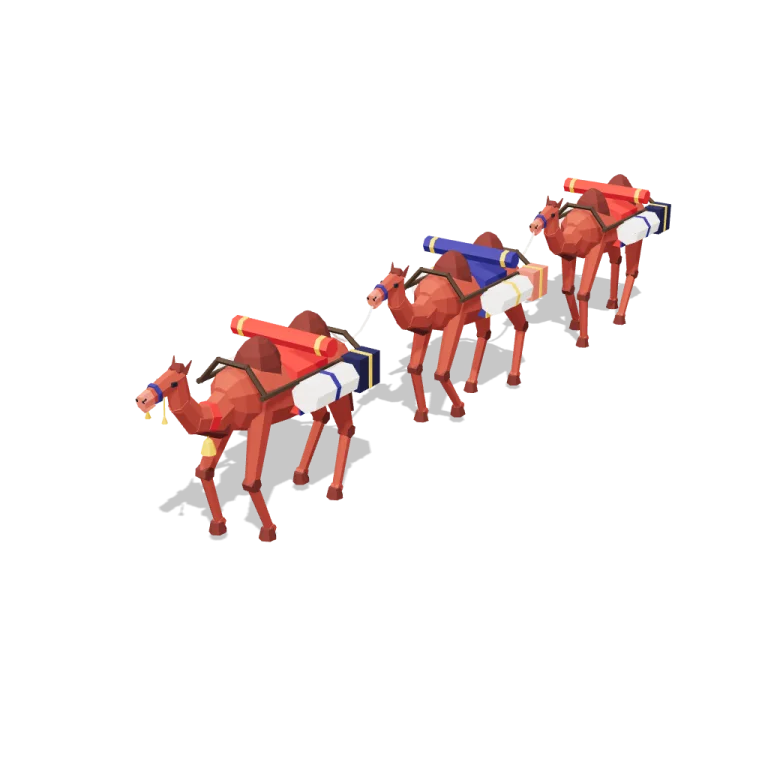
Left rail: colours and the 3 knobs the agent wrote into this model — they rebuild the geometry and go into your download. Right rail: looks for the viewer. Drag to orbit, scroll to zoom.
- Triangles
- 5,294
- Vertices
- 15,882
- Meshes · materials
- 109 · 109
- Size (W × H × D)
- 1.3 m × 2.2 m × 10 m
- File
- GLB · 671 KB
- Animation
- scene-motion · 6.0s
- Style
- Low-poly
- Collection
- Silk Road Caravanserai
Palette · named materials
- mud brick: camel bodies, necks, heads and legs (body)#9e3d2e
- mud brick dark: humps, throat manes, poll tufts, ears, knee and foot pads, tail tufts (body)#63261d
- mud brick light: muzzles and lips; bales on the middle camel (body)#c66253
- carpet red: saddle blankets, carpet rolls, lead collar (accent)#c32222
- indigo: halters, blankets, hems, carpet roll, sack and bundle cords (accent)#2d2d76
- indigo dark: rear bales (accent)#18183f
- indigo light: front bundles on the middle camel, from goodsOnSale 0.7 (accent)#4848a8
- saffron: lead camel bell and tassels, hems, cord bands, carpet-roll ends (accent)#eead2b
- warm white: side sacks, bundles and nose ropes (base)#f2ede2
- dark wood: pack frames (earth)#3d2a1c
- soot black: eyes and nostrils (trim)#1b1b22
- mid grey: copper kettle, from goodsOnSale 0.9 (trim)#7d828c
Use it
import { GLTFLoader } from "three/addons/loaders/GLTFLoader.js";

const gltf = await new GLTFLoader().loadAsync(
  "https://assets.stoicsoft.com/1designtool/3d/models/silk-road-caravanserai-camel-train/4cbb857e9e/model.glb"
);
scene.add(gltf.scene); // metres, +Y up, front faces +Z

const mixer = new THREE.AnimationMixer(gltf.scene);
gltf.animations.forEach((clip) => mixer.clipAction(clip).play());
// in your loop: mixer.update(delta)
How it was made
The brief given to 1DesignTool's “3D object” template:
Camel train for the Silk Road Caravanserai kit. Design it as one clear asset at believable real-world scale for that setting (state the size in metres in meta.notes), with its main parts modelled and named, readable at thumbnail size and from every orbit angle. It moves: author a seamless baked loop (2–12 s) with every pivot exactly at its hinge, axle or swivel, and keep the base still. This is one part of the Silk Road Caravanserai kit (Low-poly style, flat-lowpoly direction): A walled inn for desert traders. Use ONLY the kit palette, by name: mud brick #9e3d2e, indigo #2d2d76, saffron #eead2b, carpet red #c32222, mud brick dark #63261d, indigo dark #18183f, mud brick light #c66253, indigo light #4848a8, soot black #1b1b22, warm white #f2ede2, mid grey #7d828c, dark wood #3d2a1c. Every material's `name` must be exactly the palette colour it uses — the GLB carries these names so the kit recolours as one; an unnamed material fails delivery. Kit knob: expose a param `goodsOnSale` (0–1, default 0.5) for the kit's "Goods on sale" setting wherever it makes sense on this part, and keep that id.
- Agent: Claude Code · Claude Opus 5.5 in 1DesignTool
- Direction: Low-poly · family vehicles
- three-check PASS · glb-lint PASS
Named parts · 51
- Camel train
- Lead camel body
- Lead camel head
- Lead camel tail
- Lead camel pack and goods
- Lead camel, hind left leg, upper
- Lead camel, hind left leg, lower
- Lead camel, hind left leg, foot
- Lead camel, front left leg, upper
- Lead camel, front left leg, lower
- Lead camel, front left leg, foot
- Lead camel, hind right leg, upper
- Lead camel, hind right leg, lower
- Lead camel, hind right leg, foot
- Lead camel, front right leg, upper
- Lead camel, front right leg, lower
- Lead camel, front right leg, foot
- Camel 2 body
- Camel 2 head
- Camel 2 tail
- Camel 2 pack and goods
- Camel 2, hind left leg, upper
- Camel 2, hind left leg, lower
- Camel 2, hind left leg, foot
- Camel 2, front left leg, upper
- Camel 2, front left leg, lower
- Camel 2, front left leg, foot
- Camel 2, hind right leg, upper
- Camel 2, hind right leg, lower
- Camel 2, hind right leg, foot
- Camel 2, front right leg, upper
- Camel 2, front right leg, lower
- Camel 2, front right leg, foot
- Camel 3 body
- Camel 3 head
- Camel 3 tail
- Camel 3 pack and goods
- Camel 3, hind left leg, upper
- Camel 3, hind left leg, lower
- Camel 3, hind left leg, foot
- +11 more
Note: Size: about 10.4 m long (lead camel's muzzle to the last camel's tail) × 1.3 m wide over the packs × 2.23 m tall to the ear tips; each Bactrian camel is about 3.1 m nose to tail, 1.9 m at the withers and 2.14 m over the humps, at 3.6 m spacing. Origin is at the bottom centre, the model rests on y = 0 on the planted foot pads, and the lead camel faces +Z; 'left' parts are on each camel's own left (+X). The GLB has 5,294 triangles in 109 meshes; three-check's 5,584 figure includes the viewer's staging ground, which is not exported. Every material is named exactly after a kit palette colour; at the default all but indigo light and mid grey are used. The exporter writes one material per mesh, so a colour name appears on several materials: recolour by name. The baked clip scene-motion (6 s, seamless) has every camel pace in place (both legs on a side together, four strides per loop), each leg a rigid hip → knee → fetlock chain whose pivots sit on the joints, posed by two-bone IK so planted pads slide straight back along y = 0; heads nod at the poll and tails swish at the tailhead, and the camels are phase-shifted so they don't step in unison. Bodies, packs and nose ropes never move, so the train walks in place. Each nose rope's end is buried in the follower's muzzle, deep enough to stay hidden through the small head nod. The GLB's static node pose is the t = 2 s pose (mid-stride). There's no skinning; every moving piece is a rigid node. goodsOnSale (the kit's 'Goods on sale') sets how much freight each camel carries: round(goodsOnSale × 5) loads in order — side sacks, a carpet roll between the humps, rear bales, front bundles, a copper kettle — so 0 leaves only blankets and pack frames and the default 0.5 shows three loads. camelCount (1–4) and spacing rebuild the train, and nose ropes follow. Params are baked into the GLB at their defaults and only change geometry when the scene is rebuilt in the viewer; only the defaults were rendered and checked. glb-lint: 0 errors and 7 expected warnings: 109 per-mesh materials sharing 10 colour names (over the direction's count, flagged as duplicates), a draw-call estimate of 109 against the direction's 100 (one mesh per colour per jointed part), deliberately non-indexed flat-shaded geometry, nested sibling bounds on the heads, lower-leg and rope meshes flagged as detached because each joint is a separate node that meets its neighbour at the hinge, and a height-vs-1 m scale heuristic (the camels really are 2.2 m tall). The verdict reads UNVERIFIED only because no requirements contract was supplied. plan-check rejects only the hyphenated library part ids (its regex allows no hyphen); the same plan with the slug de-hyphenated passes. three-check and the GLB reload keep all 51 ids. Fix rounds were visual: (1) thicker legs and wider top/front framing, then (2) looser hero framing after (1) cropped the lead camel's head.
About the Camel train 3D model
Camel train is a free animated low-poly 3D model from the Silk Road Caravanserai set. It measures 1.3 m × 2.2 m × 10 m (W × H × D) at real-world scale and is built from 5,294 triangles across 109 meshes, with 51 named parts and a baked animation (6.0 s). Download the 671 KB GLB and drop it into three.js, React Three Fiber, Godot or Blender — free for commercial use, no attribution required.
- Is the Camel train 3D model free for commercial use?
- Yes. It is free under the 1DesignTool 3D library license: use it in personal and commercial work — games, apps, websites, renders, ads and client projects — and modify it as you like, with no credit required. What you can't do is re-sell or re-distribute the file on its own or inside a model pack.
- What file format is it, and how big is it?
- A single binary glTF 2.0 file (.glb), 671 KB: 5,294 triangles, 15,882 vertices and 109 materials, modelled in metres at 1.3 m × 2.2 m × 10 m.
- Is Camel train animated?
- Yes — the GLB carries a baked animation (6.0 s), ready to play with any glTF animation mixer.
- Which engines and tools can open it?
- Anything that reads glTF 2.0. three.js, React Three Fiber, Babylon.js, Godot 4 and Blender import the GLB directly; Unity and Unreal Engine load it through their glTF importers. The snippets above show the exact code for three.js, React Three Fiber, Godot and Blender.
- How was the Camel train 3D model made?
- Claude Code (Claude Opus 5.5) generated it inside 1DesignTool's 3D template from a written brief, then the design kit's checks verified the geometry and the GLB before it was published. You can make your own the same way with 1DesignTool.
More like this
All of Silk Road Caravanserai →
Swinging lanterns
Silk Road Caravanserai2,436 tris

Well pulley
Silk Road Caravanserai1,908 tris

Tea sets
Silk Road Caravanserai2,436 tris

Hand cart
Silk Road Caravanserai2,692 tris

Water skins
Silk Road Caravanserai1,456 tris

Scales
Silk Road Caravanserai1,106 tris

Silk bolts
Silk Road Caravanserai1,716 tris

Lanterns
Silk Road Caravanserai1,604 tris
Free under the 1DesignTool 3D library license. Model #4 of 1218.