Whale skeleton
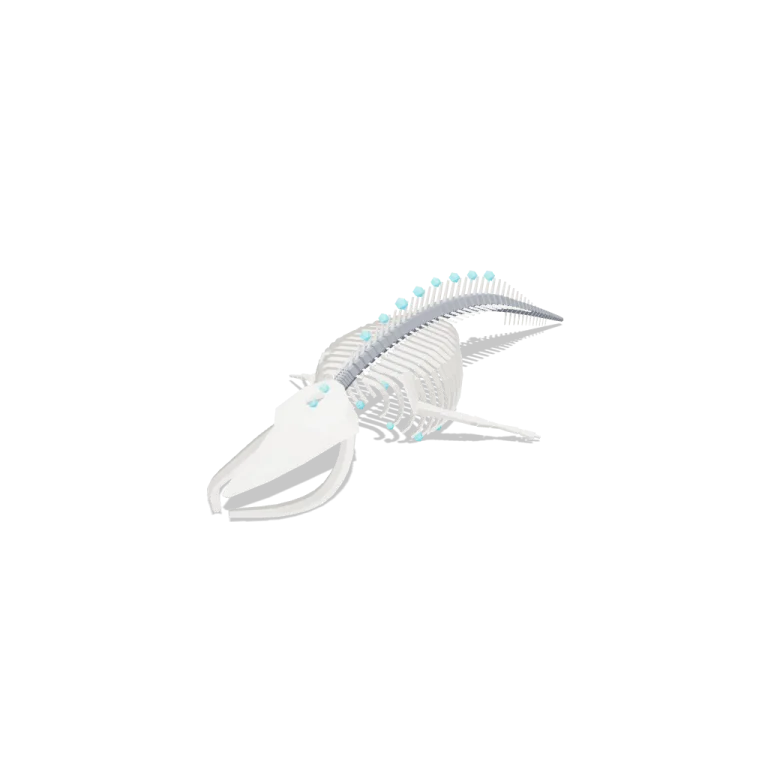
A 12 m baleen-whale skeleton lying upright on the abyssal floor, built from flat low-poly bones: a broad skull with bowed jawbones, an arched spine, a rib barrel and fanned flippers, with small glowing growths along the back. Part of the Deep Sea Abyss kit.
Left rail: colours and the 4 knobs the agent wrote into this model — they rebuild the geometry and go into your download. Bottom: what the model does — the one you pick plays here and is baked into the download. Right rail: looks for the viewer. Drag to orbit, scroll to zoom. On a desktop, Open in 1DesignTool turns it into a project you can keep editing with your agent.
- Triangles
- 7,296
- Vertices
- 31,368
- Meshes · materials
- 12 · 12
- Size (W × H × D)
- 5.9 m × 2.6 m × 12 m
- File
- GLB · 544 KB
- Animation
- Static
- Style
- Low-poly
- Collection
- Deep Sea Abyss
Palette · named materials
- base#f2ede2
- trim#7d828c
- accent#20c6df
Use it
import { GLTFLoader } from "three/addons/loaders/GLTFLoader.js";

const gltf = await new GLTFLoader().loadAsync(
  "https://assets.stoicsoft.com/1designtool/3d/models/deep-sea-abyss-whale-skeleton/0133b9a68b/model.glb"
);
scene.add(gltf.scene); // metres, +Y up, front faces +Z
How it was made
The brief given to 1DesignTool's “3D object” template:
Whale skeleton for the Deep Sea Abyss kit. Design it as one clear asset at believable real-world scale for that setting (state the size in metres in meta.notes), with its main parts modelled and named, readable at thumbnail size and from every orbit angle. This is one part of the Deep Sea Abyss kit (Low-poly style, flat-lowpoly direction): Black water and living lights. Use ONLY the kit palette, by name: abyss black #151619, glow cyan #20c6df, magenta #d02597, vent orange #ed7e1d, abyss black dark #090a0b, glow cyan dark #168a9c, abyss black light #3a3c40, glow cyan light #67d4e4, soot black #1b1b22, warm white #f2ede2, mid grey #7d828c, dark wood #3d2a1c. Every material's `name` must be exactly the palette colour it uses — the GLB carries these names so the kit recolours as one; an unnamed material fails delivery. Kit knob: expose a param `glowColour` (0–1, default 0.5) for the kit's "Glow colour" setting wherever it makes sense on this part, and keep that id.
- Agent: Claude Code · Claude Opus 5.5 in 1DesignTool
- Generation: 6.97M tokens (96% cached) · ≈ $4.09 at API prices · 5-hour plan +4%, weekly plan +0%
- Direction: Low-poly · family scenes
- three-check PASS · glb-lint PASS
Named parts · 11
- Whale skeleton
- Skull
- Left jawbone
- Right jawbone
- Spine
- Tail vertebrae
- Left ribs
- Right ribs
- Left flipper
- Right flipper
- Living lights
Note: Scale: 12 m long (12.1 m including the jaw tips), 5.9 m wide across the flippers and 2.61 m tall; metres, +Y up, head faces +Z, origin at the bottom centre, resting on y = 0. 7,296 triangles. Static: no animation clip. There are three palette materials: 'warm white' (bone), 'mid grey' (vertebral centra) and 'glow cyan' (emissive living lights). The exporter writes one material copy per mesh, so the file lists 12 material entries, but they carry only these three names. glowColour snaps to a kit swatch instead of blending: 0–0.24 vent orange, 0.25–0.49 magenta, 0.5–0.74 glow cyan (default), 0.75–1 glow cyan light. The material name follows the swatch. Each part is a group named whale.<part> (the design kit's checker id) that holds a mesh named deep-sea-abyss-whale-skeleton.<part> (the library id). Faces are split so flat facets survive import into Blender, Godot and Unity; this is why glb-lint flags non-indexed primitives. glb-lint passed with 0 errors and 5 advisory warnings: unindexed (intentional flat shading), duplicate materials and material count (the per-mesh copies above), scale (2.6 m tall against the direction's 1 m reference, which is intended at real scale), and detached parts (skull and spine sit alone inside their wrapper groups, but in the model they touch the jaws and ribs). The seabed disc and lights belong to the viewer only and are not in the GLB.
About the Whale skeleton 3D model
Whale skeleton is a free low-poly 3D model from the Deep Sea Abyss set. It measures 5.9 m × 2.6 m × 12 m (W × H × D) at real-world scale and is built from 7,296 triangles across 12 meshes, with 11 named parts. Download the 544 KB GLB and drop it into three.js, React Three Fiber, Godot or Blender — free for commercial use, no attribution required.
- Is the Whale skeleton 3D model free for commercial use?
- Yes. It is free under the 1DesignTool 3D library license: use it in personal and commercial work — games, apps, websites, renders, ads and client projects — and modify it as you like, with no credit required. What you can't do is re-sell or re-distribute the file on its own or inside a model pack.
- What file format is it, and how big is it?
- A single binary glTF 2.0 file (.glb), 544 KB: 7,296 triangles, 31,368 vertices and 12 materials, modelled in metres at 5.9 m × 2.6 m × 12 m.
- Can I animate Whale skeleton?
- It ships as a static mesh. Its 11 named parts are separate nodes, so you can move or animate each one in your engine.
- Which engines and tools can open it?
- Anything that reads glTF 2.0. three.js, React Three Fiber, Babylon.js, Godot 4 and Blender import the GLB directly; Unity and Unreal Engine load it through their glTF importers. The snippets above show the exact code for three.js, React Three Fiber, Godot and Blender.
- How was the Whale skeleton 3D model made?
- Claude Code (Claude Opus 5.5) generated it inside 1DesignTool's 3D template from a written brief, then the design kit's checks verified the geometry and the GLB before it was published. You can make your own the same way with 1DesignTool.
More like this
All of Deep Sea Abyss →
Squid tentacles
Deep Sea Abyss5,552 tris

Drifting jellies
Deep Sea Abyss2,440 tris

Vent smoke
Deep Sea Abyss1,912 tris

Submersible
Deep Sea Abyss2,040 tris

Sea snow
Deep Sea Abyss4,708 tris

Mineral crusts
Deep Sea Abyss2,886 tris

Chests
Deep Sea Abyss2,160 tris

Cables
Deep Sea Abyss2,464 tris
Free under the 1DesignTool 3D library license. Model #2023 of 2361.