Sea floor tiles
A 4 × 4 m tile of abyssal sea floor from the Deep Sea Abyss kit: dark faceted silt with three low hummocks capped in pale marine snow, a half-buried boulder outcrop and sunken branch, and living lights — glowing pods, magenta brittle stars and a tube-worm clump. Its flat edges tile seamlessly in every direction.
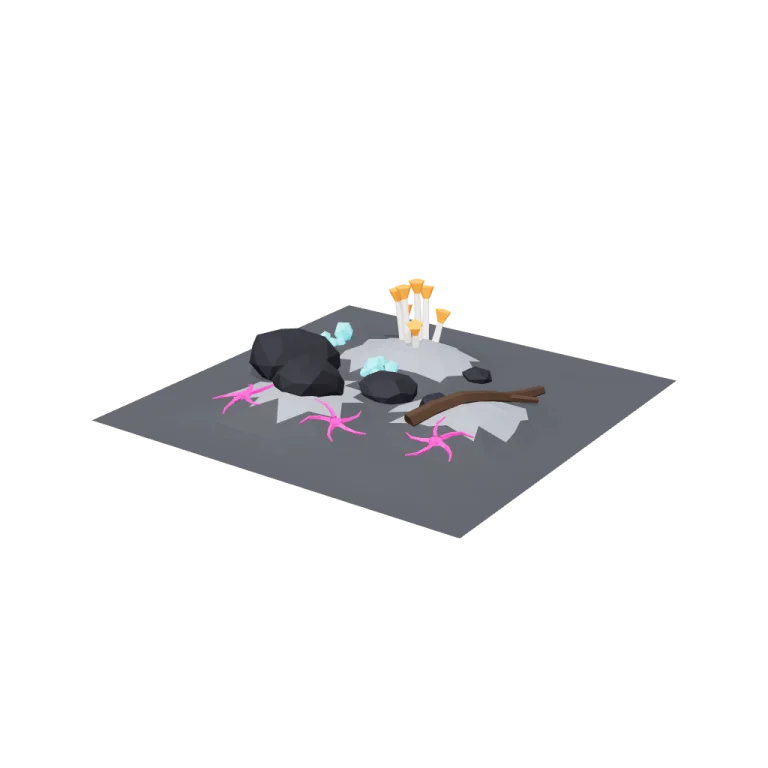
Left rail: colours and the 4 knobs the agent wrote into this model — they rebuild the geometry and go into your download. Right rail: looks for the viewer. Drag to orbit, scroll to zoom.
- Triangles
- 2,466
- Vertices
- 5,523
- Meshes · materials
- 9 · 9
- Size (W × H × D)
- 4.0 m × 89 cm × 4.0 m
- File
- GLB · 155 KB
- Animation
- Static
- Style
- Low-poly
- Collection
- Deep Sea Abyss
Palette · named materials
- sediment#3a3c40
- marine snow drifts#7d828c
- underside#090a0b
- boulders#1b1b22
- sunken branch#3d2a1c
- tube worm tubes#f2ede2
- tube worm plumes#ed7e1d
- brittle stars#d02597
- glow pods (default)#20c6df
Use it
import { GLTFLoader } from "three/addons/loaders/GLTFLoader.js";

const gltf = await new GLTFLoader().loadAsync(
  "https://assets.stoicsoft.com/1designtool/3d/models/deep-sea-abyss-sea-floor-tiles/51766eae25/model.glb"
);
scene.add(gltf.scene); // metres, +Y up, front faces +Z
How it was made
The brief given to 1DesignTool's “3D object” template:
Sea floor tiles for the Deep Sea Abyss kit. Design it as one clear asset at believable real-world scale for that setting (state the size in metres in meta.notes), with its main parts modelled and named, readable at thumbnail size and from every orbit angle. Make it a ground piece on an exact 4 × 4 m footprint with flat edges at y = 0 that tile seamlessly with its neighbours in every direction; origin at the tile centre. This is one part of the Deep Sea Abyss kit (Low-poly style, flat-lowpoly direction): Black water and living lights. Use ONLY the kit palette, by name: abyss black #151619, glow cyan #20c6df, magenta #d02597, vent orange #ed7e1d, abyss black dark #090a0b, glow cyan dark #168a9c, abyss black light #3a3c40, glow cyan light #67d4e4, soot black #1b1b22, warm white #f2ede2, mid grey #7d828c, dark wood #3d2a1c. Every material's `name` must be exactly the palette colour it uses — the GLB carries these names so the kit recolours as one; an unnamed material fails delivery. Kit knob: expose a param `glowColour` (0–1, default 0.5) for the kit's "Glow colour" setting wherever it makes sense on this part, and keep that id.
- Agent: Claude Code · Claude Opus 5.5 in 1DesignTool
- Generation: 6.16M tokens (96% cached) · ≈ $3.83 at API prices · 5-hour plan +3%, weekly plan +0%
- Direction: Low-poly · family scenes
- three-check PASS · glb-lint PASS
Named parts · 13
- Sea floor tile (assembly root)
- Sediment slab assembly
- Sediment
- Marine snow drifts
- Underside
- Rocks and sunken wood assembly
- Boulders
- Sunken branch
- Living lights assembly
- Tube worm tubes
- Tube worm plumes
- Brittle stars
- Glow pods
Note: Real scale: an exact 4 × 4 m footprint (x and z from -2 to 2), 0.89 m tall at the tallest tube worm. The sediment rises at most about 0.3 m. The origin is at the tile centre on y = 0, and the front faces +Z. The outer 0.2 m of every edge lies flat at y = 0 and always uses the sediment colour, so copies placed on a 4 m grid meet without a seam in every direction. Every prop stays at least 0.4 m from each edge, which was measured across all 12 layout variants. The tile is a closed slab: a faceted top surface and a flat underside at y = 0. Prop bases are bedded into the silt, and the model's lowest point is exactly y = 0. The model has 2466 triangles, 9 meshes and 9 materials. Each material is named exactly after its Deep Sea Abyss palette colour. Normals are baked flat. No textures and no animation. The living lights (glow cyan, magenta, vent orange) also carry their palette colour as emissive. glowColour (default 0.5) sets the glow-pod colour with the same ramp as the rest of the kit: magenta below 1/3, glow cyan up to 2/3, vent orange above. At the low end the pods share the magenta material name with the brittle stars, and at the high end they share vent orange with the worm plumes. variant, moundHeight and rockCount rebuild the tile in the viewer (2406–2606 triangles across the ranges, all tested). The GLB holds the default values only. Viewer-only staging, not in the GLB: the flat-lowpoly sun rig, exposure 0.8, no ground disc (the tile is the ground), and tone mapping turned off on the glow materials so cyan stays saturated. Other engines will render the glow according to their own lighting. glb-lint: 0 errors. Its overall verdict prints UNVERIFIED only because no requirements contract exists. Two heuristic warnings were reviewed and accepted. The first is bounding-box overlap of sediment with marine-snow, which are two partitions of one surface, and of the tube worms with their plumes, which nest on purpose. The second flags the brittle stars as detached: they lie bedded on the sediment, which sits in a different assembly. The kit's plan grammar has no hyphens, so the assembly groups use plain ids (seafloor, seafloor.ground, seafloor.debris, seafloor.life). Every mesh carries a deep-sea-abyss-sea-floor-tiles.* id. There were 3 visual fix rounds: marine-snow drifts, crest snow with exposure, and separate hummocks. After them, a lint correction clamped prop bases to y >= 0 and kept rocks inside the edge clearance.
More like this
All of Deep Sea Abyss →
Squid tentacles
Deep Sea Abyss5,552 tris

Drifting jellies
Deep Sea Abyss2,440 tris

Vent smoke
Deep Sea Abyss1,912 tris

Submersible
Deep Sea Abyss2,040 tris

Sea snow
Deep Sea Abyss4,708 tris

Mineral crusts
Deep Sea Abyss2,886 tris

Chests
Deep Sea Abyss2,160 tris

Cables
Deep Sea Abyss2,464 tris
Free under the 1DesignTool 3D library license. Model #40 of 379.