Snowmobile
A low-poly utility snowmobile with a faceted ice-blue hood, white lower panels and an aurora-green stripe, two steering skis, a lugged rubber track, a long black bench seat and a lashed wooden crate with a whip flag on the rear rack. A seamless 6-second loop steers the handlebar and skis, spins the track wheels and sways the flag.
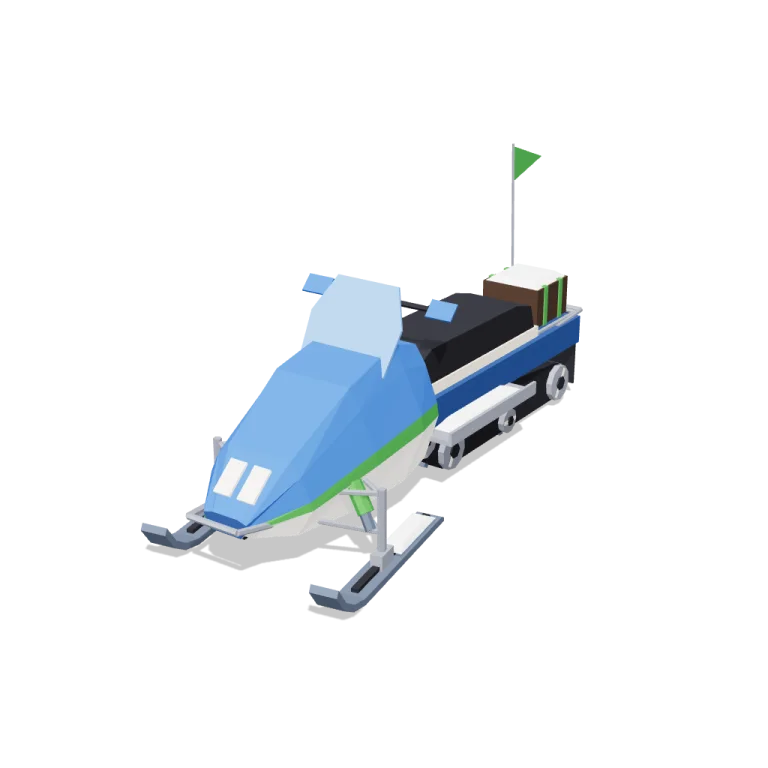
Left rail: colours and the 3 knobs the agent wrote into this model — they rebuild the geometry and go into your download. Right rail: looks for the viewer. Drag to orbit, scroll to zoom.
- Triangles
- 2,160
- Vertices
- 6,480
- Meshes · materials
- 49 · 49
- Size (W × H × D)
- 1.5 m × 1.7 m × 3.7 m
- File
- GLB · 236 KB
- Animation
- scene-motion · 6.0s
- Style
- Low-poly
- Collection
- Arctic Tundra
Palette · named materials
- ice blue: hood top and upper sides, hand guards#2e67b8
- ice blue dark: track tunnel, nose cap, handlebar riser#1f457a
- ice blue light: windshield (glass)#6190d1
- white: hood lower side panels#f4f1ec
- white dark: hood belly, seat base, wheel spoke bars#d7cebc
- white light: packed snow#f9f8f6
- aurora green: hood stripe, shock springs, crate straps, flag pennant#3a883a
- slate: skis, track lugs, shock bodies, gauge pod#525e6f
- soot black: track belt, seat, handlebar and grips, snow flap, ski ribs, intake#1b1b22
- warm white: headlights, tail lamp#f2ede2
- mid grey: running boards, A-arms, spindles, bumper, grab bar, rack, wheels, flag mast#7d828c
- dark wood: cargo crate#3d2a1c
Use it
import { GLTFLoader } from "three/addons/loaders/GLTFLoader.js";

const gltf = await new GLTFLoader().loadAsync(
  "https://assets.stoicsoft.com/1designtool/3d/models/arctic-tundra-snowmobile/a2783e64e2/model.glb"
);
scene.add(gltf.scene); // metres, +Y up, front faces +Z

const mixer = new THREE.AnimationMixer(gltf.scene);
gltf.animations.forEach((clip) => mixer.clipAction(clip).play());
// in your loop: mixer.update(delta)
How it was made
The brief given to 1DesignTool's “3D object” template:
Snowmobile for the Arctic Tundra kit. Design it as one clear asset at believable real-world scale for that setting (state the size in metres in meta.notes), with its main parts modelled and named, readable at thumbnail size and from every orbit angle. It moves: author a seamless baked loop (2–12 s) with every pivot exactly at its hinge, axle or swivel, and keep the base still. This is one part of the Arctic Tundra kit (Low-poly style, flat-lowpoly direction): Ice, wind and long light. Use ONLY the kit palette, by name: ice blue #2e67b8, white #f4f1ec, slate #525e6f, aurora green #3a883a, ice blue dark #1f457a, white dark #d7cebc, ice blue light #6190d1, white light #f9f8f6, soot black #1b1b22, warm white #f2ede2, mid grey #7d828c, dark wood #3d2a1c. Every material's `name` must be exactly the palette colour it uses — the GLB carries these names so the kit recolours as one; an unnamed material fails delivery. Kit knob: expose a param `snowDepth` (0–1, default 0.5) for the kit's "Snow depth" setting wherever it makes sense on this part, and keep that id.
- Agent: Claude Code · Claude Opus 5.5 in 1DesignTool
- Direction: Low-poly · family abstract-kinetic
- three-check PASS · glb-lint PASS
Named parts · 17
- Snowmobile
- Hood
- Windshield
- Tunnel and running boards
- Seat
- Rear rack and crate
- Track
- Front suspension
- Packed snow
- Rear idler wheels
- Front bogie wheels
- Mid rail wheels
- Drive sprocket
- Right ski
- Left ski
- Handlebar
- Whip flag
Note: Size: 3.42 m long from the bumper to the snow flap, 1.25 m wide across the skis (1.1 m ski stance), 1.32 m tall to the windshield top and 1.65 m to the whip-flag tip. The seat is at 0.86 m. The origin is at the bottom centre, the skis and the track lugs rest on y = 0, and the nose faces +Z. The GLB has 2,160 triangles in 49 meshes and uses all 12 kit palette colours. Every material is named exactly after its colour; the exporter writes one material per mesh, so names repeat, so recolour by name. The baked clip scene-motion (6 s, seamless) moves only parts on their own pivots: the handlebar swings about the 20-degree raked steering post, both skis steer by the same angle about their vertical spindles, the 0.12 m track wheels spin 2 whole turns and the 0.08 m mid wheel 3 turns, and the whip flag sways from its socket. The body never moves. The track belt itself is a rigid mesh, so its lugs do not travel round the belt; only the wheels inside it turn. The GLB's static node pose is the t = 2 s frame (three-check exports after its determinism seek), so the skis and handlebar are slightly turned in the static pose. glb-lint reports bounds y down to -0.011 m: it bounds each mesh's box after rotation, and the box corners of the spinning wheels dip at that pose. The real wheel rims stay 3 cm above the ground, and every unrotated mesh bottoms out at exactly y = 0. Params are baked into the GLB at their defaults and only change the model when the scene is rebuilt in the viewer. snowDepth (the kit's 'Snow depth') packs snow on the running boards, the ski tops and the crate lid, from an 8 mm frost film at 0 to 8 cm at 1. steerAngle sets the steering amplitude of the loop. windshieldHeight sets how far the windshield rises above the hood. Only the default params were rendered and checked; the extremes were not captured. The viewer's stage floor is recoloured mid grey so the white panels and snow read; it is outside the export. glb-lint: 0 errors and 5 heuristic warnings. They flag the per-mesh duplicate materials, the non-indexed geometry (deliberate flat shading), overlaps where hood, tunnel and seat parts are deliberately nested, and the windshield and snow as 'detached': each sits embedded in or resting on the hood and boards, but in its own part group. The verdict reads UNVERIFIED only because no requirements contract was supplied. plan-check passes except for its part-id regex, which rejects the hyphens in the slug-based ids this library requires; the same plan with the slug de-hyphenated passes. three-check accepts the real ids, and all 17 survive the GLB reload.
About the Snowmobile 3D model
Snowmobile is a free animated low-poly 3D model from the Arctic Tundra set. It measures 1.5 m × 1.7 m × 3.7 m (W × H × D) at real-world scale and is built from 2,160 triangles across 49 meshes, with 17 named parts and a baked animation (6.0 s). Download the 236 KB GLB and drop it into three.js, React Three Fiber, Godot or Blender — free for commercial use, no attribution required.
- Is the Snowmobile 3D model free for commercial use?
- Yes. It is free under the 1DesignTool 3D library license: use it in personal and commercial work — games, apps, websites, renders, ads and client projects — and modify it as you like, with no credit required. What you can't do is re-sell or re-distribute the file on its own or inside a model pack.
- What file format is it, and how big is it?
- A single binary glTF 2.0 file (.glb), 236 KB: 2,160 triangles, 6,480 vertices and 49 materials, modelled in metres at 1.5 m × 1.7 m × 3.7 m.
- Is Snowmobile animated?
- Yes — the GLB carries a baked animation (6.0 s), ready to play with any glTF animation mixer.
- Which engines and tools can open it?
- Anything that reads glTF 2.0. three.js, React Three Fiber, Babylon.js, Godot 4 and Blender import the GLB directly; Unity and Unreal Engine load it through their glTF importers. The snippets above show the exact code for three.js, React Three Fiber, Godot and Blender.
- How was the Snowmobile 3D model made?
- Claude Code (Claude Opus 5.5) generated it inside 1DesignTool's 3D template from a written brief, then the design kit's checks verified the geometry and the GLB before it was published. You can make your own the same way with 1DesignTool.
More like this
All of Arctic Tundra →
Aurora ribbon
Arctic Tundra3,532 tris

Dog sled
Arctic Tundra1,904 tris

Drifting floe
Arctic Tundra1,020 tris

Fuel drums
Arctic Tundra2,452 tris

Drying hides
Arctic Tundra3,092 tris

Ice blocks
Arctic Tundra1,412 tris

Fish racks
Arctic Tundra3,112 tris

Sled crates
Arctic Tundra1,608 tris
Free under the 1DesignTool 3D library license. Model #10 of 996.