Cafe
A low-poly zoo cafe: a timber building with a green gable roof and a big yellow coffee cup sign on the ridge, a service window with a counter under a striped awning, and a sand patio deck with parasol tables, chairs, an A-frame menu board and planters.
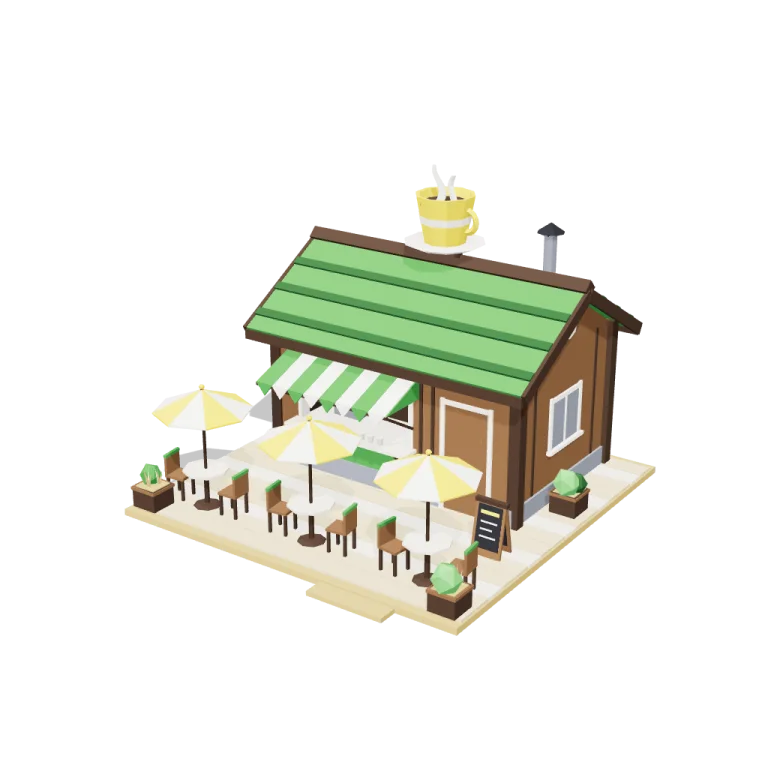
Left rail: colours and the 4 knobs the agent wrote into this model — they rebuild the geometry and go into your download. Right rail: looks for the viewer. Drag to orbit, scroll to zoom.
- Triangles
- 4,100
- Vertices
- 12,300
- Meshes · materials
- 54 · 54
- Size (W × H × D)
- 7.6 m × 6.3 m × 8.3 m
- File
- GLB · 333 KB
- Animation
- Static
- Style
- Low-poly
- Collection
- Zoo
Palette · named materials
- roof, awning stripes, door, counter front, chair back rails (base)#3a883a
- roof shingle courses, door kick panel, bushes (foliage)#235223
- bushes (foliage)#5db15d
- deck planks, grass tufts, coffee sack (earth)#d1bd94
- deck bearer and step, planter soil, grass tufts (earth)#ba9c5e
- deck planks, counter shelf, table tops (trim)#e6ddcb
- walls, gables, chairs, crates, planter rims, menu board frame (base)#765232
- coffee cup sign, parasol panels, door knob, tip jar, menu header bar (accent)#eecd2b
- menu slate, gable vents, stovepipe cap, coffee machine top (trim)#1b1b22
- window and door frames, awning stripes, saucer, cup band, steam, parasol panels, cups (accent)#f2ede2
- window glass, stone skirting, stovepipe, coffee machine (trim)#7d828c
- corner posts, battens, fascia, barge boards, ridge, recess, coffee, table and parasol poles, planters (trim)#3d2a1c
Use it
import { GLTFLoader } from "three/addons/loaders/GLTFLoader.js";

const gltf = await new GLTFLoader().loadAsync(
  "https://assets.stoicsoft.com/1designtool/3d/models/zoo-cafe/777a082c47/model.glb"
);
scene.add(gltf.scene); // metres, +Y up, front faces +Z
How it was made
The brief given to 1DesignTool's “3D object” template:
Cafe for the Zoo kit. Design it as one clear asset at believable real-world scale for that setting (state the size in metres in meta.notes), with its main parts modelled and named, readable at thumbnail size and from every orbit angle. This is one part of the Zoo kit (Low-poly style, flat-lowpoly direction): Enclosures and winding paths. Use ONLY the kit palette, by name: leaf green #3a883a, sand #d1bd94, timber #765232, sign yellow #eecd2b, leaf green dark #235223, sand dark #ba9c5e, leaf green light #5db15d, sand light #e6ddcb, soot black #1b1b22, warm white #f2ede2, mid grey #7d828c, dark wood #3d2a1c. Every material's `name` must be exactly the palette colour it uses — the GLB carries these names so the kit recolours as one; an unnamed material fails delivery. Kit knob: expose a param `habitatMix` (0–1, default 0.5) for the kit's "Habitat mix" setting wherever it makes sense on this part, and keep that id.
- Agent: Claude Code · Claude Opus 5.5 in 1DesignTool
- Generation: 4.15M tokens (95% cached) · ≈ $3.08 at API prices · 5-hour plan +11%
- Direction: Low-poly · family scenes
- three-check PASS · glb-lint PASS
Named parts · 14
- Cafe
- Patio deck
- Walls
- Windows and door
- Service counter
- Roof
- Striped awning
- Coffee cup sign
- Stovepipe
- Menu board
- Tables and parasols
- Chairs
- Planters
- Supply crates
Note: Real-world scale in metres. The building is 5.6 m wide and 3.6 m deep with walls 3.1 m high. It stands on a sand patio deck 7.6 m wide and 0.18 m high, which runs 3.6 m out in front of the service window. The roof ridge is at about 4.5 m. The coffee cup sign stands on the ridge, so the top of the cup is at about 5.8 m and the tip of the steam at 6.34 m. Overall bounds are 7.6 m wide (x), 6.34 m tall and 8.27 m deep (z), which includes the front step and the crates at the back. Origin is the bottom centre of those bounds, so the building sits towards the back (-Z) half and the patio fills the front (+Z) half. +Y is up, the service window and door face +Z, and the deck rests on y = 0. The GLB has 4,100 triangles and no animation. Every material is named exactly after a Zoo kit palette colour, and all 12 colours are used at the defaults. The exporter writes one material instance per mesh, so the same colour name appears on several of the 54 materials: recolour by name. All materials are flat-shaded, metalness 0, roughness 0.95, with no textures. Static groups are merged into one mesh per colour, so each part node holds one mesh per colour it uses. habitatMix (the kit's 'Habitat mix') sets the planting in the four planters spot by spot: 0 gives savanna planting (sand and sand-dark grass tufts) and 1 gives jungle planting (leafy bushes in the three greens). width, awningDepth and tableCount rebuild the geometry in the viewer. The GLB is baked at the defaults. Only the defaults went through the full checks; the extremes of each param were rebuilt and inspected in the viewer. glb-lint reports 0 errors and 5 heuristic warnings: the repeated per-mesh materials (over the direction's 10), non-indexed geometry (on purpose, for hard flat facets), bounding-box overlaps of merged parts that are meant to nest, and a 6.3 m height against the direction's 1 m reference. The plan records that reference-height override, but the lint does not read it. In the viewer the exposure is 0.58 instead of 1.05 so the kit colours don't wash out; that is staging only and not part of the GLB. Part ids follow the library's 'zoo-cafe.*' format. The kit's plan-check rejects them only because its part-id rule allows no hyphen; the same plan with the slug de-hyphenated passes. three-check and the GLB reload keep all 14 ids. The portrait (390×844) hero capture crops the cafe; the library's landscape views frame it whole.
About the Cafe 3D model
Cafe is a free low-poly 3D model from the Zoo set. It measures 7.6 m × 6.3 m × 8.3 m (W × H × D) at real-world scale and is built from 4,100 triangles across 54 meshes, with 14 named parts. Download the 333 KB GLB and drop it into three.js, React Three Fiber, Godot or Blender — free for commercial use, no attribution required.
- Is the Cafe 3D model free for commercial use?
- Yes. It is free under the 1DesignTool 3D library license: use it in personal and commercial work — games, apps, websites, renders, ads and client projects — and modify it as you like, with no credit required. What you can't do is re-sell or re-distribute the file on its own or inside a model pack.
- What file format is it, and how big is it?
- A single binary glTF 2.0 file (.glb), 333 KB: 4,100 triangles, 12,300 vertices and 54 materials, modelled in metres at 7.6 m × 6.3 m × 8.3 m.
- Can I animate Cafe?
- It ships as a static mesh. Its 14 named parts are separate nodes, so you can move or animate each one in your engine.
- Which engines and tools can open it?
- Anything that reads glTF 2.0. three.js, React Three Fiber, Babylon.js, Godot 4 and Blender import the GLB directly; Unity and Unreal Engine load it through their glTF importers. The snippets above show the exact code for three.js, React Three Fiber, Godot and Blender.
- How was the Cafe 3D model made?
- Claude Code (Claude Opus 5.5) generated it inside 1DesignTool's 3D template from a written brief, then the design kit's checks verified the geometry and the GLB before it was published. You can make your own the same way with 1DesignTool.
More like this
All of Zoo →


Free under the 1DesignTool 3D library license. Model #10 of 1308.