Silk Road Merchant
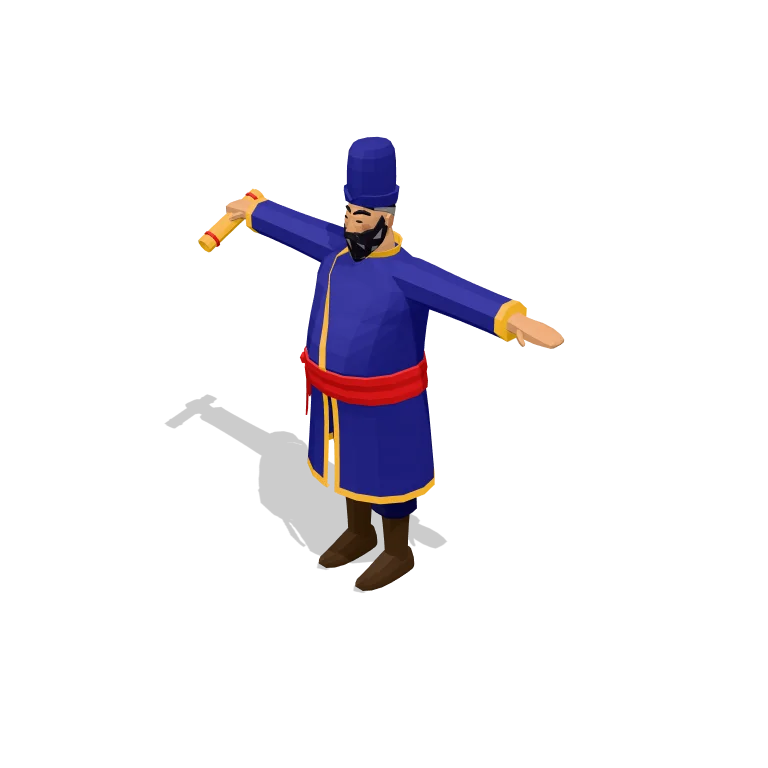
A heavy-set Silk Road merchant in his 50s with a black beard streaked with grey, a tall indigo felt cap, a knee-length indigo kaftan with saffron trim and a carpet-red sash, holding a rolled bolt of saffron silk. He's low-poly and rigged on the library's shared Mixamo-named skeleton in a T-pose, ready for retargeted clips.
Left rail: colours and the 4 knobs the agent wrote into this model — they rebuild the geometry and go into your download. Bottom: actions for the rigged character — the one you pick plays here and is baked into the download. Right rail: looks for the viewer. Drag to orbit, scroll to zoom. On a desktop, Open in 1DesignTool turns it into a project you can keep editing with your agent.
- Triangles
- 3,484
- Vertices
- 19,038
- Meshes · materials
- 13 · 13
- Size (W × H × D)
- 1.7 m × 1.9 m × 47 cm
- File
- GLB · 544 KB
- Animation
- Static
- Style
- Low-poly
- Collection
- Silk Road Caravanserai
Palette · named materials
- skin#bd8a62
- cheek#ad7352
- eyes#1f1915
- hair#1c1a1e
- hair-grey#7d7a77
- top#2d2d76
- trim#eead2b
- accent#c32222
- bottoms#18183f
- shoes#3d2a1c
- hat#2d2d76
- prop#eead2b
- prop-tie#c32222
Use it
import { GLTFLoader } from "three/addons/loaders/GLTFLoader.js";

const gltf = await new GLTFLoader().loadAsync(
  "https://assets.stoicsoft.com/1designtool/3d/models/silk-road-caravanserai-merchant/5534133386/model.glb"
);
scene.add(gltf.scene); // metres, +Y up, front faces +Z
How it was made
The brief given to 1DesignTool's “3D object” template:
A heavy-set man in his 50s, about 1.72 m tall, with a full black beard streaked with grey. Shrewd, genial expression. Wearing a tall indigo felt cap, a knee-length indigo kaftan with saffron trim belted with a carpet-red sash, loose indigo-dark trousers and soft dark-wood leather boots. Palette (Silk Road Caravanserai kit, use these exact hex values for the named colours): indigo #2d2d76, saffron #eead2b, carpet red #c32222, indigo dark #18183f, dark wood #3d2a1c. Holding a small rolled bolt of saffron silk in the right hand. Low-poly style, matching the kit's flat-shaded parts. No text, logos, brand names or lettering anywhere.
- Agent: Claude Code · Claude Opus 5.5 in 1DesignTool
- Direction: Low-poly · family characters
- three-check PASS · glb-lint PASS
Named parts · 8
- Body (warm tan skin, eyes)
- Black beard streaked with grey, brows and cropped hair
- Knee-length indigo kaftan with saffron trim
- Carpet-red sash with knot and tails
- Loose indigo-dark trousers
- Soft dark-wood leather boots
- Tall indigo felt cap
- Rolled bolt of saffron silk
Note: 3,484 triangles in 8 skinned meshes (13 primitives) with 13 flat-shaded materials named by role. There are no textures and no animation clips. The saffron trim and the grey beard streaks are modelled, not textured: they are facets or thin ribbons in their own flat roles, so they survive in any engine. The rig is one 25-bone skeleton with Mixamo names. mixamorig:Hips is the root and sits under the model root; three.js loads the names without the colon (mixamorigHips). There are no finger bones: the hands are mittens with a thumb (the right hand is a fist), so only the …Hand bones exist. Bones have identity rest rotations (world-aligned axes, not Mixamo's own bone roll), so retarget Mixamo clips by bone name (Blender, Unity Humanoid, Godot retarget, three.js SkeletonUtils) rather than copying raw local rotations. GLTFExporter writes one glTF skin per mesh, but all 8 skins list the same 25 joints with identical inverse bind matrices, so they load onto one shared set of bones. The silk bolt is its own mesh weighted 100% to mixamorig:RightHand. It runs front to back through the fist, tipped 25° down, and stands nearly upright when the forearm bends. The rig test measured 6e-8 m of drift in hand space. Head, hair, beard, brows, eyes and the cap are 100% Head. Each vertex has at most 4 normalised influences, with short blend bands at the neck, shoulders, elbows, wrists, hips and knees. Below the sash, the kaftan skirt is two panels: they're split at the centre front with a narrow gap between the saffron edges, and there's a back vent below the seat. Each panel follows its own thigh, at half strength toward the back, so a raised knee lifts one panel and opens the coat instead of stretching it. The kaftan's materials (top, trim) are double-sided for that reason. The sash knot and its two tails sit on the right hip and follow the right panel. Rig test pose (arms down 70°, forearms bent 90°, left thigh forward 45°, Spine1 twisted 20°): no seams open, 0.17% of facets collapse, 0.32% fold (inner elbows and the front of the hips), the trousers stay under the skirt and the kaftan stays under the sash; a stride and a 70° high step are also clean. Known limits: with a thigh swung back 30°, 6 trouser vertices pass through the back of the skirt, and in an 85° sit, 18 do. In a sit the front panel also lifts flat with the thigh. For sitting or high kicks, add a corrective or cloth simulation. Height is 1.72 m to the top of the head (the HeadTop_End joint); the tall felt cap brings the bounding box to 1.88 m. The low-poly style allows no mouth: the expression comes from narrowed almond eyes lifted at the outer corners, heavy black brows with the left one cocked, full cheeks and a strong nose, and the full moustache and beard cover the mouth. glb-lint reports 0 errors and 2 warnings. One is 13 materials against the direction's default of 10, recorded as a plan override because each role, including the beard's grey and the saffron trim, needs its own material. The other is intended nesting (body under clothes, hair under the cap). With glb-requirements.json the verdict is PASS. The preview renders at exposure 0.72 (also a recorded override); the exported materials carry the exact kit hex values with metalness 0. Params: height scales the whole rig and keeps the soles at y = 0. Build changes girth and belly, and the layers keep their clearance across its range. Grey adds broken grey streaks to the beard (0 is all black), and bolt switches the silk bolt on or off.
About the Silk Road Merchant 3D model
Silk Road Merchant is a free low-poly 3D model from the Silk Road Caravanserai set, rigged with a 25-bone Mixamo-compatible skeleton. It measures 1.7 m × 1.9 m × 47 cm (W × H × D) at real-world scale and is built from 3,484 triangles across 13 meshes, with 8 named parts. Download the 544 KB GLB and drop it into three.js, React Three Fiber, Godot or Blender — free for commercial use, no attribution required.
- Is the Silk Road Merchant 3D model free for commercial use?
- Yes. It is free under the 1DesignTool 3D library license: use it in personal and commercial work — games, apps, websites, renders, ads and client projects — and modify it as you like, with no credit required. What you can't do is re-sell or re-distribute the file on its own or inside a model pack.
- What file format is it, and how big is it?
- A single binary glTF 2.0 file (.glb), 544 KB: 3,484 triangles, 19,038 vertices and 13 materials, modelled in metres at 1.7 m × 1.9 m × 47 cm.
- Is Silk Road Merchant animated?
- It ships without a baked clip, in its bind pose. It is rigged with a 25-bone Mixamo-compatible skeleton, so it takes retargeted animation.
- Which engines and tools can open it?
- Anything that reads glTF 2.0. three.js, React Three Fiber, Babylon.js, Godot 4 and Blender import the GLB directly; Unity and Unreal Engine load it through their glTF importers. The snippets above show the exact code for three.js, React Three Fiber, Godot and Blender.
- How was the Silk Road Merchant 3D model made?
- Claude Code (Claude Opus 5.5) generated it inside 1DesignTool's 3D template from a written brief, then the design kit's checks verified the geometry and the GLB before it was published. You can make your own the same way with 1DesignTool.
More like this
All of Silk Road Caravanserai →
Caravanserai Guard
Silk Road Caravanserai4,131 tris

Caravanserai Innkeeper
Silk Road Caravanserai3,672 tris

Swinging lanterns
Silk Road Caravanserai2,436 tris

Well pulley
Silk Road Caravanserai1,908 tris

Camel train
Silk Road Caravanserai5,294 tris

Tea sets
Silk Road Caravanserai2,436 tris

Hand cart
Silk Road Caravanserai2,692 tris

Water skins
Silk Road Caravanserai1,456 tris
Free under the 1DesignTool 3D library license. Model #140 of 2361.