Rotating ring
A low-poly shipyard assembly ring, 20 m across, standing on edge in a deep-blue roller cradle. The white-faced ring with its orange roller track turns one full revolution per loop on three black drive rollers, with inward tool pods and a band of progress lights. Part of the Orbital Shipyard kit.
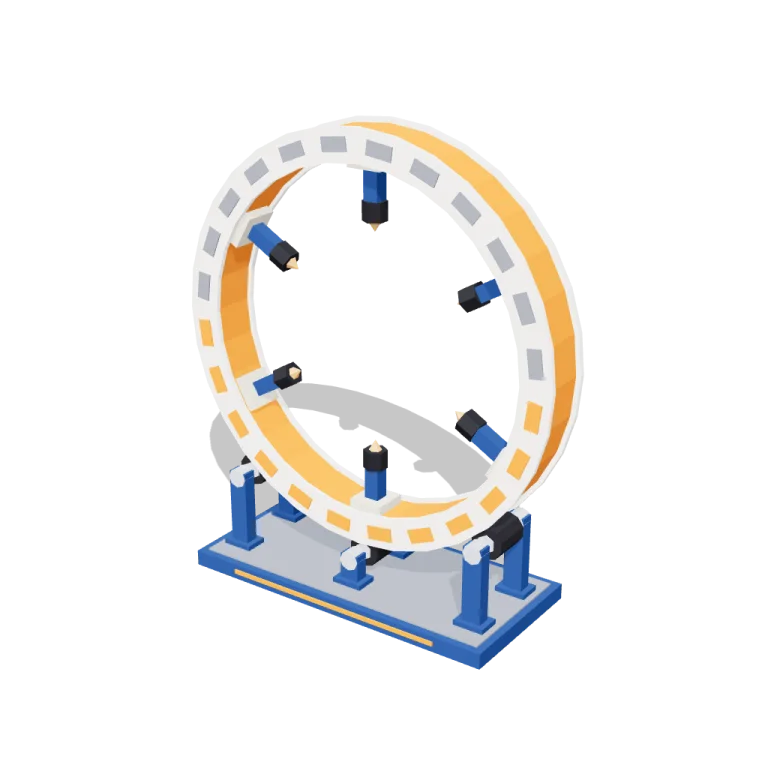
Left rail: colours and the 4 knobs the agent wrote into this model — they rebuild the geometry and go into your download. Right rail: looks for the viewer. Drag to orbit, scroll to zoom.
- Triangles
- 2,484
- Vertices
- 7,452
- Meshes · materials
- 27 · 27
- Size (W × H × D)
- 21 m × 23 m × 7.9 m
- File
- GLB · 300 KB
- Animation
- scene-motion · 8.0s
- Style
- Low-poly
- Collection
- Orbital Shipyard
Palette · named materials
- face#f4f1ec
- track#ed7e1d
- frame#1b447e
- deck#7d828c
- mount#d7cebc
- metal#b9bfc6
- rubber#1b1b22
- light#eea668
Use it
import { GLTFLoader } from "three/addons/loaders/GLTFLoader.js";

const gltf = await new GLTFLoader().loadAsync(
  "https://assets.stoicsoft.com/1designtool/3d/models/orbital-shipyard-rotating-ring/895824a959/model.glb"
);
scene.add(gltf.scene); // metres, +Y up, front faces +Z

const mixer = new THREE.AnimationMixer(gltf.scene);
gltf.animations.forEach((clip) => mixer.clipAction(clip).play());
// in your loop: mixer.update(delta)
How it was made
The brief given to 1DesignTool's “3D object” template:
Rotating ring for the Orbital Shipyard kit. Design it as one clear asset at believable real-world scale for that setting (state the size in metres in meta.notes), with its main parts modelled and named, readable at thumbnail size and from every orbit angle. It moves: author a seamless baked loop (2–12 s) with every pivot exactly at its hinge, axle or swivel, and keep the base still. This is one part of the Orbital Shipyard kit (Low-poly style, flat-lowpoly direction): Ships under construction in open space. Use ONLY the kit palette, by name: white #f4f1ec, orange #ed7e1d, deep space blue #1b447e, silver #b9bfc6, white dark #d7cebc, orange dark #af590e, white light #f9f8f6, orange light #eea668, soot black #1b1b22, warm white #f2ede2, mid grey #7d828c, dark wood #3d2a1c. Every material's `name` must be exactly the palette colour it uses — the GLB carries these names so the kit recolours as one; an unnamed material fails delivery. Kit knob: expose a param `shipCompletionStage` (0–1, default 0.5) for the kit's "Ship completion stage" setting wherever it makes sense on this part, and keep that id.
- Agent: Claude Code · Claude Opus 5.5 in 1DesignTool
- Generation: 4.27M tokens (95% cached) · ≈ $2.94 at API prices · 5-hour plan +7%
- Direction: Low-poly · family abstract-kinetic
- three-check PASS · glb-lint PASS — 0 blocking errors, 5 heuristic warnings (tool verdict UNVERIFIED: no requirements contract supplied)
Named parts · 16
- Rotating ring
- Base
- Deck
- Left cradle
- Right cradle
- Drive cradle
- Drive motor
- Left roller
- Right roller
- Drive roller
- Ring (pivot)
- Ring band
- Front flange
- Back flange
- Progress lights
- Tool pods
Note: Real-world size: ring 20.5 m outer diameter (flanges), 7.9 m deep including the deck, 23.25 m tall overall; ring centre axle at 12.6 m. Origin is the bottom centre of the deck at y = 0; front faces +Z, ring axle runs along Z. The baked 8 s clip 'scene-motion' is one full clockwise turn of the ring about its centre axle, while the three rollers counter-rotate exactly 12 turns about their own axles, so the loop is seamless. The deck, pillars, bearings and drive motor never move. The GLB's static pose is the t = 2 s frame (ring a quarter turn round). shipCompletionStage lights that fraction of the 24 progress tiles on each ring face; it, ringDiameter, ringDepth and toolPods are build-time params, and the GLB carries the defaults. Part ids use the hyphen-free root 'orbitalshipyardrotatingring' because the kit's part-id rule rejects hyphens. Materials are named by palette colour (8 distinct colours), but the exporter writes one material copy per mesh (27 entries) — recolour by name. Geometry is non-indexed with per-face normals so the faceted look survives in any engine. glb-lint: 0 errors; its warnings are heuristics (duplicate same-name materials, non-indexed flat geometry, deliberate embedded joins, 23 m height vs a 1 m reference).
More like this
All of Orbital Shipyard →
Half-built frigate
Orbital Shipyard3,860 tris

Robotic arm
Orbital Shipyard1,524 tris

Tug ship
Orbital Shipyard3,184 tris

Cable reels
Orbital Shipyard4,052 tris

Signal lights
Orbital Shipyard1,124 tris

Thruster units
Orbital Shipyard2,456 tris

Welding sparks
Orbital Shipyard2,772 tris

Cargo pods
Orbital Shipyard2,100 tris
Free under the 1DesignTool 3D library license. Model #7 of 589.