Thruster units
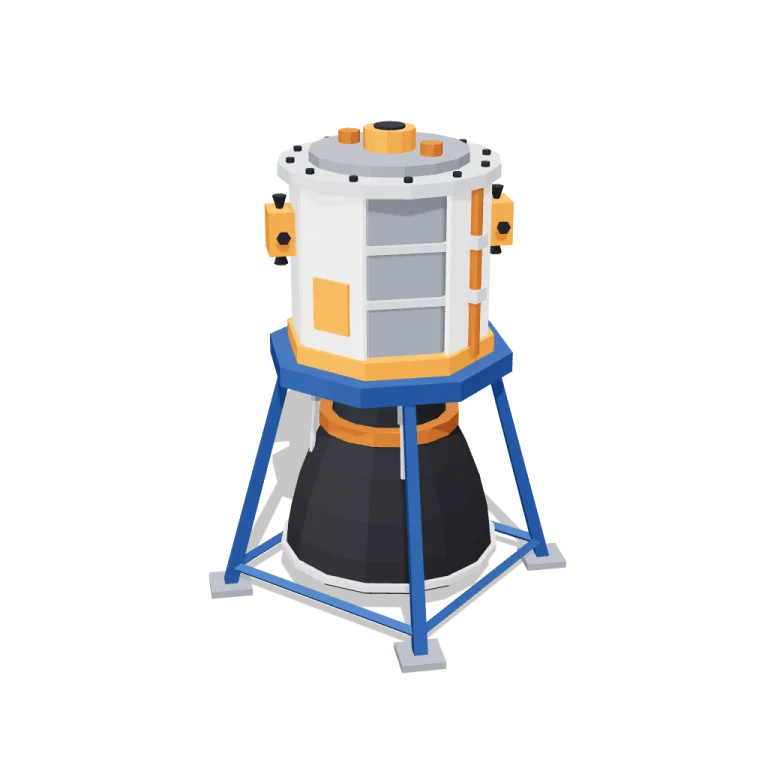
A low-poly main thruster unit for an orbital shipyard: a bell-nozzle engine with gimbal, bolted mounting flange and four RCS quads, standing nozzle-down on a four-leg assembly stand. Part of the housing is still unskinned, so it reads as a ship part under construction.
Left rail: colours and the 4 knobs the agent wrote into this model — they rebuild the geometry and go into your download. Right rail: looks for the viewer. Drag to orbit, scroll to zoom.
- Triangles
- 2,456
- Vertices
- 7,368
- Meshes · materials
- 23 · 23
- Size (W × H × D)
- 2.4 m × 3.9 m × 2.4 m
- File
- GLB · 194 KB
- Animation
- Static
- Style
- Low-poly
- Collection
- Orbital Shipyard
Palette · named materials
- white#f4f1ec
- orange#ed7e1d
- silver#b9bfc6
- mid grey#7d828c
- soot black#1b1b22
- orange dark#af590e
- orange light#eea668
- deep space blue#1b447e
Use it
import { GLTFLoader } from "three/addons/loaders/GLTFLoader.js";

const gltf = await new GLTFLoader().loadAsync(
  "https://assets.stoicsoft.com/1designtool/3d/models/orbital-shipyard-thruster-units/f718725987/model.glb"
);
scene.add(gltf.scene); // metres, +Y up, front faces +Z
How it was made
The brief given to 1DesignTool's “3D object” template:
Thruster units for the Orbital Shipyard kit. Design it as one clear asset at believable real-world scale for that setting (state the size in metres in meta.notes), with its main parts modelled and named, readable at thumbnail size and from every orbit angle. This is one part of the Orbital Shipyard kit (Low-poly style, flat-lowpoly direction): Ships under construction in open space. Use ONLY the kit palette, by name: white #f4f1ec, orange #ed7e1d, deep space blue #1b447e, silver #b9bfc6, white dark #d7cebc, orange dark #af590e, white light #f9f8f6, orange light #eea668, soot black #1b1b22, warm white #f2ede2, mid grey #7d828c, dark wood #3d2a1c. Every material's `name` must be exactly the palette colour it uses — the GLB carries these names so the kit recolours as one; an unnamed material fails delivery. Kit knob: expose a param `shipCompletionStage` (0–1, default 0.5) for the kit's "Ship completion stage" setting wherever it makes sense on this part, and keep that id.
- Agent: Claude Code · Claude Opus 5.5 in 1DesignTool
- Generation: 4.26M tokens (96% cached) · ≈ $2.67 at API prices · 5-hour plan +11%
- Direction: Low-poly · family products
- three-check PASS · glb-lint PASS
Named parts · 9
- Thruster unit
- Core frame
- Skin panels
- Mounting flange
- Gimbal ring
- Bell nozzle
- RCS quads
- Feed lines
- Assembly stand
Note: Physical size at default params: 3.86 m tall, 2.39 m across the stand footprint (X and Z). The housing is 1.4 m long and 1.49 m across its flats, and the bell nozzle is 1.5 m long with a 1.7 m exit diameter. Origin is at the bottom centre with the stand feet resting on y = 0. Front (+Z) is the service hatch panel. The engine stands nozzle-down on a shipyard assembly stand; delete the stand node if you want a free engine. shipCompletionStage installs the white skin panels in a fixed order, from 2 of 8 at 0 to all 8 at 1 (5 at the default 0.5), and the orange RCS quads from 0 to 4 (2 at the default). Missing bays show the mid-grey core frame and silver ribs, and RCS struts always reach the core, so nothing floats at any stage. bodyLength, nozzleLength and nozzleExitRadius reshape the geometry; the stand legs follow. The GLB is static, with no animation clip. Each part node carries two part ids: the library id (orbital-shipyard-thruster-units.*) on the outer group and the plan id (thrusterunits.*) on the inner one. Material names are the exact kit palette names (8 colours used). The exporter writes one material copy per mesh, so the GLB lists 23 materials with repeated names. Facets are non-indexed with baked flat normals, so the model looks faceted in any engine. 2456 triangles. glb-lint has 0 errors and 5 non-blocking warnings: material count from the per-mesh copies, duplicate materials, intentionally non-indexed flat facets, nested parts overlapping by design, and height compared against the direction's 1 m reference. Its printed verdict is UNVERIFIED only because no requirements contract was supplied. The nozzle interior colours are visible only from below; they were not checked in a capture.
About the Thruster units 3D model
Thruster units is a free low-poly 3D model from the Orbital Shipyard set. It measures 2.4 m × 3.9 m × 2.4 m (W × H × D) at real-world scale and is built from 2,456 triangles across 23 meshes, with 9 named parts. Download the 194 KB GLB and drop it into three.js, React Three Fiber, Godot or Blender — free for commercial use, no attribution required.
- Is the Thruster units 3D model free for commercial use?
- Yes. It is free under the 1DesignTool 3D library license: use it in personal and commercial work — games, apps, websites, renders, ads and client projects — and modify it as you like, with no credit required. What you can't do is re-sell or re-distribute the file on its own or inside a model pack.
- What file format is it, and how big is it?
- A single binary glTF 2.0 file (.glb), 194 KB: 2,456 triangles, 7,368 vertices and 23 materials, modelled in metres at 2.4 m × 3.9 m × 2.4 m.
- Can I animate Thruster units?
- It ships as a static mesh. Its 9 named parts are separate nodes, so you can move or animate each one in your engine.
- Which engines and tools can open it?
- Anything that reads glTF 2.0. three.js, React Three Fiber, Babylon.js, Godot 4 and Blender import the GLB directly; Unity and Unreal Engine load it through their glTF importers. The snippets above show the exact code for three.js, React Three Fiber, Godot and Blender.
- How was the Thruster units 3D model made?
- Claude Code (Claude Opus 5.5) generated it inside 1DesignTool's 3D template from a written brief, then the design kit's checks verified the geometry and the GLB before it was published. You can make your own the same way with 1DesignTool.
More like this
All of Orbital Shipyard →
Rotating ring
Orbital Shipyard2,484 tris

Half-built frigate
Orbital Shipyard3,860 tris

Robotic arm
Orbital Shipyard1,524 tris

Tug ship
Orbital Shipyard3,184 tris

Cable reels
Orbital Shipyard4,052 tris

Signal lights
Orbital Shipyard1,124 tris

Welding sparks
Orbital Shipyard2,772 tris

Cargo pods
Orbital Shipyard2,100 tris
Free under the 1DesignTool 3D library license. Model #1367 of 1941.