Menu boards
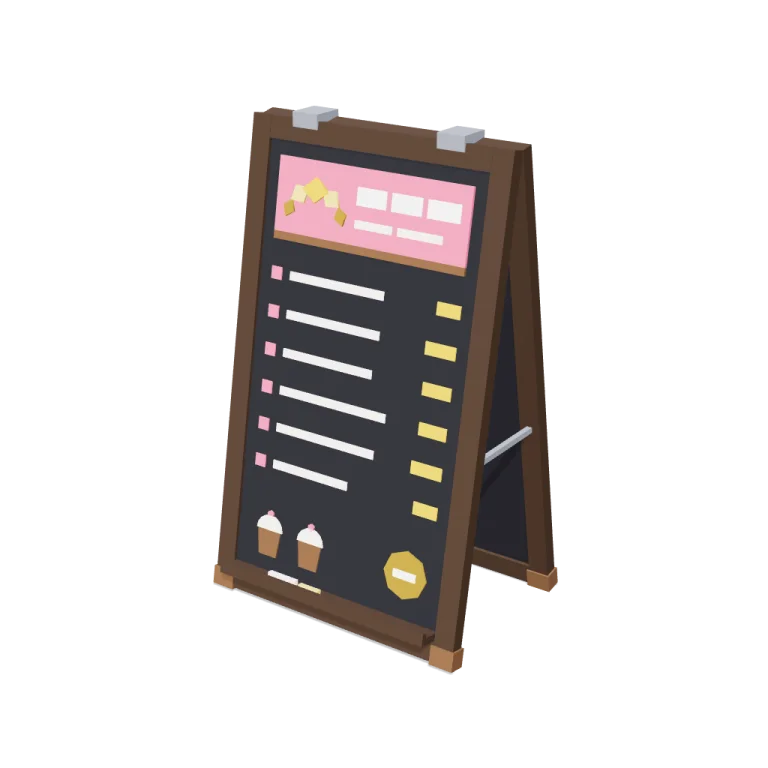
A low-poly patisserie A-frame menu board: two dark-wood framed chalkboards hinged at the top, each with a rose header and golden croissant icon, chalk menu lines with gold prices, chalk cupcakes, a gold price tag and a chalk ledge.
Left rail: colours and the 3 knobs the agent wrote into this model — they rebuild the geometry and go into your download. Right rail: looks for the viewer. Drag to orbit, scroll to zoom.
- Triangles
- 1,432
- Vertices
- 2,466
- Meshes · materials
- 21 · 21
- Size (W × H × D)
- 61 cm × 1.0 m × 49 cm
- File
- GLB · 89 KB
- Animation
- Static
- Style
- Low-poly
- Collection
- Bakery and Patisserie
Palette · named materials
- dark wood — frame stiles and rails, chalk ledge#3d2a1c
- soot black — chalkboard faces#1b1b22
- rose — header plate, menu bullets, cupcake cherries#cc6680
- chocolate brown — header trim, cupcake wrappers, feet#6b4a2e
- pastry gold — prices, croissant centre#d0a225
- pastry gold light — croissant segments, gold chalk stick#debd63
- pastry gold dark — croissant tips, round price tag#8f7019
- cream light — header sign words, price-tag figure#fbf9f4
- cream — header sub-line, cupcake frosting#f1e7d0
- warm white — menu item lines, white chalk stick#f2ede2
- mid grey — apex hinges and spreader stays#7d828c
Use it
import { GLTFLoader } from "three/addons/loaders/GLTFLoader.js";

const gltf = await new GLTFLoader().loadAsync(
  "https://assets.stoicsoft.com/1designtool/3d/models/bakery-and-patisserie-menu-boards/c0ac28e0a6/model.glb"
);
scene.add(gltf.scene); // metres, +Y up, front faces +Z
How it was made
The brief given to 1DesignTool's “3D object” template:
Menu boards for the Bakery and Patisserie kit. Design it as one clear asset at believable real-world scale for that setting (state the size in metres in meta.notes), with its main parts modelled and named, readable at thumbnail size and from every orbit angle. This is one part of the Bakery and Patisserie kit (Low-poly style, flat-lowpoly direction): Warm ovens and glass counters. Use ONLY the kit palette, by name: cream #f1e7d0, pastry gold #d0a225, rose #cc6680, chocolate brown #6b4a2e, cream dark #e0c994, pastry gold dark #8f7019, cream light #fbf9f4, pastry gold light #debd63, soot black #1b1b22, warm white #f2ede2, mid grey #7d828c, dark wood #3d2a1c. Every material's `name` must be exactly the palette colour it uses — the GLB carries these names so the kit recolours as one; an unnamed material fails delivery. Kit knob: expose a param `productRange` (0–1, default 0.5) for the kit's "Product range" setting wherever it makes sense on this part, and keep that id.
- Agent: Claude Code · Claude Opus 5.5 in 1DesignTool
- Direction: Low-poly · family products
- three-check PASS · glb-lint PASS
Named parts · 7
- Menu boards
- Wooden A-frame
- Chalkboards
- Patisserie header
- Menu lines and cake drawing
- Chalk ledge
- Hinges, spreaders and feet
Note: Size: 0.61 m wide × 0.49 m deep (splayed) × 1.01 m tall, a typical pavement sandwich board outside a bakery. The origin is the bottom centre of the footprint, resting on y = 0, and the front panel faces +Z. The back panel is a full mirrored menu face, so the board is finished from every angle. The GLB has 1,432 triangles across 21 meshes (merged per part and colour) and no animation clip. Every material is named exactly after a kit palette colour; 11 of the 12 kit colours are used (cream dark is not). The exporter writes one material per mesh, so a colour name can appear on several materials: recolour by name. Menu text is abstract modelled bars, never letters. Params are baked into the GLB at their defaults and only change geometry when the scene is rebuilt in the viewer. productRange (the kit's 'Product range') sets how many items are chalked on the menu (3 at 0, 8 at 1; 6 by default) and how many cupcakes are drawn under them (1–3; 2 by default). glb-lint: 0 errors and 4 warnings: material count and duplicates (from the per-mesh materials), overlaps where the header, chalk lines and ledge sit on the boards on purpose, and a 'detached' grey hinge/spreader mesh that is attached to the frame in a different part group. plan-check passes on a copy with the slug de-hyphenated; its part-id regex rejects the hyphens in the slug-based ids this library requires. three-check accepts those ids, and all 7 survive the GLB reload.
About the Menu boards 3D model
Menu boards is a free low-poly 3D model from the Bakery and Patisserie set. It measures 61 cm × 1.0 m × 49 cm (W × H × D) at real-world scale and is built from 1,432 triangles across 21 meshes, with 7 named parts. Download the 89 KB GLB and drop it into three.js, React Three Fiber, Godot or Blender — free for commercial use, no attribution required.
- Is the Menu boards 3D model free for commercial use?
- Yes. It is free under the 1DesignTool 3D library license: use it in personal and commercial work — games, apps, websites, renders, ads and client projects — and modify it as you like, with no credit required. What you can't do is re-sell or re-distribute the file on its own or inside a model pack.
- What file format is it, and how big is it?
- A single binary glTF 2.0 file (.glb), 89 KB: 1,432 triangles, 2,466 vertices and 21 materials, modelled in metres at 61 cm × 1.0 m × 49 cm.
- Can I animate Menu boards?
- It ships as a static mesh. Its 7 named parts are separate nodes, so you can move or animate each one in your engine.
- Which engines and tools can open it?
- Anything that reads glTF 2.0. three.js, React Three Fiber, Babylon.js, Godot 4 and Blender import the GLB directly; Unity and Unreal Engine load it through their glTF importers. The snippets above show the exact code for three.js, React Three Fiber, Godot and Blender.
- How was the Menu boards 3D model made?
- Claude Code (Claude Opus 5.5) generated it inside 1DesignTool's 3D template from a written brief, then the design kit's checks verified the geometry and the GLB before it was published. You can make your own the same way with 1DesignTool.
More like this
All of Bakery and Patisserie →
Door bell
Bakery and Patisserie1,582 tris

Oven doors
Bakery and Patisserie2,572 tris

Delivery bike
Bakery and Patisserie3,550 tris

Dough mixer
Bakery and Patisserie1,684 tris

Cake stands
Bakery and Patisserie2,276 tris

Mixers
Bakery and Patisserie1,424 tris

Trays
Bakery and Patisserie696 tris

Cakes
Bakery and Patisserie3,328 tris
Free under the 1DesignTool 3D library license. Model #19 of 1727.