Tundra Hunter
A low-poly stocky Arctic hunter in his 50s: a slate parka with its deep hood pushed back inside a thick white fur ruff, dark-wood hide mitts, ice-blue insulated trousers and fur-topped sealskin boots, holding a wooden-shafted harpoon in his right fist. Rigged on the library's shared Mixamo skeleton in T-pose.
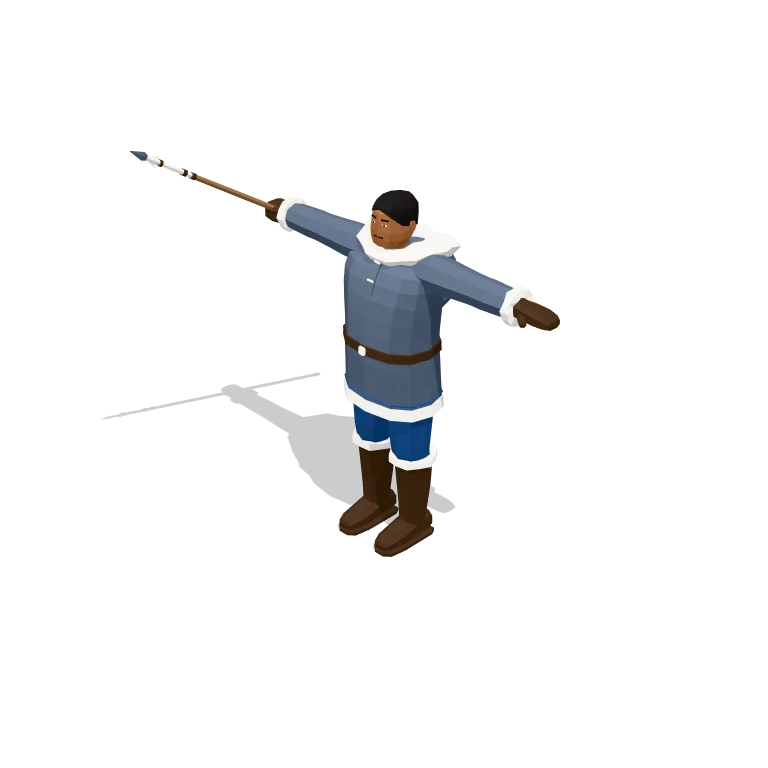
Left rail: colours and the 4 knobs the agent wrote into this model — they rebuild the geometry and go into your download. Bottom: actions for the rigged character — the one you pick plays here and is baked into the download. Right rail: looks for the viewer. Drag to orbit, scroll to zoom. On a desktop, Open in 1DesignTool turns it into a project you can keep editing with your agent.
- Triangles
- 3,518
- Vertices
- 16,842
- Meshes · materials
- 18 · 10
- Size (W × H × D)
- 1.7 m × 1.9 m × 1.3 m
- File
- GLB · 558 KB
- Animation
- Static
- Style
- Low-poly
- Collection
- Arctic Tundra
Palette · named materials
- skin#96613f
- hair#1b1918
- eyes#16161b
- top#525e6f
- accent#f4f1ec
- bottoms#1f457a
- shoes#3d2a1c
- hide#3d2a1c
- prop#8d6a47
- blade#525e6f
Use it
import { GLTFLoader } from "three/addons/loaders/GLTFLoader.js";

const gltf = await new GLTFLoader().loadAsync(
  "https://assets.stoicsoft.com/1designtool/3d/models/arctic-tundra-hunter/4e2ebc76ce/model.glb"
);
scene.add(gltf.scene); // metres, +Y up, front faces +Z
How it was made
The brief given to 1DesignTool's “3D object” template:
A stocky man in his 50s, about 1.68 m tall, with a wide weathered face, a thin moustache and short black hair. Calm, watchful expression. Wearing a slate-grey parka with a deep hood trimmed in thick white fur pushed back on the shoulders, dark-wood hide mitts, ice-blue-dark insulated trousers and knee-high dark-wood sealskin boots. Palette (Arctic Tundra kit, use these exact hex values for the named colours): slate #525e6f, white #f4f1ec, dark wood #3d2a1c, ice blue dark #1f457a. Holding a wooden-shafted harpoon in the right hand. Low-poly style, matching the kit's flat-shaded parts. No text, logos, brand names or lettering anywhere.
- Agent: Claude Code · Claude Opus 5.5 in 1DesignTool
- Direction: Low-poly · family characters
- three-check PASS · glb-lint PASS
Named parts · 11
- Body (skin: head, neck, ears)
- Hair, brows and moustache
- Eyes
- Slate parka
- Hem band, cord, belt and toggles
- Hood pushed back
- Fur ruff and cuffs
- Hide mitts
- Insulated trousers
- Sealskin boots
- Harpoon
Note: 3,518 triangles in 11 skinned meshes (18 glTF primitives, one per material) bound to one 25-bone skeleton with exact mixamorig:* names (three.js loads them as mixamorigHips and so on). The GLB carries 11 glTF skins that all list the same 25 joints, which three.js, Godot, Unity and Blender import as one armature. No finger bones: the left mitt is open and the right a fist, weighted to mixamorig:LeftHand / mixamorig:RightHand. The harpoon is its own mesh weighted 100% to mixamorig:RightHand and is held tip-raised 32° forward through the fist; it is 1.55 m long, so its tip reaches 1.87 m and the model's bounds are deeper than the body (z -0.55 to 0.78). Head, hair, moustache and eyes are rigid on mixamorig:Head; the parka skirt below the belt hands itself over to the thighs (up to 78% at the hem) so a lifted leg drags the hem instead of tearing it; the hood follows the parka back and the fur ruff rides Spine2 and the clavicles, not the upper arms. Bone rest rotations are identity (local axes match the world in the T-pose, no roll), unlike Mixamo's own +Y-along-the-bone axes, so retarget clips by rest pose (SkeletonUtils.retargetClip, Blender, Godot or Unity humanoid) rather than copying raw rotations. Weights use at most 3 influences per vertex (cap 4), normalised to 1. Height 1.68 m is soles to the crown of the hair. Faces are flat-shaded through per-face normals, so they stay faceted in any engine. No textures, no animation clips. Mitts and boots share the brief's dark wood; they are separate materials (hide, shoes) because the Caribou colourway turns the mitts slate. Rig stress pose (arms down 70°, forearms 90°, left thigh forward 45°, Spine1 twist 20°): worst edge 2.35× stretch, on the parka sleeve under the armpit; in that pose the harpoon stands nearly upright and its tip rises past 2 m, so the rig test's sane box is the rest bounds plus 0.5 m rather than a fixed human-sized box. glb-lint reports 0 errors; its plain run reads UNVERIFIED because no contract is passed, and it PASSES against the plan's requirements contract. Its two heuristic warnings (overlapping head/hair/eye boxes, the harpoon not touching a sibling mesh) are by design.
About the Tundra Hunter 3D model
Tundra Hunter is a free low-poly 3D model from the Arctic Tundra set, rigged with a 25-bone Mixamo-compatible skeleton. It measures 1.7 m × 1.9 m × 1.3 m (W × H × D) at real-world scale and is built from 3,518 triangles across 18 meshes, with 11 named parts. Download the 558 KB GLB and drop it into three.js, React Three Fiber, Godot or Blender — free for commercial use, no attribution required.
- Is the Tundra Hunter 3D model free for commercial use?
- Yes. It is free under the 1DesignTool 3D library license: use it in personal and commercial work — games, apps, websites, renders, ads and client projects — and modify it as you like, with no credit required. What you can't do is re-sell or re-distribute the file on its own or inside a model pack.
- What file format is it, and how big is it?
- A single binary glTF 2.0 file (.glb), 558 KB: 3,518 triangles, 16,842 vertices and 10 materials, modelled in metres at 1.7 m × 1.9 m × 1.3 m.
- Is Tundra Hunter animated?
- It ships without a baked clip, in its bind pose. It is rigged with a 25-bone Mixamo-compatible skeleton, so it takes retargeted animation.
- Which engines and tools can open it?
- Anything that reads glTF 2.0. three.js, React Three Fiber, Babylon.js, Godot 4 and Blender import the GLB directly; Unity and Unreal Engine load it through their glTF importers. The snippets above show the exact code for three.js, React Three Fiber, Godot and Blender.
- How was the Tundra Hunter 3D model made?
- Claude Code (Claude Opus 5.5) generated it inside 1DesignTool's 3D template from a written brief, then the design kit's checks verified the geometry and the GLB before it was published. You can make your own the same way with 1DesignTool.
More like this
All of Arctic Tundra →
Ice Floe Penguin
Arctic Tundra956 tris

Tundra Arctic Fox
Arctic Tundra1,556 tris

Tundra Seal
Arctic Tundra2,374 tris

Aurora ribbon
Arctic Tundra3,532 tris

Snowmobile
Arctic Tundra2,160 tris

Dog sled
Arctic Tundra1,904 tris

Drifting floe
Arctic Tundra1,020 tris

Fuel drums
Arctic Tundra2,452 tris
Free under the 1DesignTool 3D library license. Model #145 of 2361.