Prize counter
A low-poly arcade prize counter. A lit display case of small prizes sits under a purple countertop with a ticket counting machine and a register on top. Behind a staff aisle, a tall prize wall holds plush bears and gift boxes under a glowing star sign with chaser bulbs.
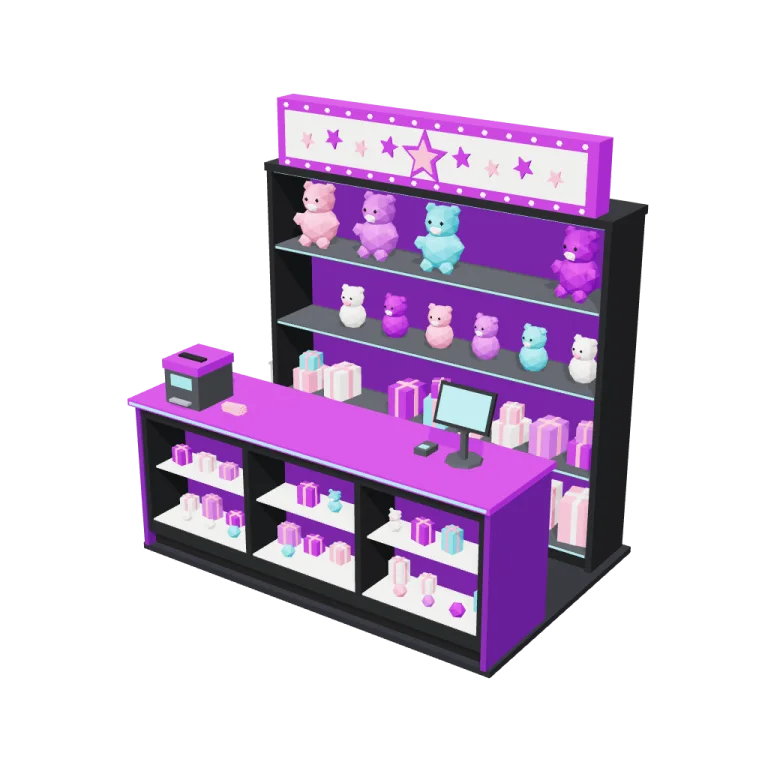
Left rail: colours and the 4 knobs the agent wrote into this model — they rebuild the geometry and go into your download. Right rail: looks for the viewer. Drag to orbit, scroll to zoom.
- Triangles
- 6,492
- Vertices
- 19,476
- Meshes · materials
- 88 · 88
- Size (W × H × D)
- 2.5 m × 2.6 m × 1.7 m
- File
- GLB · 542 KB
- Animation
- Static
- Style
- Low-poly
- Collection
- Arcade
Palette · named materials
- body: counter carcass, case posts, wall frame and battens, register housing (black)#151619
- base: kick plinths, ticket mouth, bear eyes (black dark)#090a0b
- trim: wall shelves, ticket counter body, staff shelf, register stand (black light)#3a3c40
- deck: staff deck (soot black)#1b1b22
- top: countertop, sign shell, ticket counter hood, outer star (neon purple)#9123c7
- panel: case and wall back panels; end panels at the default era (neon purple dark)#611886
- prize: plush bears, gift boxes, balls (hot pink, neon purple light, cyan, warm white, neon purple)#b15bdc
- accent: star emblem, ticket bundle, gift ribbons (hot pink)#f589ad
- strip / screen: light strips, ticket counter and register screens (cyan, faint emissive)#20c6df
- light: sign panel, chaser bulbs, lit case floor and shelf (warm white, faint emissive)#f2ede2
- metal: ticket lip, staff stock boxes, retro register (mid grey)#7d828c
- cheek: end panels at era below 0.34 (dark wood)#3d2a1c
Use it
import { GLTFLoader } from "three/addons/loaders/GLTFLoader.js";

const gltf = await new GLTFLoader().loadAsync(
  "https://assets.stoicsoft.com/1designtool/3d/models/arcade-prize-counter/0c3e07723c/model.glb"
);
scene.add(gltf.scene); // metres, +Y up, front faces +Z
How it was made
The brief given to 1DesignTool's “3D object” template:
Prize counter for the Arcade kit. Design it as one clear asset at believable real-world scale for that setting (state the size in metres in meta.notes), with its main parts modelled and named, readable at thumbnail size and from every orbit angle. This is one part of the Arcade kit (Low-poly style, flat-lowpoly direction): Screens glowing in a dark room. Use ONLY the kit palette, by name: black #151619, neon purple #9123c7, cyan #20c6df, hot pink #f589ad, black dark #090a0b, neon purple dark #611886, black light #3a3c40, neon purple light #b15bdc, soot black #1b1b22, warm white #f2ede2, mid grey #7d828c, dark wood #3d2a1c. Every material's `name` must be exactly the palette colour it uses — the GLB carries these names so the kit recolours as one; an unnamed material fails delivery. Kit knob: expose a param `era` (0–1, default 0.5) for the kit's "Era" setting wherever it makes sense on this part, and keep that id.
- Agent: Claude Code · Claude Opus 5.5 in 1DesignTool
- Generation: 9.30M tokens (97% cached) · ≈ $5.22 at API prices · 5-hour plan +13%, weekly plan +2%
- Direction: Low-poly · family scenes
- three-check PASS · glb-lint PASS
Named parts · 26
- Prize counter
- Staff deck
- Counter
- Kick plinth
- Counter body
- End panels
- Display case
- Case light strip
- Countertop
- Countertop edge light
- Staff shelf
- Display case prizes
- Ticket counter
- Ticket bundle
- Register
- Prize wall
- Wall frame
- Back panel
- Shelves
- Wall light strip
- Plush bears
- Gift boxes
- Prize sign
- Sign light panel
- Star emblem
- Chaser bulbs
Note: Size: 2.62 m tall to the top of the sign, 2.50 m wide across the countertop overhang, and 1.74 m deep from the back of the staff deck to the countertop's front edge light. This is a walk-behind redemption counter at real scale. The counter is 1.02 m high and 0.62 m deep, with a 0.62 m staff aisle behind it. The prize wall is 2.2 m tall and 0.42 m deep. The whole fixture stands on a 4 cm staff deck. The origin is at the bottom centre and the deck rests on y = 0. The front (the customer side) faces +Z. The GLB has 6492 triangles in 88 meshes. It is static: there is no animation clip. Every material is named exactly after an Arcade kit palette colour, so you can recolour by name. The exporter writes one material per mesh, so the same colour name appears on several materials (88 materials, 11 distinct colours at the default era; dark wood appears only at low era). The light strips, screens, sign panel, bulbs and the display case's floor and shelf have a faint emissive equal to their base colour, so they glow in a dark scene without bloom. The prizes are merged into one mesh per colour for each prize part. The display case is open-fronted, with no glass. The GLB is baked at the default params. Changing a param rebuilds the model in the viewer only. era (the kit's 'Era' setting) does three things. The end panels switch from dark wood (below 0.34) to neon purple dark to black light (0.67 and above), using the same thresholds as the other Arcade kit assets. The register changes from a chunky mid-grey box register with a key deck (below 0.5) to a slim POS screen on a stand. The sign goes from a tall 0.50 m marquee with many large bulbs (era 0) to a slim 0.34 m lightbox with fewer, smaller bulbs (era 1). width sets the counter and wall length; the number of case bays and prize slots follow it. wallHeight sets the prize wall height, and the four shelf compartments share it. stock sets the fraction of prize slots that are filled; which slots are filled is seeded and fixed. three-check passed at both extremes: era 0, 3.2 m, 2.4 m and full stock exported 9856 triangles; era 1, 1.8 m, 1.9 m and 0.2 stock exported 2236. Lighting override: the viewer uses exposure 0.8 instead of the direction's 1.05 so the cyan and warm white don't wash out. This affects only the viewer, not the GLB. glb-lint: 0 errors and 6 heuristic warnings, all expected. Two are about material count and duplicates, both caused by the per-mesh materials. One flags non-indexed geometry, which is deliberate flat shading. One flags sibling overlaps from the merged prize meshes sharing bounds. One flags 'detached' parts that are seated on a part in another group: shelves on the wall posts, light strips on the shelves and rails, stars on the sign panel, bulbs on the sign shell. One compares the 2.62 m height with the direction's 1 m reference. Its verdict reads UNVERIFIED only because no host requirements contract was supplied. plan-check rejects only the hyphens in the slug-based part ids this library requires; the same plan with the slug de-hyphenated passes. three-check accepts those ids, and all 26 planned ids survive the GLB reload. Known viewer artifact: in the headless side capture, faint 1-pixel hairlines show on the counter's end panel where the interior panels end behind it. They are not shadows (they remain with shadows off). No visible faces are coplanar, and the GLB geometry is clean.
About the Prize counter 3D model
Prize counter is a free low-poly 3D model from the Arcade set. It measures 2.5 m × 2.6 m × 1.7 m (W × H × D) at real-world scale and is built from 6,492 triangles across 88 meshes, with 26 named parts. Download the 542 KB GLB and drop it into three.js, React Three Fiber, Godot or Blender — free for commercial use, no attribution required.
- Is the Prize counter 3D model free for commercial use?
- Yes. It is free under the 1DesignTool 3D library license: use it in personal and commercial work — games, apps, websites, renders, ads and client projects — and modify it as you like, with no credit required. What you can't do is re-sell or re-distribute the file on its own or inside a model pack.
- What file format is it, and how big is it?
- A single binary glTF 2.0 file (.glb), 542 KB: 6,492 triangles, 19,476 vertices and 88 materials, modelled in metres at 2.5 m × 2.6 m × 1.7 m.
- Can I animate Prize counter?
- It ships as a static mesh. Its 26 named parts are separate nodes, so you can move or animate each one in your engine.
- Which engines and tools can open it?
- Anything that reads glTF 2.0. three.js, React Three Fiber, Babylon.js, Godot 4 and Blender import the GLB directly; Unity and Unreal Engine load it through their glTF importers. The snippets above show the exact code for three.js, React Three Fiber, Godot and Blender.
- How was the Prize counter 3D model made?
- Claude Code (Claude Opus 5.5) generated it inside 1DesignTool's 3D template from a written brief, then the design kit's checks verified the geometry and the GLB before it was published. You can make your own the same way with 1DesignTool.
More like this
All of Arcade →


Free under the 1DesignTool 3D library license. Model #30 of 1410.