Tunnel tank
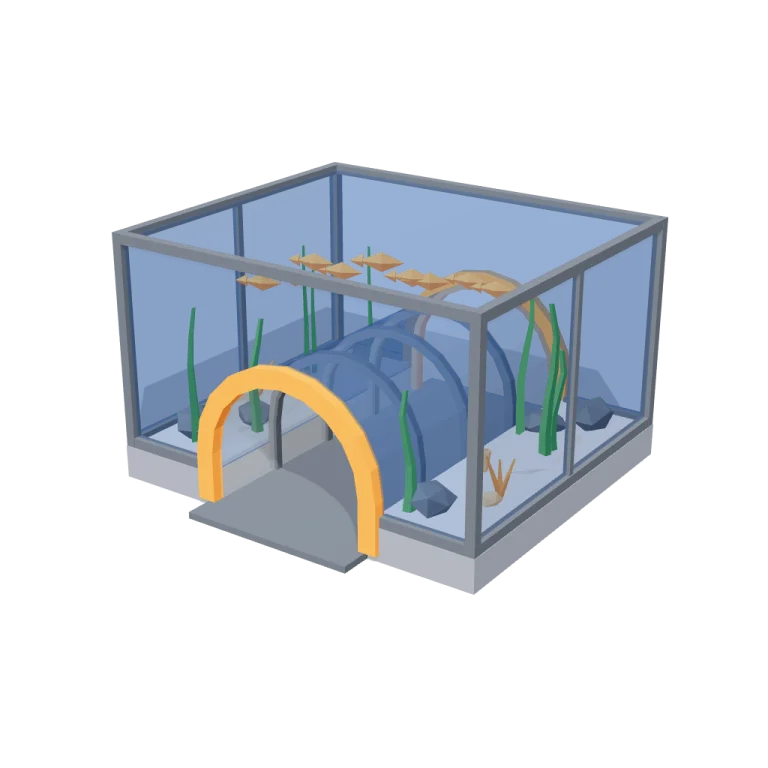
A low-poly walk-through aquarium tank: a steel-framed glass box of blue water on a concrete plinth, with a ribbed acrylic tunnel running front to back through its floor between coral-orange portal frames. Sand, rocks, coral, kelp and a fish school fill the water around the tube.
Left rail: colours and the 4 knobs the agent wrote into this model — they rebuild the geometry and go into your download. Right rail: looks for the viewer. Drag to orbit, scroll to zoom.
- Triangles
- 2,122
- Vertices
- 6,366
- Meshes · materials
- 13 · 13
- Size (W × H × D)
- 7.2 m × 4.5 m × 7.4 m
- File
- GLB · 162 KB
- Animation
- Static
- Style
- Low-poly
- Collection
- Aquarium
Palette · named materials
- plinth (base)#7d828c
- deck, frame, tunnel ribs, rocks (trim)#525860
- portal frames, branch coral, fish (accent)#ed7e1d
- sponges and brain coral (accent)#eea668
- water (translucent)#1b447e
- acrylic tunnel (translucent), sand (earth)#f2ede2
- kelp (foliage)#3a883a
Use it
import { GLTFLoader } from "three/addons/loaders/GLTFLoader.js";

const gltf = await new GLTFLoader().loadAsync(
  "https://assets.stoicsoft.com/1designtool/3d/models/aquarium-tunnel-tank/81c9facaf2/model.glb"
);
scene.add(gltf.scene); // metres, +Y up, front faces +Z
How it was made
The brief given to 1DesignTool's “3D object” template:
Tunnel tank for the Aquarium kit. Design it as one clear asset at believable real-world scale for that setting (state the size in metres in meta.notes), with its main parts modelled and named, readable at thumbnail size and from every orbit angle. This is one part of the Aquarium kit (Low-poly style, flat-lowpoly direction): Glass tunnels through blue water. Use ONLY the kit palette, by name: deep blue #1b447e, coral orange #ed7e1d, glow green #3a883a, dark grey #525860, deep blue dark #0d223f, coral orange dark #af590e, deep blue light #2e67b8, coral orange light #eea668, soot black #1b1b22, warm white #f2ede2, mid grey #7d828c, dark wood #3d2a1c. Every material's `name` must be exactly the palette colour it uses — the GLB carries these names so the kit recolours as one; an unnamed material fails delivery. Kit knob: expose a param `seaRegion` (0–1, default 0.5) for the kit's "Sea region" setting wherever it makes sense on this part, and keep that id.
- Agent: Claude Code · Claude Opus 5.5 in 1DesignTool
- Generation: 3.68M tokens (95% cached) · ≈ $2.74 at API prices · 5-hour plan +8%
- Direction: Low-poly · family scenes
- three-check PASS · glb-lint PASS
Named parts · 14
- Tunnel tank
- Concrete plinth
- Tunnel deck
- Steel frame
- Portal frames
- Water
- Acrylic tunnel
- Tunnel ribs
- Sand beds
- Rocks
- Branch coral
- Sponges and brain coral
- Kelp
- Fish school (9)
Note: Size at default params: 7.2 m wide × 4.49 m tall × 7.4 m long. The tank is 6.2 m long including the plinth lip, and the walkway deck runs 0.7 m out past both tunnel mouths. Inside the tunnel there is 3.0 m of clear width and 2.4 m of headroom above the deck. The water stands 3.8 m deep above a 0.6 m plinth. Metres, +Y up, the tunnel mouth faces +Z, origin at the bottom centre, resting on y = 0. 2,476 triangles and 16 draw calls; the largest settings stay under 3,200 triangles. Static: there is no animation clip. Every material is named exactly after its Aquarium palette colour, with no textures and flat shading only. The water (deep blue, 32% opacity, double-sided) and the acrylic tube (warm white, 30%) are translucent alpha-blend materials. How they sort in other engines depends on that engine's transparency ordering; the viewer draws the tube before the water. Sea region (0 to 1) changes colours in three steps, not smoothly. 0 to 0.33 is the shallows: deep blue light water and mid grey rocks. 0.33 to 0.67 is open water (the default). 0.67 to 1 is the deep sea: deep blue dark water, mid grey sand, glow green coral, deep blue light kelp and coral orange light fish. The fish school is suspended mid-water above the tunnel, so it touches no other part by design. A sweep of all 81 combinations of min, default and max for each param confirmed that the reef and fish stay inside the glass and out of the tunnel. Deliberate overlaps: steel posts and rails straddle the water box edges, the portal frames sink 5 cm into the water face and the plinth, the ribs sit on the acrylic, and rocks and coral bases are sunk into the sand. Because the exporter writes one material per mesh, the GLB repeats some palette names (13 material slots, 7 colours), so recolour by name rather than by index. glb-lint found 0 errors and 6 heuristic warnings: material count and duplicates (those per-mesh copies), non-indexed flat-shaded meshes, overlapping siblings (the deliberate overlaps above), the fish counted as detached, and height against a 1 m reference. It exits with code 2 because its verdict is UNVERIFIED when no requirements contract is supplied. The kit's part-id grammar has no hyphens, so the plan-level transform groups are named tunneltank.* and the meshes carry the aquarium-tunnel-tank.* ids.
About the Tunnel tank 3D model
Tunnel tank is a free low-poly 3D model from the Aquarium set. It measures 7.2 m × 4.5 m × 7.4 m (W × H × D) at real-world scale and is built from 2,122 triangles across 13 meshes, with 14 named parts. Download the 162 KB GLB and drop it into three.js, React Three Fiber, Godot or Blender — free for commercial use, no attribution required.
- Is the Tunnel tank 3D model free for commercial use?
- Yes. It is free under the 1DesignTool 3D library license: use it in personal and commercial work — games, apps, websites, renders, ads and client projects — and modify it as you like, with no credit required. What you can't do is re-sell or re-distribute the file on its own or inside a model pack.
- What file format is it, and how big is it?
- A single binary glTF 2.0 file (.glb), 162 KB: 2,122 triangles, 6,366 vertices and 13 materials, modelled in metres at 7.2 m × 4.5 m × 7.4 m.
- Can I animate Tunnel tank?
- It ships as a static mesh. Its 14 named parts are separate nodes, so you can move or animate each one in your engine.
- Which engines and tools can open it?
- Anything that reads glTF 2.0. three.js, React Three Fiber, Babylon.js, Godot 4 and Blender import the GLB directly; Unity and Unreal Engine load it through their glTF importers. The snippets above show the exact code for three.js, React Three Fiber, Godot and Blender.
- How was the Tunnel tank 3D model made?
- Claude Code (Claude Opus 5.5) generated it inside 1DesignTool's 3D template from a written brief, then the design kit's checks verified the geometry and the GLB before it was published. You can make your own the same way with 1DesignTool.
More like this
All of Aquarium →


Free under the 1DesignTool 3D library license. Model #73 of 1344.