Shipping container homes
A low-poly scrap dwelling made from two stacked 20 ft shipping containers: a rust lower unit on cinder blocks and a faded yellow upper unit crossed on top and cantilevered over the front on timber props. Ship stairs climb to a railed roof terrace with a water tank, and a scrap awning shelters the front door.
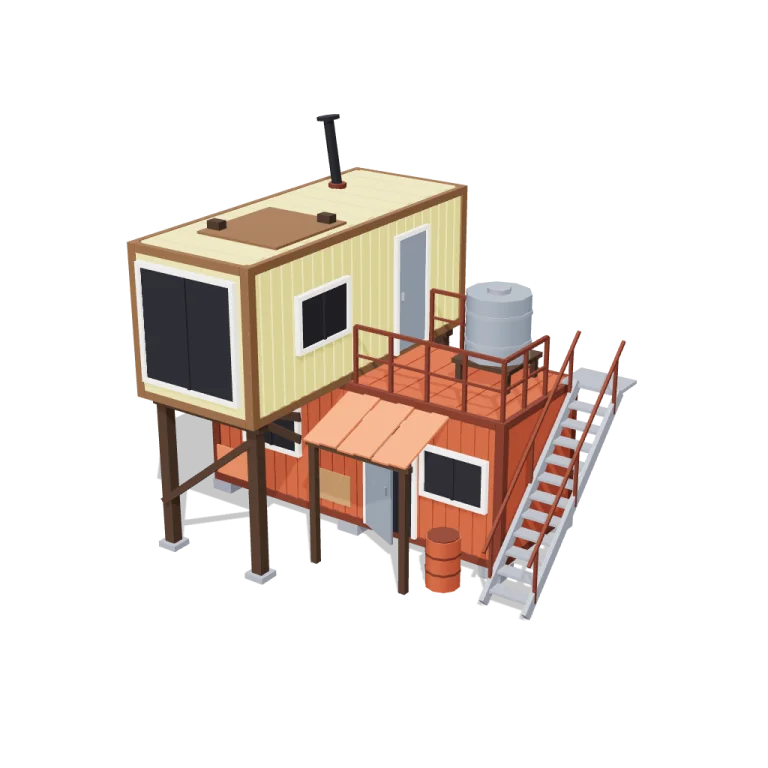
Left rail: colours and the 3 knobs the agent wrote into this model — they rebuild the geometry and go into your download. Right rail: looks for the viewer. Drag to orbit, scroll to zoom.
- Triangles
- 3,876
- Vertices
- 11,604
- Meshes · materials
- 34 · 34
- Size (W × H × D)
- 7.1 m × 6.7 m × 6.3 m
- File
- GLB · 398 KB
- Animation
- Static
- Style
- Low-poly
- Collection
- Wasteland Outpost
Palette · named materials
- body — lower container shell, oil drum (rust)#9b4427
- trim — lower corner posts and rails, cargo lock bars, railing, stair handrails (rust dark)#5e2917
- accent — scrap awning, patch plates (rust light)#c96645
- body — upper container shell (faded yellow)#dbc970
- trim — upper corner posts and rails, roof tarp (dust brown)#6b4a2e
- patch — patch plates (dust brown light)#9b704b
- earth — tarp weights (dust brown dark)#362517
- door — front and terrace doors, water tank (grey)#757e8a
- metal — cinder blocks, stairs, tank bands, door handle (mid grey)#7d828c
- glass — window panes, doorway, stovepipe (soot black)#1b1b22
- frame — window and door frames (warm white)#f2ede2
- wood — timber props, awning posts, tank stand, window boards (dark wood)#3d2a1c
Use it
import { GLTFLoader } from "three/addons/loaders/GLTFLoader.js";

const gltf = await new GLTFLoader().loadAsync(
  "https://assets.stoicsoft.com/1designtool/3d/models/wasteland-outpost-shipping-container-homes/4bb7b9cc43/model.glb"
);
scene.add(gltf.scene); // metres, +Y up, front faces +Z
How it was made
The brief given to 1DesignTool's “3D object” template:
Shipping container homes for the Wasteland Outpost kit. Design it as one clear asset at believable real-world scale for that setting (state the size in metres in meta.notes), with its main parts modelled and named, readable at thumbnail size and from every orbit angle. This is one part of the Wasteland Outpost kit (Low-poly style, flat-lowpoly direction): A scrap fort in a dead land. Use ONLY the kit palette, by name: dust brown #6b4a2e, rust #9b4427, faded yellow #dbc970, grey #757e8a, dust brown dark #362517, rust dark #5e2917, dust brown light #9b704b, rust light #c96645, soot black #1b1b22, warm white #f2ede2, mid grey #7d828c, dark wood #3d2a1c. Every material's `name` must be exactly the palette colour it uses — the GLB carries these names so the kit recolours as one; an unnamed material fails delivery. Kit knob: expose a param `decayLevel` (0–1, default 0.5) for the kit's "Decay level" setting wherever it makes sense on this part, and keep that id.
- Agent: Claude Code · Claude Opus 5.5 in 1DesignTool
- Direction: Low-poly · family scenes
- three-check PASS · glb-lint PASS
Named parts · 15
- Shipping container homes
- Cinder block foundation
- Lower container
- Front door
- Lower windows
- Upper container
- Upper windows
- Timber props
- Ship stairs
- Terrace railing
- Scrap awning
- Water tank
- Stovepipe
- Oil drum
- Scrap patches
Note: Size: about 7.1 m wide (X, cargo doors to stair stringers), 6.1 m deep (Z) and 5.38 m to the upper container roof, or 6.66 m to the stovepipe cap. Built from two ISO 20 ft containers (6.06 × 2.59 × 2.44 m) on 0.2 m cinder blocks. Origin is at the bottom centre with the blocks, props and stair foot resting on y = 0; the front (glazed upper end, front door) faces +Z. 4166 triangles across 36 meshes, static with no animation clip. All 12 Wasteland Outpost palette colours are used, and every material is named after its palette colour. The exporter writes one material per mesh, so the same colour name appears on several materials: recolour by name. Params are baked into the GLB at their default values. decayLevel (the kit's Decay level) sets the number of scrap patch plates (0–8), how far the awning sags, whether one front window is boarded over (2 boards from 0.4, 3 from 0.75) and how far the stovepipe leans. cantilever slides the upper container forward, and the timber props appear only under an overhang longer than 0.6 m. doorOpen swings the front door leaf. glb-lint: 0 errors and 6 heuristic warnings: duplicate same-colour materials from the exporter, non-indexed flat-shaded geometry, intended overlaps (door leaf and frames on the wall), railing and tank stand standing on the roof, and the 6.66 m height compared with the direction's 1 m reference. The kit's plan-check rejects hyphens in part ids, so design-plan.md fails plan-check only on the slug-based ids this library requires. three-check accepts those ids, and all 15 survive the GLB reload.
About the Shipping container homes 3D model
Shipping container homes is a free low-poly 3D model from the Wasteland Outpost set. It measures 7.1 m × 6.7 m × 6.3 m (W × H × D) at real-world scale and is built from 3,876 triangles across 34 meshes, with 15 named parts. Download the 398 KB GLB and drop it into three.js, React Three Fiber, Godot or Blender — free for commercial use, no attribution required.
- Is the Shipping container homes 3D model free for commercial use?
- Yes. It is free under the 1DesignTool 3D library license: use it in personal and commercial work — games, apps, websites, renders, ads and client projects — and modify it as you like, with no credit required. What you can't do is re-sell or re-distribute the file on its own or inside a model pack.
- What file format is it, and how big is it?
- A single binary glTF 2.0 file (.glb), 398 KB: 3,876 triangles, 11,604 vertices and 34 materials, modelled in metres at 7.1 m × 6.7 m × 6.3 m.
- Can I animate Shipping container homes?
- It ships as a static mesh. Its 15 named parts are separate nodes, so you can move or animate each one in your engine.
- Which engines and tools can open it?
- Anything that reads glTF 2.0. three.js, React Three Fiber, Babylon.js, Godot 4 and Blender import the GLB directly; Unity and Unreal Engine load it through their glTF importers. The snippets above show the exact code for three.js, React Three Fiber, Godot and Blender.
- How was the Shipping container homes 3D model made?
- Claude Code (Claude Opus 5.5) generated it inside 1DesignTool's 3D template from a written brief, then the design kit's checks verified the geometry and the GLB before it was published. You can make your own the same way with 1DesignTool.
More like this
All of Wasteland Outpost →
Radio mast
Wasteland Outpost1,760 tris

Wind pump
Wasteland Outpost2,280 tris

Armoured buggy
Wasteland Outpost3,368 tris

Gate on a counterweight
Wasteland Outpost1,164 tris

Wrecks
Wasteland Outpost844 tris

Campfire barrels
Wasteland Outpost1,668 tris

Solar scraps
Wasteland Outpost1,804 tris

Barbed wire
Wasteland Outpost3,360 tris
Free under the 1DesignTool 3D library license. Model #101 of 701.