Tailor
A realistic, static full-body Indian tailor in his mid 60s, 1.70 m and in a neutral A-pose, with a neatly trimmed white beard and moustache made of hair cards, a white collarless kurta, a grey waistcoat with brass scissors in the pocket, charcoal trousers and black leather sandals. A measuring tape is draped round his neck and a pin cushion is strapped to his wrist.
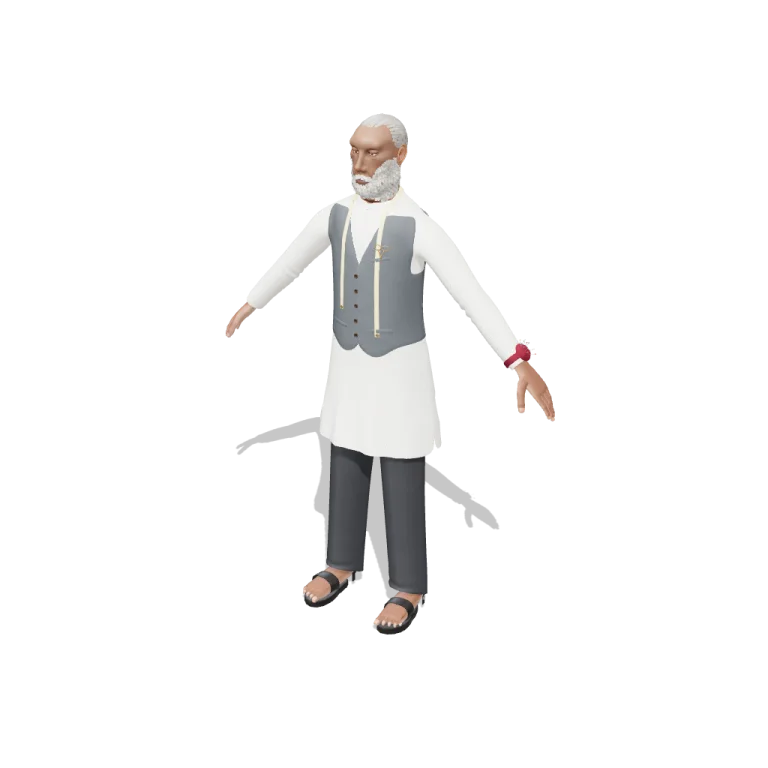
Left rail: colours and the 3 knobs the agent wrote into this model — they rebuild the geometry and go into your download. Right rail: looks for the viewer. Drag to orbit, scroll to zoom.
- Triangles
- 149,594
- Vertices
- 219,383
- Meshes · materials
- 20 · 20
- Size (W × H × D)
- 1.3 m × 1.7 m × 38 cm
- File
- GLB · 22.0 MB
- Animation
- Static
- Style
- Realistic
- Collection
- Characters
Palette · named materials
- skin#85604d
- hair-beard#dedad2
- iris#3b2416
- kurta-cotton#f1eee7
- waistcoat-wool#5f6367
- trousers-wool#3a3c40
- sandal-leather#1c1a19
- brass#b08d57
- measuring-tape#eadb97
- pin-cushion-velvet#7a1f2b
Use it
import { GLTFLoader } from "three/addons/loaders/GLTFLoader.js";

const gltf = await new GLTFLoader().loadAsync(
  "https://assets.stoicsoft.com/1designtool/3d/models/tailor/e31a1b1cbd/model.glb"
);
scene.add(gltf.scene); // metres, +Y up, front faces +Z
How it was made
The brief given to 1DesignTool's “3D object” template:
A realistic full-body 3D character: an Indian man in his mid 60s, slim and upright, 170 cm tall. Dark brown eyes with heavy lids, a neatly trimmed white beard and moustache, medium brown skin with deep wrinkles and visible pores. Thinning white hair combed back, modelled as hair cards. Clothing: a crisp white collarless kurta shirt under a grey tailored waistcoat with pin cushion on the wrist, a cloth measuring tape draped around the neck, charcoal pressed trousers, black leather sandals, and small brass scissors in the waistcoat pocket. Pose: neutral A-pose, arms at 45 degrees, fingers slightly spread, feet shoulder-width apart, neutral facial expression, mouth closed. Technical: 120,000 to 150,000 triangles total, with density concentrated in the face, hands and clothing folds. Clean quad-dominant topology with edge loops around the eyes, mouth, shoulders, elbows, knees and fingers so it deforms well when rigged. Separate meshes for body, eyes, teeth, hair and each clothing layer. Real-world scale in metres, origin at ground level between the feet. PBR textures at 4K: base colour, normal, roughness, metallic, ambient occlusion. No baked lighting or shadows in the base colour. No logos, brand names or readable text anywhere.
- Agent: Claude Code · Claude Opus 5.5 in 1DesignTool
- Generation: 8.79M tokens (97% cached) · ≈ $8.20 at API prices · 5-hour plan +8%
- Direction: Realistic · family characters
- three-check PASS · glb-lint PASS
Named parts · 13
- Tailor
- Body
- Eyes
- Teeth
- Hair
- Beard and moustache
- Kurta
- Waistcoat
- Trousers
- Sandals
- Measuring tape
- Wrist pin cushion
- Brass scissors
Note: Triangles: 149,594 measured in dist/model.glb (74,247 quads + 1,100 triangles before triangulation, 98.5% quads). Density goes to the face (an SDF-sculpted 112-column head grid with concentric edge-loop patches round each eye and the mouth, about 30k triangles), the hands (Catmull-Clark level 2 with three edge loops per knuckle, about 15k) and the kurta/trouser/waistcoat folds. The body is one continuous Catmull-Clark surface (torso, arms, five-finger hands, legs, feet with toes) zipped to the head at the neck base under the collar. Body, eyes, teeth, hair, beard and each clothing layer are separate meshes. Units are metres, +Y up, facing +Z, with the origin on the ground between the feet and the sandal soles exactly on y = 0. Stature is 1.70 m barefoot to the crown; the 24 mm sandal soles and hair make the bounding box 1.731 m tall (1.34 m wide in the A-pose). Textures: every map is generated by tools/textures. dist/textures-4k holds 4096² PNG base colour, normal, roughness, metallic and AO for 13 texture sets (65 files, about 450 MB): body-face (an atlas baked from the head geometry, with pores, age spots, moles and forehead, glabellar, crow's-feet, under-eye, nasolabial and neck wrinkles, plus SDF occlusion), body-skin (tiling, tinted by vertex colour for the palm/sole/nail versus dorsal tone), eyes, teeth, hair, beard, kurta, waistcoat, trousers, sandals, tape, pincushion and trims. The GLB (23.1 MB) embeds 2048² copies: JPEG base colour and normal, plus PNG base colour with alpha for hair and beard, with roughness/metallic/AO packed into one glTF ORM JPEG per set (39 images). In those 2K copies, noise finer than one texel is lightly blurred and the strand atlases are palette-quantised so the export stays small enough for the kit checker's transfer; the 4K masters keep full detail. Base colour has no baked lighting; occlusion lives only in the AO maps. Shared or untextured materials: the cornea uses constant PBR factors (no maps); the waistcoat lining reuses the waistcoat maps with a darker tint and lower roughness factor; one trims atlas covers the brass scissors and tape tips, steel pins and buckle, shell and horn buttons, and glass pin heads. The GLB lists 20 material entries for 15 distinct roles because the runtime exporter clones shared materials per mesh, which glb-lint reports as a warning. No logos or text anywhere: the tape carries only unlabelled graduation ticks. Honest limits: (1) the model is not rigged; the topology has deformation loops at the eyes, mouth, shoulders, elbows, knees and fingers, but there is no skeleton, no skin weights and no blendshapes. (2) The face is an analytic SDF sculpt: it reads as an elderly South Asian man with heavy lids and a neutral closed mouth, but it is not portrait- or scan-fidelity. Nostrils are painted occlusion rather than cavities, and nails are vertex-colour tints rather than separate geometry. (3) Hair, brows and lashes are static alpha-tested cards. The trimmed beard and moustache (part tailor.beard) are 2,160 layered alpha-tested hair cards, about 9,000 triangles: 620 dense inner mats, 760 main and 330 outer tufts that follow a growth field (down the cheeks and chin, back toward the throat under the jaw, parting round the lips), 260 sparse fringe cards that soften the cheek line, jaw-angle edge and neckline so a little skin shows, and 190 fanned moustache cards trimmed at the upper lip. They use their own clumped-strand atlas (beard maps). There is no strand simulation; up close, individual card edges and a few small skin gaps on the jaw are visible. (4) Cloth folds are sculpted static displacements fitted by collision push-out, not simulation. (5) Topology is quad-dominant rather than all-quad: there are triangles at the crown pole fan, the head-to-neck zipper strip, the neck transition ring, the cornea apex, the ear centres, the footbed centres, the pin heads and the cap ends. (6) Parameters: stature scales the whole figure uniformly, build changes torso and limb girth with the garments refitted, and beardLength sets the beard's trim depth (skin to outer surface) and its card lengths (all values stay within the 150k triangle budget). Checks: three-check PASS (22/22, including GLB reload with all 13 part ids); glb-lint PASS with the harvested quality contract (0 errors; warnings for material count and triangle budget, which are both declared direction overrides, duplicate trims materials, and intended garment/body box nesting).
About the Tailor 3D model
Tailor is a free realistic 3D model from the Characters set. It measures 1.3 m × 1.7 m × 38 cm (W × H × D) at real-world scale and is built from 149,594 triangles across 20 meshes, with 13 named parts. Download the 22.0 MB GLB and drop it into three.js, React Three Fiber, Godot or Blender — free for commercial use, no attribution required.
- Is the Tailor 3D model free for commercial use?
- Yes. It is free under the 1DesignTool 3D library license: use it in personal and commercial work — games, apps, websites, renders, ads and client projects — and modify it as you like, with no credit required. What you can't do is re-sell or re-distribute the file on its own or inside a model pack.
- What file format is it, and how big is it?
- A single binary glTF 2.0 file (.glb), 22.0 MB: 149,594 triangles, 219,383 vertices and 20 materials, modelled in metres at 1.3 m × 1.7 m × 38 cm.
- Can I animate Tailor?
- It ships as a static mesh. Its 13 named parts are separate nodes, so you can move or animate each one in your engine.
- Which engines and tools can open it?
- Anything that reads glTF 2.0. three.js, React Three Fiber, Babylon.js, Godot 4 and Blender import the GLB directly; Unity and Unreal Engine load it through their glTF importers. The snippets above show the exact code for three.js, React Three Fiber, Godot and Blender.
- How was the Tailor 3D model made?
- Claude Code (Claude Opus 5.5) generated it inside 1DesignTool's 3D template from a written brief, then the design kit's checks verified the geometry and the GLB before it was published. You can make your own the same way with 1DesignTool.
More like this
All of Characters →


Free under the 1DesignTool 3D library license. Model #26 of 1218.