Trekker
A Nepali trekker in his early thirties standing in a neutral A-pose: red down jacket half unzipped over a grey fleece, wool beanie, softshell trousers, gaiters over leather boots, a large pack with a rolled sleeping mat, and one trekking pole. Every mesh and texture is generated procedurally, with full-resolution 4K PBR maps.
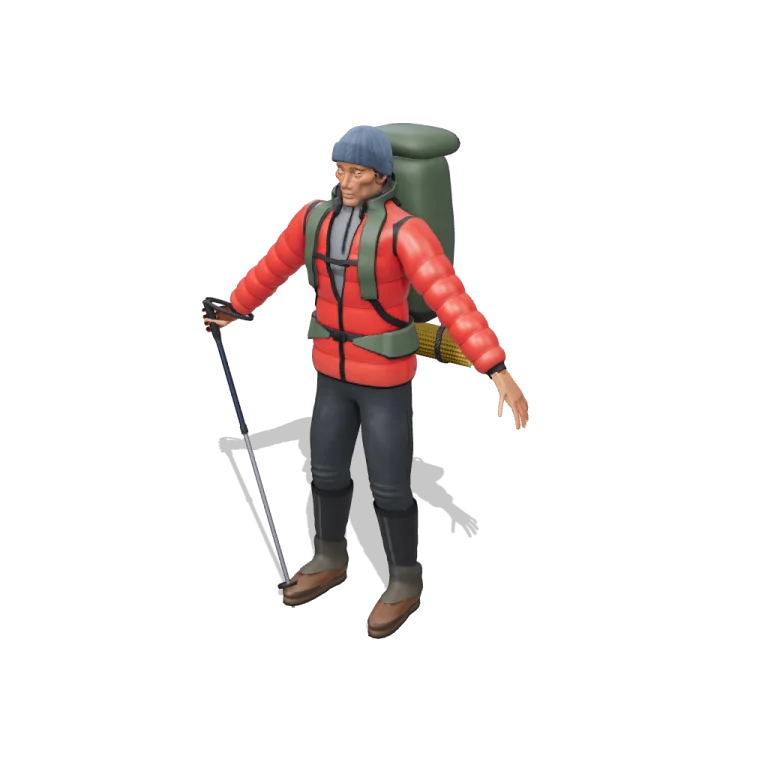
Left rail: colours and the 3 knobs the agent wrote into this model — they rebuild the geometry and go into your download. Right rail: looks for the viewer. Drag to orbit, scroll to zoom.
- Triangles
- 145,584
- Vertices
- 135,882
- Meshes · materials
- 18 · 18
- Size (W × H × D)
- 1.3 m × 1.7 m × 65 cm
- File
- GLB · 15.7 MB
- Animation
- Static
- Style
- Realistic
- Collection
- Characters
Palette · named materials
- skin#986246
- jacket#B02823
- fleece#5A5E62
- beanie#404F62
- trousers#2A2E32
- gaiters#212325
- boot-leather#543723
- backpack#404A3D
- sleeping-mat#C6A036
- pole#383F50
- hair#1E1815
Use it
import { GLTFLoader } from "three/addons/loaders/GLTFLoader.js";

const gltf = await new GLTFLoader().loadAsync(
  "https://assets.stoicsoft.com/1designtool/3d/models/trekker/3dd7e54c0b/model.glb"
);
scene.add(gltf.scene); // metres, +Y up, front faces +Z
How it was made
The brief given to 1DesignTool's “3D object” template:
A realistic full-body 3D character: a Nepali man in his early 30s, lean and wiry, 168 cm tall. Dark brown eyes, high cheekbones, light stubble, wind-burned light brown skin with visible pores and chapped lips. Short black hair under a knitted wool beanie, modelled as hair cards. Clothing: a red insulated down jacket half unzipped over a grey fleece, a large hiking backpack with a rolled sleeping mat strapped on, dark softshell trousers, gaiters over brown leather hiking boots, and a single trekking pole held in one hand. No brand marks on any gear. Pose: neutral A-pose, arms at 45 degrees, fingers slightly spread, feet shoulder-width apart, neutral facial expression, mouth closed. Technical: 120,000 to 150,000 triangles total, with density concentrated in the face, hands and clothing folds. Clean quad-dominant topology with edge loops around the eyes, mouth, shoulders, elbows, knees and fingers so it deforms well when rigged. Separate meshes for body, eyes, teeth, hair and each clothing layer. Real-world scale in metres, origin at ground level between the feet. PBR textures at 4K: base colour, normal, roughness, metallic, ambient occlusion. No baked lighting or shadows in the base colour. No logos, brand names or readable text anywhere.
- Agent: Claude Code · Claude Opus 5.5 in 1DesignTool
- Generation: 75.62M tokens (98% cached) · ≈ $30.07 at API prices · 5-hour plan +67%
- Direction: Realistic · family characters
- three-check PASS · glb-lint PASS
Named parts · 14
- Trekker
- Body
- Eyes
- Teeth
- Hair
- Beanie
- Fleece
- Down jacket
- Softshell trousers
- Gaiters
- Hiking boots
- Backpack
- Sleeping mat
- Trekking pole
Note: Triangles: 145,584 in the GLB (13 meshes, 18 primitives, 18 materials, 42 textures). By part: body 64,800 (sculpted head and neck 39,936 at three Catmull-Clark levels, two posed hands 19,584, torso/limbs/feet 5,280 subdivided once because they sit under the clothes), jacket 23,804 (including zipper teeth and slider), fleece 10,508 (including quarter-zip), trousers 9,216, backpack and straps 8,544 (including buckles), beanie 5,568, boots 5,524 (modelled lugs), gaiters 4,528 (hooks and cord locks), eyes 4,416, mat 3,384, teeth 2,496, pole 1,504, hair cards 1,292. Height: overall bounds 0 to 1.729 m, including the beanie, the pack lid and 2.8 cm boot soles. The man is 1.68 m anatomically, with feet exactly on y = 0 and the origin between the feet. Topology: the body, head, hands and every garment shell are quad cages subdivided with Catmull-Clark. They have built-in edge loops: inset loops around both eye openings (with a lid-margin strip) and the closed lip seam, three-ring loops at the shoulders, elbows, knees and every finger knuckle. Triangles appear only at the beanie crown fan, eyeball poles, boot tread caps and teeth fills, so 99.6% of faces (72,646 quads, 292 other faces) are quads before the export triangulates them, since glTF has no quads. Honest limits: the torso/limb surface is one continuous mesh, but the head-and-neck shell and each hand are separate continuous shells inside the same body mesh. They overlap, unwelded, under the fleece collar and the jacket cuffs. The face is a procedural SDF sculpt (eye sockets, lids, nose, lips, high cheekbones), not a scan, so its likeness is generic and the ears are simplified and mostly under the beanie. Nothing is rigged or skinned and there are no blend shapes: the A-pose, the relaxed spread left hand and the right hand closed around the pole grip (fingers solved to wrap the grip) are static. Cloth folds, down-jacket baffles and the half-unzipped front are sculpted, not simulated. Every garment has real thickness, but the jacket lining is modelled only as a band near the openings, because the rest of the inside is never visible. Hair cards cover the sideburns, nape, temples, brows and lashes. The scalp hair under the beanie and the light stubble are painted into the skin maps (base colour, normal, roughness) rather than built as cards or a shell. The cornea is a transmissive clear surface with constant factors and no texture maps, and the teeth sit behind closed lips. There is no subsurface scattering, because skin is standard PBR in glTF. Textures: everything is procedural at build time (tools/gen-textures.mjs), using seeded noise only. It covers pores, freckles, wind-burn, chapped lips, stubble, nails, knuckle and palm creases, ripstop and baffle stitching, fleece pile, cable and rib knit, cordura, leather grain, rubber, egg-crate foam, anodised metal and mud/dust/wear. Maps are authored at 4096x4096 for 14 materials x 5 maps (base colour, normal, roughness, metallic, AO), giving 70 PNGs in dist/textures-4k/<material>_<map>.png named by material role ('skin' covers the body mesh's head, hands and body). AO is per-vertex ray-traced occlusion (40 rays across all opaque parts) times procedural micro-occlusion. Base colour has no baked lighting. The GLB embeds 2048x2048 copies: base colour as JPEG (hair as PNG with alpha), normal as JPEG, and roughness/metallic/AO packed into one ORM JPEG as glTF intends. The GLB is 16.4 MB. The UV atlas is computed at default parameters and saved (assets/textures/atlas.json), so the height, build and jacketOpen parameters keep UVs aligned. The AO bake reflects the default parameters. At jacketOpen extremes a few new lining/rim faces fall outside the saved atlas and sample a corner texel. No logos, brand names or readable text anywhere. Checks: three-check PASS (22/22, including GLB reload with all 14 part ids). glb-lint has 0 errors. Its verdict is PASS against the harvested quality contract (7 visual/runtime items it cannot decide from file structure) and UNVERIFIED without it. Its 4 warnings are intentional: the material count and triangle budget against the mannequin-figure defaults (overridden in the plan), duplicate hardware materials created by the per-mesh export, and nested clothing layers whose bounding boxes overlap by design.
About the Trekker 3D model
Trekker is a free realistic 3D model from the Characters set. It measures 1.3 m × 1.7 m × 65 cm (W × H × D) at real-world scale and is built from 145,584 triangles across 18 meshes, with 14 named parts. Download the 15.7 MB GLB and drop it into three.js, React Three Fiber, Godot or Blender — free for commercial use, no attribution required.
- Is the Trekker 3D model free for commercial use?
- Yes. It is free under the 1DesignTool 3D library license: use it in personal and commercial work — games, apps, websites, renders, ads and client projects — and modify it as you like, with no credit required. What you can't do is re-sell or re-distribute the file on its own or inside a model pack.
- What file format is it, and how big is it?
- A single binary glTF 2.0 file (.glb), 15.7 MB: 145,584 triangles, 135,882 vertices and 18 materials, modelled in metres at 1.3 m × 1.7 m × 65 cm.
- Can I animate Trekker?
- It ships as a static mesh. Its 14 named parts are separate nodes, so you can move or animate each one in your engine.
- Which engines and tools can open it?
- Anything that reads glTF 2.0. three.js, React Three Fiber, Babylon.js, Godot 4 and Blender import the GLB directly; Unity and Unreal Engine load it through their glTF importers. The snippets above show the exact code for three.js, React Three Fiber, Godot and Blender.
- How was the Trekker 3D model made?
- Claude Code (Claude Opus 5.5) generated it inside 1DesignTool's 3D template from a written brief, then the design kit's checks verified the geometry and the GLB before it was published. You can make your own the same way with 1DesignTool.
More like this
All of Characters →
Yoga Instructor
Characters144.9k tris

Lab Scientist
Characters146.1k tris

Painter
Characters145.8k tris

Retired Teacher
Characters149.6k tris

Line Cook
Characters149.2k tris

Firefighter
Characters146.6k tris

Market Vendor
Characters140.8k tris

Workshop Mechanic
Characters149.9k tris
Free under the 1DesignTool 3D library license. Model #37 of 1125.