Steam Locomotive
A 4-6-2 Pacific express steam locomotive and six-wheel tender in deep green and black with brass bands, with a riveted boiler, hinged smokebox door and full Walschaerts valve gear. The driving wheels turn in a seamless 4-second loop with every rod and link following its pin.
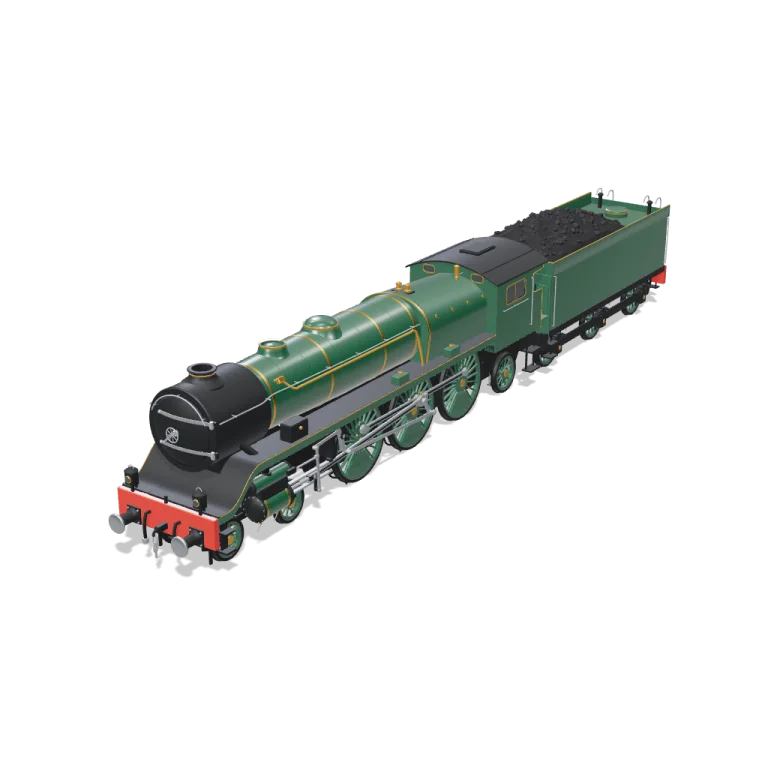
Left rail: colours and the 4 knobs the agent wrote into this model — they rebuild the geometry and go into your download. Right rail: looks for the viewer. Drag to orbit, scroll to zoom.
- Triangles
- 188,334
- Vertices
- 179,736
- Meshes · materials
- 106 · 106
- Size (W × H × D)
- 2.9 m × 4.1 m × 23 m
- File
- GLB · 5.4 MB
- Animation
- scene-motion · 4.0s
- Style
- Product
- Collection
- Hero Props
Palette · named materials
- body#1d4a34
- trim#141619
- brass#c99a45
- metal#a9aeb3
- accent#a8281d
- glass#1c2a2f
- coal#141417
Use it
import { GLTFLoader } from "three/addons/loaders/GLTFLoader.js";

const gltf = await new GLTFLoader().loadAsync(
  "https://assets.stoicsoft.com/1designtool/3d/models/steam-locomotive/fecaae44b1/model.glb"
);
scene.add(gltf.scene); // metres, +Y up, front faces +Z

const mixer = new THREE.AnimationMixer(gltf.scene);
gltf.animations.forEach((clip) => mixer.clipAction(clip).play());
// in your loop: mixer.update(delta)
How it was made
The brief given to 1DesignTool's “3D object” template:
A 4-6-2 steam locomotive with tender (~22 m) in deep green and black with brass bands: riveted boiler, smokebox door with hinges and dart handle, chimney, steam and sand domes, whistle, full valve gear (connecting rods, crossheads, Walschaerts linkage) on spoked driving wheels with counterweights, bogie and trailing wheels, cab with windows and handrails, tender with coal load and ladders. Drivers turn with linked rods in a baked seamless loop.
- Agent: Claude Code · Claude Opus 5.5 in 1DesignTool
- Direction: Product · family vehicles
- three-check PASS · glb-lint PASS
Named parts · 39
- Steam locomotive
- Frames, running plate and buffer beams
- Cylinders, valve chests and slide bars
- Boiler, firebox, bands and handrails
- Smokebox, door, hinges and lamps
- Chimney
- Steam dome, sand dome, safety valves and whistle
- Cab
- Leading bogie frame
- Brake gear and sand pipes
- Bogie wheels front
- Bogie wheels rear
- Leading driving wheels
- Main driving wheels
- Trailing driving wheels
- Trailing truck wheels
- Coupling rod left
- Coupling rod right
- Connecting rod left
- Connecting rod right
- Crosshead and piston rod left
- Crosshead and piston rod right
- Combination lever left
- Combination lever right
- Radius rod left
- Radius rod right
- Expansion link left
- Expansion link right
- Eccentric rod left
- Eccentric rod right
- Valve rod left
- Valve rod right
- Drawbar, fall plate and hoses
- Tender frames, axleboxes, springs and buffers
- Tender tank, coping, lockers, ladders and handrails
- Coal load
- Tender wheels front
- Tender wheels middle
- Tender wheels rear
Note: 188,334 triangles in the GLB, 106 meshes (one per role per part). Real scale in metres: about 22.8 m over buffers, 2.9 m wide, 4.15 m tall, standard gauge, front (smokebox) toward +Z, origin at bottom centre with the wheel flanges on y = 0 (no track included). The 4 s clip 'scene-motion' turns the drivers two whole turns and the smaller wheels whole turns rounded to their diameter, so the smaller wheels very slightly slip rather than roll exactly. The valve gear is a solved linkage: every rod keeps its length through the loop. All four params change the exported geometry or clip; cutoff moves the die in the expansion link, so it changes the valve-gear motion only. The exporter writes a material copy per mesh, but there are only seven role names (body, trim, brass, metal, accent, glass, coal), so merge by name if your engine wants seven materials. glb-lint has 0 errors. Its warnings are the plan's declared triangle/draw-call overrides for the Hero Props target, the per-mesh material copies, its 0.15 m product reference scale, and overlap/detached heuristics for single-mesh rods and the coal load, all of which were checked in captures. design-plan.md keeps the hyphenated part ids. plan-check's id regex rejects hyphens, so it was verified as PASS on a de-hyphenated copy.
About the Steam Locomotive 3D model
Steam Locomotive is a free animated PBR 3D model from the Hero Props set. It measures 2.9 m × 4.1 m × 23 m (W × H × D) at real-world scale and is built from 188,334 triangles across 106 meshes, with 39 named parts and a baked animation (4.0 s). Download the 5.4 MB GLB and drop it into three.js, React Three Fiber, Godot or Blender — free for commercial use, no attribution required.
- Is the Steam Locomotive 3D model free for commercial use?
- Yes. It is free under the 1DesignTool 3D library license: use it in personal and commercial work — games, apps, websites, renders, ads and client projects — and modify it as you like, with no credit required. What you can't do is re-sell or re-distribute the file on its own or inside a model pack.
- What file format is it, and how big is it?
- A single binary glTF 2.0 file (.glb), 5.4 MB: 188,334 triangles, 179,736 vertices and 106 materials, modelled in metres at 2.9 m × 4.1 m × 23 m.
- Is Steam Locomotive animated?
- Yes — the GLB carries a baked animation (4.0 s), ready to play with any glTF animation mixer.
- Which engines and tools can open it?
- Anything that reads glTF 2.0. three.js, React Three Fiber, Babylon.js, Godot 4 and Blender import the GLB directly; Unity and Unreal Engine load it through their glTF importers. The snippets above show the exact code for three.js, React Three Fiber, Godot and Blender.
- How was the Steam Locomotive 3D model made?
- Claude Code (Claude Opus 5.5) generated it inside 1DesignTool's 3D template from a written brief, then the design kit's checks verified the geometry and the GLB before it was published. You can make your own the same way with 1DesignTool.
More like this
All of Hero Props →
Gothic Cathedral
Hero Props2156.2k tris

Lever Espresso Bar
Hero Props129.1k tris

Victorian Dollhouse
Hero Props150.1k tris

Ferris Wheel
Hero Props132.9k tris

Space Shuttle Stack
Hero Props170k tris

Cuckoo Clock
Hero Props118.7k tris

Chess Set
Hero Props146.6k tris

Industrial Robot Arm
Hero Props144.5k tris
Free under the 1DesignTool 3D library license. Model #7 of 1930.