Temple
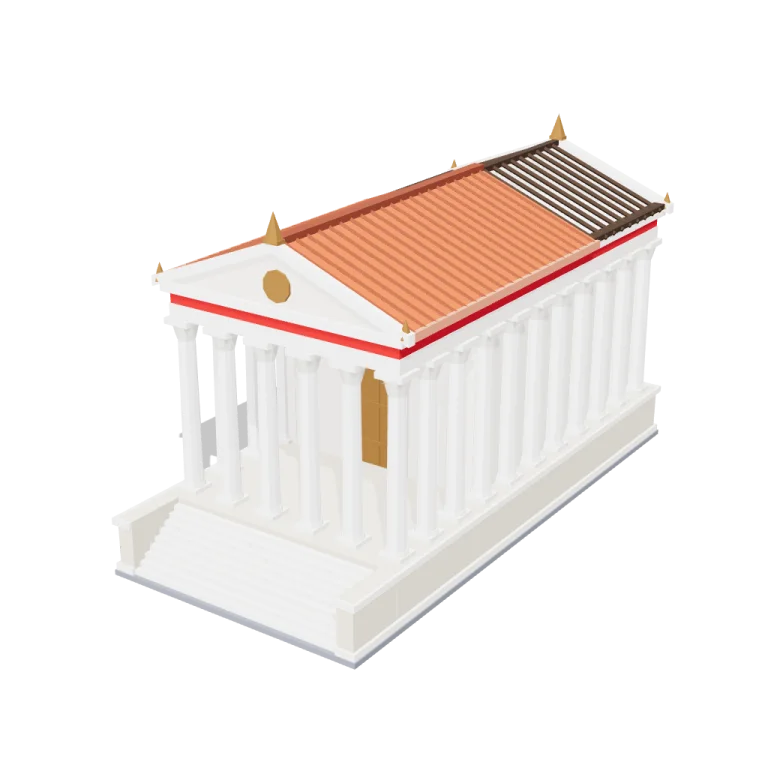
A low-poly Roman forum temple: six Corinthian columns across a deep porch on a high podium with a frontal stair, a cella wrapped in engaged half-columns, a red-painted frieze and a terracotta tiled roof. One knob takes it from intact to a weathered ruin.
Left rail: colours and the 4 knobs the agent wrote into this model — they rebuild the geometry and go into your download. Right rail: looks for the viewer. Drag to orbit, scroll to zoom.
- Triangles
- 6,288
- Vertices
- 18,864
- Meshes · materials
- 21 · 21
- Size (W × H × D)
- 16 m × 20 m × 34 m
- File
- GLB · 460 KB
- Animation
- Static
- Style
- Low-poly
- Collection
- Roman Forum
Palette · named materials
- marble white — column bases and capitals, mouldings, stair, architrave (body)#f4f1ec
- marble white light — column shafts, cornices, raking cornices, door frame (trim)#f9f8f6
- marble white dark — podium core (base)#d7cebc
- warm white — cella walls and tympana (wall)#f2ede2
- mid grey — footing course (base)#7d828c
- imperial red — painted frieze (accent)#c32222
- bronze — doors, tympanum shields, acroteria (accent)#916430
- terracotta — roof tiles (roof)#be5937
- terracotta dark — cover-tile ribs and ridge (roof trim)#823d26
- terracotta light — antefix line along the eaves (roof trim)#d08971
- dark wood — exposed rafters, ridge beam and wall plates where tiles are stripped (structure)#3d2a1c
Use it
import { GLTFLoader } from "three/addons/loaders/GLTFLoader.js";

const gltf = await new GLTFLoader().loadAsync(
  "https://assets.stoicsoft.com/1designtool/3d/models/roman-forum-temple/01e06fe128/model.glb"
);
scene.add(gltf.scene); // metres, +Y up, front faces +Z
How it was made
The brief given to 1DesignTool's “3D object” template:
Temple for the Roman Forum kit. Design it as one clear asset at believable real-world scale for that setting (state the size in metres in meta.notes), with its main parts modelled and named, readable at thumbnail size and from every orbit angle. This is one part of the Roman Forum kit (Low-poly style, flat-lowpoly direction): The civic heart of an imperial city. Use ONLY the kit palette, by name: marble white #f4f1ec, terracotta #be5937, imperial red #c32222, bronze #916430, marble white dark #d7cebc, terracotta dark #823d26, marble white light #f9f8f6, terracotta light #d08971, soot black #1b1b22, warm white #f2ede2, mid grey #7d828c, dark wood #3d2a1c. Every material's `name` must be exactly the palette colour it uses — the GLB carries these names so the kit recolours as one; an unnamed material fails delivery. Kit knob: expose a param `intactOrRuined` (0–1, default 0.5) for the kit's "Intact or ruined" setting wherever it makes sense on this part, and keep that id.
- Agent: Claude Code · Claude Opus 5.5 in 1DesignTool
- Direction: Low-poly · family scenes
- three-check PASS · glb-lint PASS
Named parts · 10
- Temple
- Podium
- Front stair
- Front colonnade
- Cella
- Bronze doors
- Entablature
- Pediments
- Tiled roof
- Acroteria
Note: Size: 16.1 m wide (X) × 33.8 m long (Z, including the front stair) × 20.3 m tall to the apex acroterion (19 m to the ridge cap). The podium stands 3.4 m tall and the Corinthian columns are 10 m, set 2.7 m apart. The origin is at the bottom centre, the footing rests on y = 0, and the front (stair and porch) faces +Z. The GLB has 6,288 triangles in 21 meshes. It is static and carries no animation clip. Every material is named exactly after a kit palette colour; 11 of the 12 are used at the default (soot black is unused). The exporter writes one material per mesh, so a colour name can appear on several materials; recolour by name. intactOrRuined (the kit's 'Intact or ruined' knob): below 0.4 the temple is whole; from 0.4 to 0.7 the roof tiles are stripped from the back forward, exposing dark-wood rafters (at the default 0.5, the back third is stripped), with the acroteria gone from 0.55 and the bronze doors from 0.6; above 0.7 the roof, pediments and most of the entablature fall, columns and walls break to seeded heights, and drums lie on the podium. Only the three front-left columns stay standing under an entablature fragment, and a 'rubble' part is added. In that ruined range the doors, pediments, roof and acroteria parts are absent, so those ids exist only at lower values. podiumHeight, columnHeight and cellaBays reshape the building. Params are baked into the GLB at their defaults and change the geometry only when the scene is rebuilt in the viewer; the default was fully checked and the fully ruined state (1.0) was rendered as a spot check. glb-lint: 0 errors and 6 warnings, all expected: duplicate same-named materials from the per-mesh export (hence 21 materials over the direction's 10); deliberately non-indexed geometry for hard flat facets; nested sibling meshes (engaged columns in walls, capitals in the architrave); doors and acroteria flagged 'detached' because they touch other parts, not siblings; and a 20 m height against the direction's 1 m reference height. plan-check rejects only the hyphenated library part ids, because its regex allows no hyphen; the same plan with the slug de-hyphenated passes. three-check and the GLB reload keep all 10 ids.
About the Temple 3D model
Temple is a free low-poly 3D model from the Roman Forum set. It measures 16 m × 20 m × 34 m (W × H × D) at real-world scale and is built from 6,288 triangles across 21 meshes, with 10 named parts. Download the 460 KB GLB and drop it into three.js, React Three Fiber, Godot or Blender — free for commercial use, no attribution required.
- Is the Temple 3D model free for commercial use?
- Yes. It is free under the 1DesignTool 3D library license: use it in personal and commercial work — games, apps, websites, renders, ads and client projects — and modify it as you like, with no credit required. What you can't do is re-sell or re-distribute the file on its own or inside a model pack.
- What file format is it, and how big is it?
- A single binary glTF 2.0 file (.glb), 460 KB: 6,288 triangles, 18,864 vertices and 21 materials, modelled in metres at 16 m × 20 m × 34 m.
- Can I animate Temple?
- It ships as a static mesh. Its 10 named parts are separate nodes, so you can move or animate each one in your engine.
- Which engines and tools can open it?
- Anything that reads glTF 2.0. three.js, React Three Fiber, Babylon.js, Godot 4 and Blender import the GLB directly; Unity and Unreal Engine load it through their glTF importers. The snippets above show the exact code for three.js, React Three Fiber, Godot and Blender.
- How was the Temple 3D model made?
- Claude Code (Claude Opus 5.5) generated it inside 1DesignTool's 3D template from a written brief, then the design kit's checks verified the geometry and the GLB before it was published. You can make your own the same way with 1DesignTool.
More like this
All of Roman Forum →
Water flowing in the aqueduct
Roman Forum3,078 tris

Ox cart
Roman Forum5,528 tris

Litter
Roman Forum2,688 tris

Scroll racks
Roman Forum4,008 tris

Chariot
Roman Forum2,952 tris

Braziers
Roman Forum2,046 tris

Standards
Roman Forum1,688 tris

Fountain
Roman Forum1,844 tris
Free under the 1DesignTool 3D library license. Model #31 of 1157.