Hull plates
A transport rack of six curved, faceted starship hull plates standing upright on timber sleepers, each with crane lugs on top and stiffener ribs behind. A completion knob finishes the plates front to back, from bare steel through orange primer to white livery with a blue stripe.
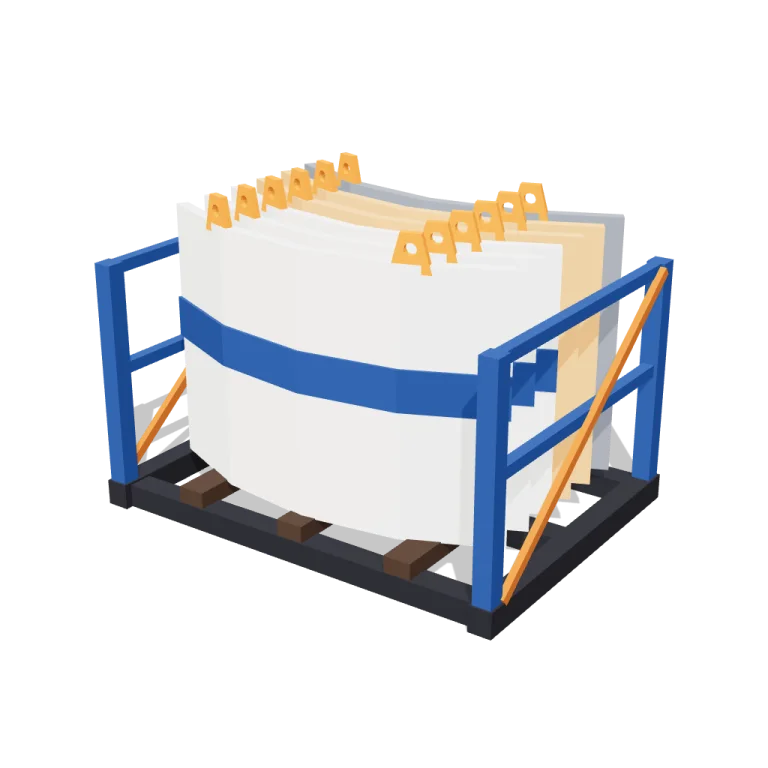
Left rail: colours and the 4 knobs the agent wrote into this model — they rebuild the geometry and go into your download. Right rail: looks for the viewer. Drag to orbit, scroll to zoom.
- Triangles
- 1,740
- Vertices
- 5,004
- Meshes · materials
- 51 · 51
- Size (W × H × D)
- 3.8 m × 2.8 m × 2.8 m
- File
- GLB · 220 KB
- Animation
- Static
- Style
- Low-poly
- Collection
- Orbital Shipyard
Palette · named materials
- painted plates#f4f1ec
- primer plates#eea668
- bare-steel plates#7d828c
- livery stripe, rack posts and rails#1b447e
- lifting lugs#ed7e1d
- stiffener ribs#b9bfc6
- diagonal braces#af590e
- rack skid#1b1b22
- sleepers#3d2a1c
Use it
import { GLTFLoader } from "three/addons/loaders/GLTFLoader.js";

const gltf = await new GLTFLoader().loadAsync(
  "https://assets.stoicsoft.com/1designtool/3d/models/orbital-shipyard-hull-plates/6b62763bb6/model.glb"
);
scene.add(gltf.scene); // metres, +Y up, front faces +Z
How it was made
The brief given to 1DesignTool's “3D object” template:
Hull plates for the Orbital Shipyard kit. Design it as one clear asset at believable real-world scale for that setting (state the size in metres in meta.notes), with its main parts modelled and named, readable at thumbnail size and from every orbit angle. This is one part of the Orbital Shipyard kit (Low-poly style, flat-lowpoly direction): Ships under construction in open space. Use ONLY the kit palette, by name: white #f4f1ec, orange #ed7e1d, deep space blue #1b447e, silver #b9bfc6, white dark #d7cebc, orange dark #af590e, white light #f9f8f6, orange light #eea668, soot black #1b1b22, warm white #f2ede2, mid grey #7d828c, dark wood #3d2a1c. Every material's `name` must be exactly the palette colour it uses — the GLB carries these names so the kit recolours as one; an unnamed material fails delivery. Kit knob: expose a param `shipCompletionStage` (0–1, default 0.5) for the kit's "Ship completion stage" setting wherever it makes sense on this part, and keep that id.
- Agent: Claude Code · Claude Opus 5.5 in 1DesignTool
- Generation: 1.64M tokens (92% cached) · ≈ $1.63 at API prices · 5-hour plan +6%
- Direction: Low-poly · family products
- three-check PASS · glb-lint PASS
Named parts · 10
- Hull plates
- Plates
- Stiffener ribs
- Livery stripes
- Lifting lugs
- Rack skid
- Timber sleepers
- Rack posts
- Side rails
- Braces
Note: Size at defaults: 3.81 m wide x 2.76 m tall x 2.80 m deep, including the crane lugs. Origin is at the bottom centre, resting on y = 0, and the painted convex face of the front plate faces +Z. 1740 triangles. Each plate is a 4-facet slice of a 3 m radius hull (6 m across, the same size as the kit's Hull sections): 3.2 m chord, 2.2 m tall, 0.1 m thick. shipCompletionStage finishes the plates front to back. Finished plates are white with a raised deep-blue stripe, the next ones are in orange-light primer and the rest are bare mid-grey steel (0 = all bare, 1 = all painted). The exported GLB is a snapshot at the default values (stage 0.5, 6 plates); the other params change the model only in the viewer. Static model with no animation clip. Each part carries two ids: the library id (orbital-shipyard-hull-plates.*) on an outer group and the plan id (hullplates.*) on the inner one. Material names are the exact kit palette names (9 colours). The exporter writes one material copy per mesh, so the GLB repeats those names across 51 materials. glb-lint reports 0 errors. Its overall verdict reads UNVERIFIED only because no requirements contract was supplied. It also gives 5 non-blocking heuristic warnings: material count and duplicates from the per-mesh copies; lugs and ribs flagged as detached because the plates they are embedded in sit in a sibling group; non-indexed flat-shaded extrusions; and height compared with a 1 m reference.
About the Hull plates 3D model
Hull plates is a free low-poly 3D model from the Orbital Shipyard set. It measures 3.8 m × 2.8 m × 2.8 m (W × H × D) at real-world scale and is built from 1,740 triangles across 51 meshes, with 10 named parts. Download the 220 KB GLB and drop it into three.js, React Three Fiber, Godot or Blender — free for commercial use, no attribution required.
- Is the Hull plates 3D model free for commercial use?
- Yes. It is free under the 1DesignTool 3D library license: use it in personal and commercial work — games, apps, websites, renders, ads and client projects — and modify it as you like, with no credit required. What you can't do is re-sell or re-distribute the file on its own or inside a model pack.
- What file format is it, and how big is it?
- A single binary glTF 2.0 file (.glb), 220 KB: 1,740 triangles, 5,004 vertices and 51 materials, modelled in metres at 3.8 m × 2.8 m × 2.8 m.
- Can I animate Hull plates?
- It ships as a static mesh. Its 10 named parts are separate nodes, so you can move or animate each one in your engine.
- Which engines and tools can open it?
- Anything that reads glTF 2.0. three.js, React Three Fiber, Babylon.js, Godot 4 and Blender import the GLB directly; Unity and Unreal Engine load it through their glTF importers. The snippets above show the exact code for three.js, React Three Fiber, Godot and Blender.
- How was the Hull plates 3D model made?
- Claude Code (Claude Opus 5.5) generated it inside 1DesignTool's 3D template from a written brief, then the design kit's checks verified the geometry and the GLB before it was published. You can make your own the same way with 1DesignTool.
More like this
All of Orbital Shipyard →
Rotating ring
Orbital Shipyard2,484 tris

Half-built frigate
Orbital Shipyard3,860 tris

Robotic arm
Orbital Shipyard1,524 tris

Tug ship
Orbital Shipyard3,184 tris

Cable reels
Orbital Shipyard4,052 tris

Signal lights
Orbital Shipyard1,124 tris

Thruster units
Orbital Shipyard2,456 tris

Welding sparks
Orbital Shipyard2,772 tris
Free under the 1DesignTool 3D library license. Model #1371 of 1941.