Shop houses
A low-poly terrace of three two-storey Lunar New Year shop houses with pastel upper facades, a covered five-foot-way arcade with red doors, couplets and hanging lanterns, black signboards with gold zodiac medallions, and a red tile roof between stepped fire gables.
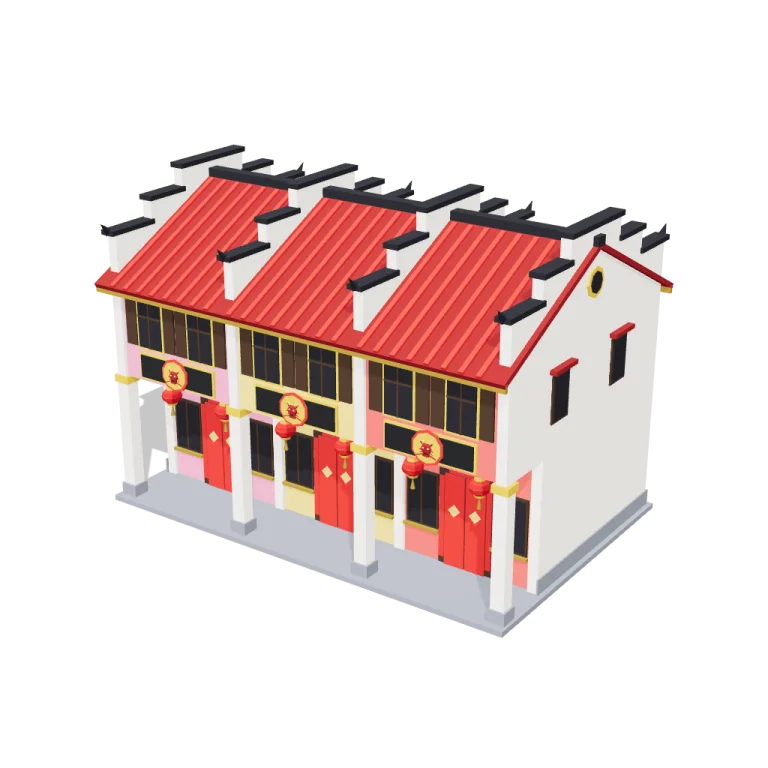
Left rail: colours and the 4 knobs the agent wrote into this model — they rebuild the geometry and go into your download. Right rail: looks for the viewer. Drag to orbit, scroll to zoom.
- Triangles
- 4,944
- Vertices
- 14,832
- Meshes · materials
- 39 · 39
- Size (W × H × D)
- 13 m × 9.6 m × 9.3 m
- File
- GLB · 502 KB
- Animation
- Static
- Style
- Low-poly
- Collection
- Lunar New Year Street
Palette · named materials
- accent#c32222
- trim#d0a225
- facadeA#e085a3
- sign#151619
- roof#821717
- trimDark#8f7019
- facadeC#db5757
- facadeB#debd63
- coping#1b1b22
- wall#f2ede2
- stone#7d828c
- wood#3d2a1c
Use it
import { GLTFLoader } from "three/addons/loaders/GLTFLoader.js";

const gltf = await new GLTFLoader().loadAsync(
  "https://assets.stoicsoft.com/1designtool/3d/models/lunar-new-year-street-shop-houses/acd9535c04/model.glb"
);
scene.add(gltf.scene); // metres, +Y up, front faces +Z
How it was made
The brief given to 1DesignTool's “3D object” template:
Shop houses for the Lunar New Year Street kit. Design it as one clear asset at believable real-world scale for that setting (state the size in metres in meta.notes), with its main parts modelled and named, readable at thumbnail size and from every orbit angle. This is one part of the Lunar New Year Street kit (Low-poly style, flat-lowpoly direction): A street dressed for the festival. Use ONLY the kit palette, by name: red #c32222, gold #d0a225, peach blossom pink #e085a3, black #151619, red dark #821717, gold dark #8f7019, red light #db5757, gold light #debd63, soot black #1b1b22, warm white #f2ede2, mid grey #7d828c, dark wood #3d2a1c. Every material's `name` must be exactly the palette colour it uses — the GLB carries these names so the kit recolours as one; an unnamed material fails delivery. Kit knob: expose a param `zodiacAnimal` (0–1, default 0.5) for the kit's "Zodiac animal" setting wherever it makes sense on this part, and keep that id.
- Agent: Claude Code · Claude Opus 5.5 in 1DesignTool
- Generation: 9.49M tokens (97% cached) · ≈ $5.08 at API prices · 5-hour plan +10%
- Direction: Low-poly · family scenes
- three-check PASS · glb-lint PASS
Named parts · 13
- Shop houses
- Plinth and five-foot way
- Body walls
- Fire gables
- Upper facades
- Windows and shutters
- Arcade columns
- Shopfronts
- Couplets
- Signboards
- Zodiac medallions
- Lanterns
- Roof
Note: Real-world street scale. The default terrace has three 4.2 m wide units, 8 m deep, giving a 12.6 m frontage. The ground floor is 3.8 m and the upper floor 3.0 m. A 1.8 m deep five-foot-way arcade runs under the upper floor. Overall the model is 13.3 m wide including the roof verge, 9.62 m tall to the ridge cap and 9.28 m deep including the eaves. The gable steps reach 9.5 m. Units are metres, +Y is up and the front (+Z) is the arcade side. The origin is at the bottom centre of the plinth, which rests exactly on y = 0. The model has 4,944 triangles and 39 meshes. It is a static asset with no animation clip. zodiacAnimal ('Zodiac animal') reshapes the relief head on the gold medallion on every signboard: 0 = ox, 0.5 = dragon, 1 = rabbit, and values in between blend. unitCount sets 2–4 units, and the facade colours cycle pink, gold light and red light. unitWidth sets each frontage, and doors, windows, shutters and signboards scale with it. upperFloors adds a second upper storey and raises the roof and gables with it; the largest setting is about 7,300 triangles. Part ids use the slug with its hyphens removed ('lunarnewyearstreetshophouses.*') because the kit's part-id schema does not allow hyphens. Every material is flat-shaded, metalness 0, roughness 0.9–1.0 and untextured, and each is named exactly after its palette colour (all 12 kit colours are used). The exporter writes one material instance per merged mesh, so the GLB carries repeated copies of those 12 palette-named materials; dedupe them by name if needed. Signboards and couplets are deliberately blank, with no text. glb-lint reports 0 errors. Its verdict is UNVERIFIED only because no requirements contract was supplied. The 6 warnings are heuristic and expected: material copies above the direction default of 10, non-indexed primitives (deliberate flat facets), sibling overlaps (trim is intentionally embedded in walls), bounding-box 'detached' flags on capitals, cornices, hoods and tassels that do touch their supports, and the 9.6 m height, which is the intended real-world scale. The ground disc and light rig in the preview are viewer staging only and are not part of the GLB.
About the Shop houses 3D model
Shop houses is a free low-poly 3D model from the Lunar New Year Street set. It measures 13 m × 9.6 m × 9.3 m (W × H × D) at real-world scale and is built from 4,944 triangles across 39 meshes, with 13 named parts. Download the 502 KB GLB and drop it into three.js, React Three Fiber, Godot or Blender — free for commercial use, no attribution required.
- Is the Shop houses 3D model free for commercial use?
- Yes. It is free under the 1DesignTool 3D library license: use it in personal and commercial work — games, apps, websites, renders, ads and client projects — and modify it as you like, with no credit required. What you can't do is re-sell or re-distribute the file on its own or inside a model pack.
- What file format is it, and how big is it?
- A single binary glTF 2.0 file (.glb), 502 KB: 4,944 triangles, 14,832 vertices and 39 materials, modelled in metres at 13 m × 9.6 m × 9.3 m.
- Can I animate Shop houses?
- It ships as a static mesh. Its 13 named parts are separate nodes, so you can move or animate each one in your engine.
- Which engines and tools can open it?
- Anything that reads glTF 2.0. three.js, React Three Fiber, Babylon.js, Godot 4 and Blender import the GLB directly; Unity and Unreal Engine load it through their glTF importers. The snippets above show the exact code for three.js, React Three Fiber, Godot and Blender.
- How was the Shop houses 3D model made?
- Claude Code (Claude Opus 5.5) generated it inside 1DesignTool's 3D template from a written brief, then the design kit's checks verified the geometry and the GLB before it was published. You can make your own the same way with 1DesignTool.
More like this
All of Lunar New Year Street →
Gate arch
Lunar New Year Street2,848 tris

Temple front
Lunar New Year Street6,378 tris

Flower market
Lunar New Year Street7,416 tris

Stage
Lunar New Year Street3,396 tris

Street tiles
Lunar New Year Street3,360 tris

Lanterns
Lunar New Year Street2,340 tris

Blossom trees
Lunar New Year Street5,584 tris

Red banners
Lunar New Year Street2,164 tris
Free under the 1DesignTool 3D library license. Model #9 of 794.