Giant cutlery
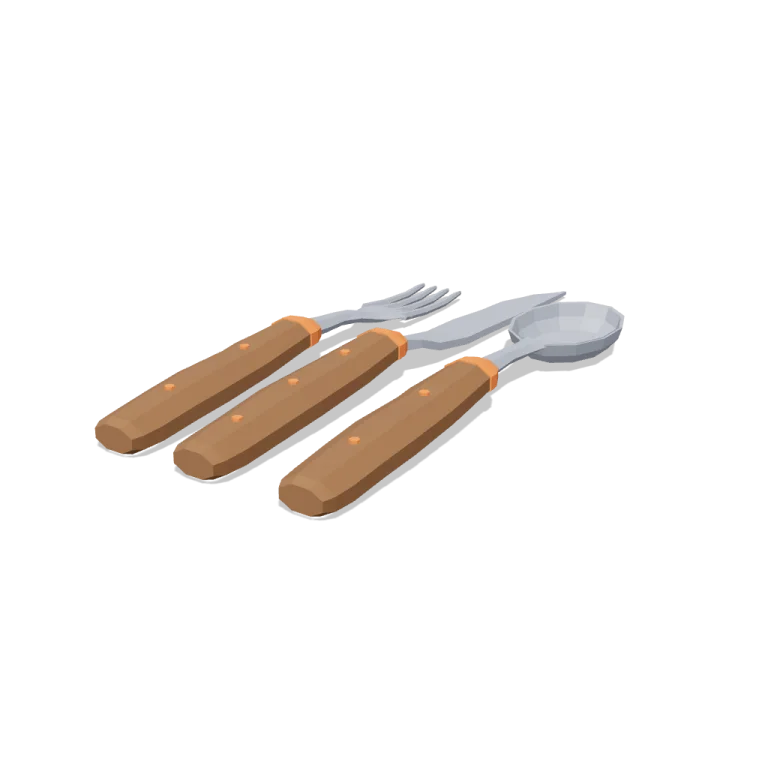
A giant's fork, knife and spoon laid side by side like a place setting, with chunky riveted wooden handles, copper bolsters and faceted steel heads. Low-poly and built at giant scale, so tiny people can walk between the fork tines.
Left rail: colours and the 4 knobs the agent wrote into this model — they rebuild the geometry and go into your download. Right rail: looks for the viewer. Drag to orbit, scroll to zoom.
- Triangles
- 1,482
- Vertices
- 4,446
- Meshes · materials
- 21 · 3
- Size (W × H × D)
- 1.1 m × 21 cm × 2.3 m
- File
- GLB · 133 KB
- Animation
- Static
- Style
- Low-poly
- Collection
- Giant's Kitchen
Palette · named materials
- handle#6b4a2e
- steel#7d828c
- trim#b8602e
Use it
import { GLTFLoader } from "three/addons/loaders/GLTFLoader.js";

const gltf = await new GLTFLoader().loadAsync(
  "https://assets.stoicsoft.com/1designtool/3d/models/giants-kitchen-giant-cutlery/57f0d1fe48/model.glb"
);
scene.add(gltf.scene); // metres, +Y up, front faces +Z
How it was made
The brief given to 1DesignTool's “3D object” template:
Giant cutlery for the Giant's Kitchen kit. Design it as one clear asset at believable real-world scale for that setting (state the size in metres in meta.notes), with its main parts modelled and named, readable at thumbnail size and from every orbit angle. This is one part of the Giant's Kitchen kit (Low-poly style, flat-lowpoly direction): Tiny people on a huge table. Use ONLY the kit palette, by name: wood brown #6b4a2e, enamel white #f4f1ec, copper #b8602e, tomato red #c32222, wood brown dark #362517, enamel white dark #d7cebc, wood brown light #9b704b, enamel white light #f9f8f6, soot black #1b1b22, warm white #f2ede2, mid grey #7d828c, dark wood #3d2a1c. Every material's `name` must be exactly the palette colour it uses — the GLB carries these names so the kit recolours as one; an unnamed material fails delivery. Kit knob: expose a param `scaleRatio` (0–1, default 0.5) for the kit's "Scale ratio" setting wherever it makes sense on this part, and keep that id.
- Agent: Claude Code · Claude Opus 5.5 in 1DesignTool
- Generation: 5.34M tokens (96% cached) · ≈ $3.48 at API prices · 5-hour plan +7%, weekly plan +0%
- Direction: Low-poly · family products
- three-check PASS · glb-lint PASS
Named parts · 18
- Giant cutlery
- Fork
- Fork handle
- Fork rivets
- Fork bolster
- Fork neck and palm
- Fork tines
- Knife
- Knife handle
- Knife rivets
- Knife bolster
- Knife blade
- Spoon
- Spoon handle
- Spoon rivets
- Spoon bolster
- Spoon neck
- Spoon bowl
Note: Size at the default scaleRatio 0.5 (10x human scale): 1.11 m wide x 0.21 m tall x 2.32 m long. The knife is 2.32 m, the fork 2.0 m and the spoon 1.98 m. scaleRatio sets the giant factor linearly from 6x (0, a 1.39 m knife) to 14x (1, a 3.25 m knife). The GLB is exported at the defaults (4 tines, 0.12 m gap, no fan); the params only change the model in the 1designtool viewer. The handles face +Z (front), the heads point to -Z, and the origin is at the bottom centre on y = 0. Each piece arches like real cutlery, so only the handle end and the head touch the table. The three materials are named after the kit palette colours they use: 'wood brown' for the handles, 'mid grey' for the steel and 'copper' for the bolsters and rivets. All are flat-shaded, with metalness 0 and no textures. The mesh is non-indexed with flat normals, so the facets look the same in any engine. Rivet heads and fork tine roots are deliberately sunk into the handle and palm. Each piece sits under a placement node (pivot.fork, pivot.knife, pivot.spoon) that applies the gap and fan. glb-lint reports 0 errors (its overall verdict reads UNVERIFIED only because no requirements contract was supplied); its heuristic warnings (non-indexed mesh, rivets and tines 'detached' from siblings, 0.21 m height vs a 1 m reference) are all intended.
More like this
All of Giant's Kitchen →
Sink lake
Giant's Kitchen1,346 tris

Shelf cliffs
Giant's Kitchen1,600 tris

Table top
Giant's Kitchen2,656 tris

Teacup houses
Giant's Kitchen4,748 tris

Stove range
Giant's Kitchen1,660 tris

Bread loaf hills
Giant's Kitchen1,098 tris

Rope ladders
Giant's Kitchen2,804 tris

Fruit boulders
Giant's Kitchen1,207 tris
Free under the 1DesignTool 3D library license. Model #55 of 485.