Lollipop trees
A Candy Land grove of three giant lollipop trees: swirled candy crowns (two flat pinwheel discs and one round swirl ball) on striped candy-stick trunks with mint leaves, each planted in a chocolate fudge mound.
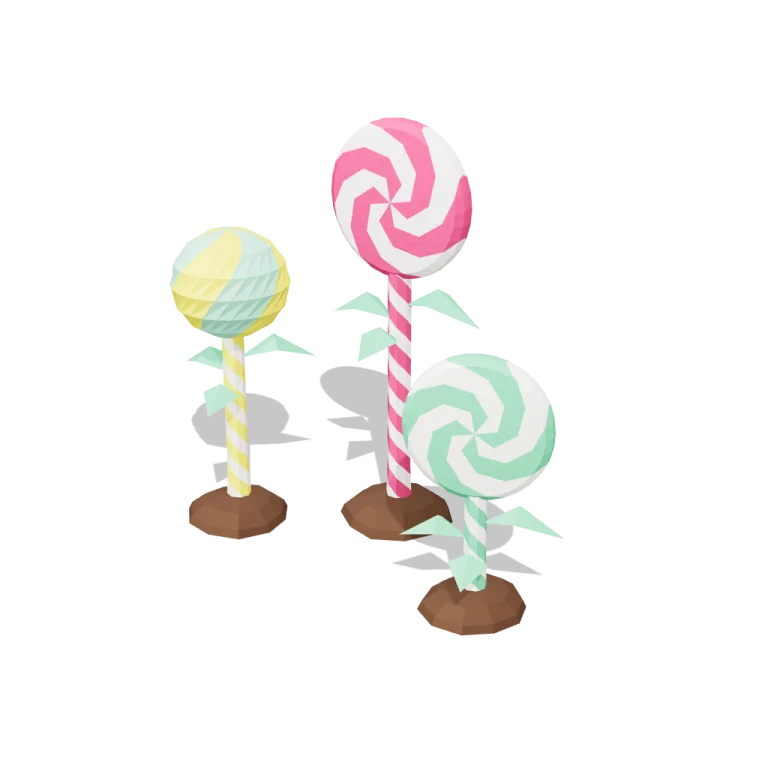
Left rail: colours and the 4 knobs the agent wrote into this model — they rebuild the geometry and go into your download. Right rail: looks for the viewer. Drag to orbit, scroll to zoom.
- Triangles
- 3,432
- Vertices
- 10,296
- Meshes · materials
- 18 · 18
- Size (W × H × D)
- 3.4 m × 3.0 m × 1.8 m
- File
- GLB · 260 KB
- Animation
- Static
- Style
- Low-poly
- Collection
- Candy Land
Palette · named materials
- base#d14775
- trim#f2ede2
- accent#f0e142
- accent#90d5b3
- foliage#59c08c
- earth#51341f
Use it
import { GLTFLoader } from "three/addons/loaders/GLTFLoader.js";

const gltf = await new GLTFLoader().loadAsync(
  "https://assets.stoicsoft.com/1designtool/3d/models/candy-land-lollipop-trees/e82203a2a0/model.glb"
);
scene.add(gltf.scene); // metres, +Y up, front faces +Z
How it was made
The brief given to 1DesignTool's “3D object” template:
Lollipop trees for the Candy Land kit. Design it as one clear asset at believable real-world scale for that setting (state the size in metres in meta.notes), with its main parts modelled and named, readable at thumbnail size and from every orbit angle. This is one part of the Candy Land kit (Low-poly style, flat-lowpoly direction): A world you could eat. Use ONLY the kit palette, by name: bubblegum pink #e085a3, mint #90d5b3, chocolate #51341f, lemon #f0e142, bubblegum pink dark #d14775, mint dark #59c08c, bubblegum pink light #eec4d2, mint light #c9e8d9, soot black #1b1b22, warm white #f2ede2, mid grey #7d828c, dark wood #3d2a1c. Every material's `name` must be exactly the palette colour it uses — the GLB carries these names so the kit recolours as one; an unnamed material fails delivery. Kit knob: expose a param `flavourPalette` (0–1, default 0.5) for the kit's "Flavour palette" setting wherever it makes sense on this part, and keep that id.
- Agent: Claude Code · Claude Opus 5.5 in 1DesignTool
- Generation: 3.84M tokens (95% cached) · ≈ $2.89 at API prices · 5-hour plan +6%
- Direction: Low-poly · family scenes
- three-check PASS · glb-lint PASS
Named parts · 28
- Lollipop trees
- Tall pinwheel tree
- Tree 1 fudge mound
- Tree 1 lollipop crown
- Tree 1 crown swirl a
- Tree 1 crown swirl b
- Tree 1 candy-stick trunk
- Tree 1 trunk stick
- Tree 1 trunk stripes
- Tree 1 leaves
- Ball tree
- Tree 2 fudge mound
- Tree 2 lollipop crown
- Tree 2 crown swirl a
- Tree 2 crown swirl b
- Tree 2 candy-stick trunk
- Tree 2 trunk stick
- Tree 2 trunk stripes
- Tree 2 leaves
- Small pinwheel tree
- Tree 3 fudge mound
- Tree 3 lollipop crown
- Tree 3 crown swirl a
- Tree 3 crown swirl b
- Tree 3 candy-stick trunk
- Tree 3 trunk stick
- Tree 3 trunk stripes
- Tree 3 leaves
Note: Real-world Candy Land scale: the grove is 3.00 m tall and 3.23 x 1.65 m in footprint (W x D). The tall pinwheel tree is 3.0 m with a 1.12 m crown, the ball tree 2.2 m and the small pinwheel tree 1.8 m. Metres, +Y up, front faces +Z, origin at the bottom centre of the grove's footprint. All three fudge mounds rest exactly on y = 0 (GLB bounds y 0.000-2.999). The model is static, with no animation clip. 3432 triangles, 18 meshes, no textures. Every surface is built from explicit triangles with baked face normals, so it stays flat-shaded in any engine. The swirls and trunk stripes are coloured facets of real geometry, split into two meshes per crown and trunk. Trunk ends are buried in the mound and crown, so they have no caps. The disc crowns face +Z (the small one is turned about 20 degrees), so they look like thin striped pills from the side. The ball tree is there so the grove reads from every angle. Material names are the Candy Land palette colour names verbatim (6 of the 12 at the default flavour), and the design role is stored on material.userData.role. The exporter writes one material per mesh, so names repeat in the GLB (18 records, 6 distinct names); recolouring by name still catches all of them. flavourPalette picks one of five all-palette schemes rather than blending, because a blend would leave the palette: 0-0.2 strawberry patch, 0.2-0.4 berry and mint, 0.4-0.6 mixed (default: pink/white pinwheel, lemon/mint ball, mint/white pinwheel), 0.6-0.8 citrus, 0.8-1 mint grove. treeCount (1-5; trees 4 and 5 fill in behind), treeHeight, crownSize and flavourPalette rebuild the model in the viewer, and the grove re-centres on its footprint. The downloadable GLB is the default build. The worst case (5 trees, 4 m, crown 1.25) is about 7,100 triangles by construction count, within the 10,000 budget. Part ids use the 'lollipoptrees.' root because the kit's part-id grammar does not allow hyphens. glb-lint reports 0 errors; its verdict reads UNVERIFIED only because no requirements contract is supplied at this stage. Its 6 warnings are expected: material count and duplicate names (the per-mesh copies above), non-indexed primitives (intended flat shading), sibling box overlap (swirl halves and stick/stripes nest by design), leaves flagged as detached (their bases are embedded in the trunk, which is a sibling group, not a sibling mesh), and the 3 m height versus the direction's 1 m reference. The viewer renders at exposure 0.85 rather than the direction's 1.05 so the pastels don't wash out; this is viewer-only. In a narrow portrait viewer the hero view crops the outer trees, because the view is framed for the landscape card. The viewer's ground disc and lights are staging only and sit outside exportGLB({scope:'model'}).
About the Lollipop trees 3D model
Lollipop trees is a free low-poly 3D model from the Candy Land set. It measures 3.4 m × 3.0 m × 1.8 m (W × H × D) at real-world scale and is built from 3,432 triangles across 18 meshes, with 28 named parts. Download the 260 KB GLB and drop it into three.js, React Three Fiber, Godot or Blender — free for commercial use, no attribution required.
- Is the Lollipop trees 3D model free for commercial use?
- Yes. It is free under the 1DesignTool 3D library license: use it in personal and commercial work — games, apps, websites, renders, ads and client projects — and modify it as you like, with no credit required. What you can't do is re-sell or re-distribute the file on its own or inside a model pack.
- What file format is it, and how big is it?
- A single binary glTF 2.0 file (.glb), 260 KB: 3,432 triangles, 10,296 vertices and 18 materials, modelled in metres at 3.4 m × 3.0 m × 1.8 m.
- Can I animate Lollipop trees?
- It ships as a static mesh. Its 28 named parts are separate nodes, so you can move or animate each one in your engine.
- Which engines and tools can open it?
- Anything that reads glTF 2.0. three.js, React Three Fiber, Babylon.js, Godot 4 and Blender import the GLB directly; Unity and Unreal Engine load it through their glTF importers. The snippets above show the exact code for three.js, React Three Fiber, Godot and Blender.
- How was the Lollipop trees 3D model made?
- Claude Code (Claude Opus 5.5) generated it inside 1DesignTool's 3D template from a written brief, then the design kit's checks verified the geometry and the GLB before it was published. You can make your own the same way with 1DesignTool.
More like this
All of Candy Land →
Gingerbread houses
Candy Land5,317 tris

Chocolate river tiles
Candy Land6,862 tris

Candy cane fences
Candy Land3,816 tris

Cake hills
Candy Land4,340 tris

Wrapped sweets
Candy Land1,920 tris

Gumdrops
Candy Land3,568 tris

Icing lamps
Candy Land3,888 tris

Cookie tables
Candy Land3,640 tris
Free under the 1DesignTool 3D library license. Model #23 of 701.