Chocolate river tiles
A 4 × 4 m low-poly Candy Land ground tile: a meandering chocolate river cuts through a slab of layer cake with mint frosting banks, piped icing, marshmallow stepping stones, gumdrops and sprinkles. The river enters and leaves at the same point on opposite edges, so copies of the tile line up seamlessly into a longer river.
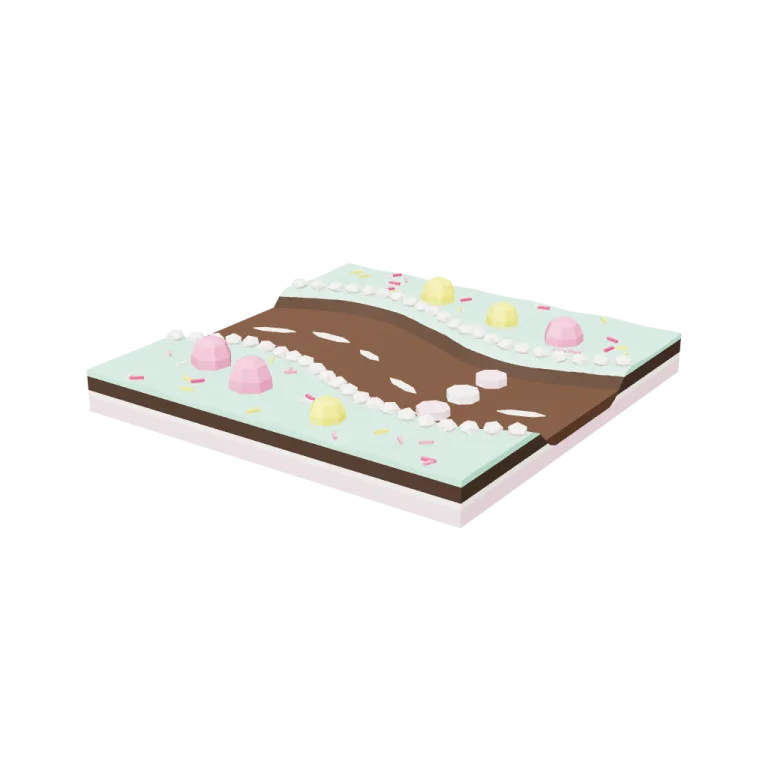
Left rail: colours and the 4 knobs the agent wrote into this model — they rebuild the geometry and go into your download. Right rail: looks for the viewer. Drag to orbit, scroll to zoom.
- Triangles
- 6,862
- Vertices
- 20,586
- Meshes · materials
- 17 · 17
- Size (W × H × D)
- 4.0 m × 67 cm × 4.0 m
- File
- GLB · 497 KB
- Animation
- Static
- Style
- Low-poly
- Collection
- Candy Land
Palette · named materials
- foliage (frosting banks, top cake layer) — mint#90d5b3
- water (river surface and river cross-section) — chocolate#51341f
- earth (channel slopes, chocolate sponge layer) — dark wood#3d2a1c
- base (pink sponge layer, underside, pink marshmallows) — bubblegum pink light#eec4d2
- trim (cream layer, icing beads, cream swirls, white marshmallows, sprinkles) — warm white#f2ede2
- accent (pink gumdrops, sprinkles) — bubblegum pink#e085a3
- accent (sprinkles) — bubblegum pink dark#d14775
- accent (lemon gumdrops, sprinkles) — lemon#f0e142
Use it
import { GLTFLoader } from "three/addons/loaders/GLTFLoader.js";

const gltf = await new GLTFLoader().loadAsync(
  "https://assets.stoicsoft.com/1designtool/3d/models/candy-land-chocolate-river-tiles/d4cdbc8e56/model.glb"
);
scene.add(gltf.scene); // metres, +Y up, front faces +Z
How it was made
The brief given to 1DesignTool's “3D object” template:
Chocolate river tiles for the Candy Land kit. Design it as one clear asset at believable real-world scale for that setting (state the size in metres in meta.notes), with its main parts modelled and named, readable at thumbnail size and from every orbit angle. Make it a ground piece on an exact 4 × 4 m footprint with flat edges at y = 0 that tile seamlessly with its neighbours in every direction; origin at the tile centre. This is one part of the Candy Land kit (Low-poly style, flat-lowpoly direction): A world you could eat. Use ONLY the kit palette, by name: bubblegum pink #e085a3, mint #90d5b3, chocolate #51341f, lemon #f0e142, bubblegum pink dark #d14775, mint dark #59c08c, bubblegum pink light #eec4d2, mint light #c9e8d9, soot black #1b1b22, warm white #f2ede2, mid grey #7d828c, dark wood #3d2a1c. Every material's `name` must be exactly the palette colour it uses — the GLB carries these names so the kit recolours as one; an unnamed material fails delivery. Kit knob: expose a param `flavourPalette` (0–1, default 0.5) for the kit's "Flavour palette" setting wherever it makes sense on this part, and keep that id.
- Agent: Claude Code · Claude Opus 5.5 in 1DesignTool
- Generation: 6.99M tokens (97% cached) · ≈ $3.74 at API prices · 5-hour plan +10%
- Direction: Low-poly · family scenes
- three-check PASS · glb-lint PASS
Named parts · 10
- Chocolate river tile
- Mint frosting banks
- Chocolate channel slopes
- Chocolate river
- Cake edge layers
- Piped icing beads
- Cream swirls
- Marshmallow stepping stones
- Gumdrops
- Sprinkles
Note: Real-world scale for a Candy Land ground piece: exactly 4.00 x 4.00 m footprint, 0.40 m thick at the frosting banks, 0.67 m to the top of the tallest gumdrop (GLB bounds x/z -2..2, y 0.000-0.672). Metres, +Y up, front faces +Z, origin at the tile centre on y = 0; the underside is one flat face at y = 0 and all four edges are vertical flat walls. The river runs along X on the centreline z = meander * sin(pi*x/2), so it enters and leaves at z = 0 with the same slope on both X edges, and the frosting ripple uses only 4 m-periodic frequencies, so opposite edges have identical profiles and the tile repeats seamlessly in every direction (along X the river continues; along Z bank meets bank). All decoration is inset from the edges so neighbouring tiles never collide. The exposed edge walls show a layer-cake cross-section (pink sponge, cream, chocolate sponge, mint frosting, with the river in section on the X edges); in a tiled layout these walls sit face to face and are hidden. Static model: no animation clip. 6862 triangles, 17 meshes, no textures; every surface is built from explicit triangles with baked face normals, so it stays flat-shaded in any engine. Material names are the Candy Land palette names verbatim (8 of the 12 are used); the design role is stored on material.userData.role. The exporter writes one material per mesh, so names repeat in the GLB (17 records, 8 distinct names); recolouring by name still catches all of them. flavourPalette sets the candy flavour mix: 0 makes every gumdrop lemon and every marshmallow warm white with lemon/white sprinkles, 1 makes them bubblegum pink / pink-light marshmallows with pink sprinkles, and values in between switch candies in a fixed spread order (default 0.5 is an even mix); the banks and river do not change. candyCount is an upper limit: gumdrops are only placed where they fit on the banks without touching the icing, so a wide or strongly meandering river fits fewer (for example 5 of 10 at riverWidth 2.0, meander 0.5). Part ids use the 'chocolateriver.' root because the kit's part-id grammar does not allow hyphens. All four params rebuild the model in the viewer; the downloadable GLB is the default build. Viewer staging overrides (lighting only, not in the GLB): exposure 0.4, sun key x0.75, hemisphere fill x2.2, environment reflections 0.4, chosen so the flat pastel faces render at their palette values instead of washing toward white. glb-lint reports 0 errors. Its overall verdict reads UNVERIFIED only because no requirements contract is supplied at this stage. Its 5 warnings are expected: material count and duplicate names (the per-mesh copies above), non-indexed primitives (intended flat shading), sibling bounding-box overlap (the river ribbon, swirls and stones sit inside the channel's bounds by design), and three 'detached' edge-wall bands (they share their boundary lines with the band below; only the bottom band reaches y = 0). The viewer's ground disc and lights are staging only and sit outside exportGLB({scope:'model'}).
About the Chocolate river tiles 3D model
Chocolate river tiles is a free low-poly 3D model from the Candy Land set. It measures 4.0 m × 67 cm × 4.0 m (W × H × D) at real-world scale and is built from 6,862 triangles across 17 meshes, with 10 named parts. Download the 497 KB GLB and drop it into three.js, React Three Fiber, Godot or Blender — free for commercial use, no attribution required.
- Is the Chocolate river tiles 3D model free for commercial use?
- Yes. It is free under the 1DesignTool 3D library license: use it in personal and commercial work — games, apps, websites, renders, ads and client projects — and modify it as you like, with no credit required. What you can't do is re-sell or re-distribute the file on its own or inside a model pack.
- What file format is it, and how big is it?
- A single binary glTF 2.0 file (.glb), 497 KB: 6,862 triangles, 20,586 vertices and 17 materials, modelled in metres at 4.0 m × 67 cm × 4.0 m.
- Can I animate Chocolate river tiles?
- It ships as a static mesh. Its 10 named parts are separate nodes, so you can move or animate each one in your engine.
- Which engines and tools can open it?
- Anything that reads glTF 2.0. three.js, React Three Fiber, Babylon.js, Godot 4 and Blender import the GLB directly; Unity and Unreal Engine load it through their glTF importers. The snippets above show the exact code for three.js, React Three Fiber, Godot and Blender.
- How was the Chocolate river tiles 3D model made?
- Claude Code (Claude Opus 5.5) generated it inside 1DesignTool's 3D template from a written brief, then the design kit's checks verified the geometry and the GLB before it was published. You can make your own the same way with 1DesignTool.
More like this
All of Candy Land →


Free under the 1DesignTool 3D library license. Model #50 of 731.