Candy cane fences
A modular 2 m candy cane fence for the Candy Land kit: striped, hooked candy cane posts on gumdrop footings, a row of smaller candy cane pickets and two chocolate rails. Low-poly, flat-shaded and built to snap on a 1 m grid.
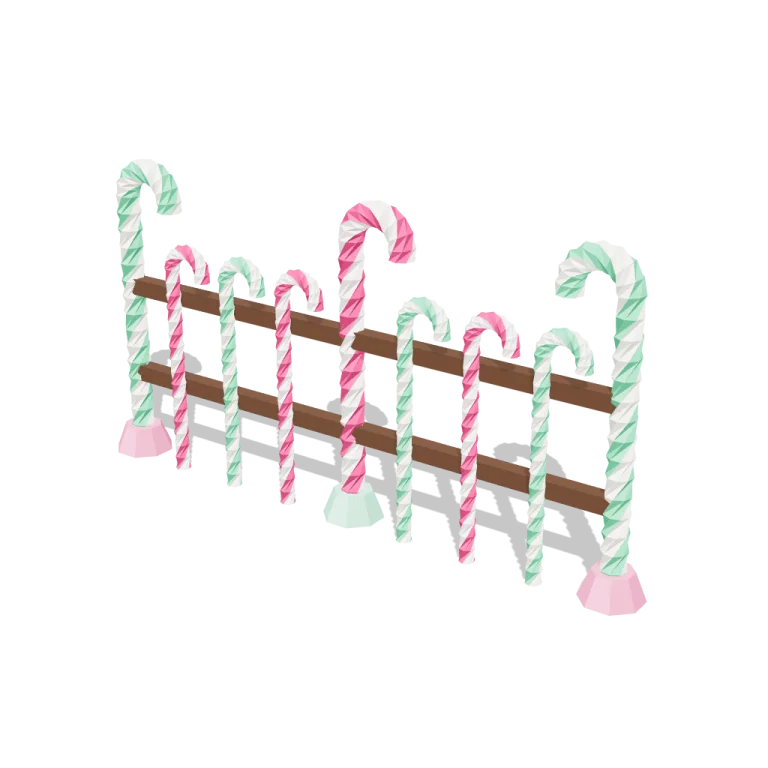
Left rail: colours and the 4 knobs the agent wrote into this model — they rebuild the geometry and go into your download. Right rail: looks for the viewer. Drag to orbit, scroll to zoom.
- Triangles
- 3,816
- Vertices
- 33,912
- Meshes · materials
- 9 · 9
- Size (W × H × D)
- 2.2 m × 1.1 m × 20 cm
- File
- GLB · 297 KB
- Animation
- Static
- Style
- Low-poly
- Collection
- Candy Land
Palette · named materials
- base (cane white)#f2ede2
- accent (bubblegum stripe)#d14775
- accent (mint stripe)#59c08c
- trim (bubblegum gumdrop)#e085a3
- trim (mint gumdrop)#90d5b3
- earth (chocolate rails)#51341f
Use it
import { GLTFLoader } from "three/addons/loaders/GLTFLoader.js";

const gltf = await new GLTFLoader().loadAsync(
  "https://assets.stoicsoft.com/1designtool/3d/models/candy-land-candy-cane-fences/ba32341dd2/model.glb"
);
scene.add(gltf.scene); // metres, +Y up, front faces +Z
How it was made
The brief given to 1DesignTool's “3D object” template:
Candy cane fences for the Candy Land kit. Design it as one clear asset at believable real-world scale for that setting (state the size in metres in meta.notes), with its main parts modelled and named, readable at thumbnail size and from every orbit angle. It is a modular piece that snaps on a 1 m grid: give it a length in whole metres and put the origin at its snapping end, stated in meta.notes. This is one part of the Candy Land kit (Low-poly style, flat-lowpoly direction): A world you could eat. Use ONLY the kit palette, by name: bubblegum pink #e085a3, mint #90d5b3, chocolate #51341f, lemon #f0e142, bubblegum pink dark #d14775, mint dark #59c08c, bubblegum pink light #eec4d2, mint light #c9e8d9, soot black #1b1b22, warm white #f2ede2, mid grey #7d828c, dark wood #3d2a1c. Every material's `name` must be exactly the palette colour it uses — the GLB carries these names so the kit recolours as one; an unnamed material fails delivery. Kit knob: expose a param `flavourPalette` (0–1, default 0.5) for the kit's "Flavour palette" setting wherever it makes sense on this part, and keep that id.
- Agent: Claude Code · Claude Opus 5.5 in 1DesignTool
- Generation: 2.95M tokens (94% cached) · ≈ $2.35 at API prices · 5-hour plan +5%
- Direction: Low-poly · family scenes
- three-check PASS · glb-lint PASS
Named parts · 5
- Candy cane fence
- Candy cane posts
- Gumdrop footings
- Candy cane pickets
- Chocolate rails
Note: Size at default params: 2.22 m long x 1.14 m tall x 0.22 m deep (posts 1.14 m, pickets 0.88 m tall), a garden-fence scale for Candy Land. Modular on a 1 m grid: the length is a whole number of metres along +X, and the origin is the centre of the snapping-end post at ground level (x = 0, bottom on y = 0, front faces +Z). Posts stand every metre. When you chain segments, set endPost = 0 so the posts don't double up; the rails then tuck into the next segment's origin post. The GLB is exported at default params (endPost = 1, a standalone piece). flavourPalette spreads the canes between mint (0) and bubblegum (1); at 0.5 they alternate, and each gumdrop footing takes the opposite flavour to its post. Every material is named exactly after its Candy Land palette colour (warm white, bubblegum pink dark, mint dark, bubblegum pink, mint, chocolate). Posts and pickets each carry their own copy of warm white and the stripe colours, so recolour by material name. Stripes are modelled as twisted facet columns, not textures. Meshes are non-indexed with per-facet normals so the flat-lowpoly look survives in any engine. Part ids use the root 'candycanefences' because the kit's part-id format doesn't allow hyphens. 3816 triangles at default params, 8840 at the maximum (4 m, 4 pickets/m). Static: no animation clip. glb-lint shows 0 errors and 2 heuristic warnings, both expected: same-named duplicate materials, and the rails nesting inside the post/picket bounds.
About the Candy cane fences 3D model
Candy cane fences is a free low-poly 3D model from the Candy Land set. It measures 2.2 m × 1.1 m × 20 cm (W × H × D) at real-world scale and is built from 3,816 triangles across 9 meshes, with 5 named parts. Download the 297 KB GLB and drop it into three.js, React Three Fiber, Godot or Blender — free for commercial use, no attribution required.
- Is the Candy cane fences 3D model free for commercial use?
- Yes. It is free under the 1DesignTool 3D library license: use it in personal and commercial work — games, apps, websites, renders, ads and client projects — and modify it as you like, with no credit required. What you can't do is re-sell or re-distribute the file on its own or inside a model pack.
- What file format is it, and how big is it?
- A single binary glTF 2.0 file (.glb), 297 KB: 3,816 triangles, 33,912 vertices and 9 materials, modelled in metres at 2.2 m × 1.1 m × 20 cm.
- Can I animate Candy cane fences?
- It ships as a static mesh. Its 5 named parts are separate nodes, so you can move or animate each one in your engine.
- Which engines and tools can open it?
- Anything that reads glTF 2.0. three.js, React Three Fiber, Babylon.js, Godot 4 and Blender import the GLB directly; Unity and Unreal Engine load it through their glTF importers. The snippets above show the exact code for three.js, React Three Fiber, Godot and Blender.
- How was the Candy cane fences 3D model made?
- Claude Code (Claude Opus 5.5) generated it inside 1DesignTool's 3D template from a written brief, then the design kit's checks verified the geometry and the GLB before it was published. You can make your own the same way with 1DesignTool.
More like this
All of Candy Land →
Gingerbread houses
Candy Land5,317 tris

Chocolate river tiles
Candy Land6,862 tris

Cake hills
Candy Land4,340 tris

Lollipop trees
Candy Land3,432 tris

Wrapped sweets
Candy Land1,920 tris

Gumdrops
Candy Land3,568 tris

Icing lamps
Candy Land3,888 tris

Cookie tables
Candy Land3,640 tris
Free under the 1DesignTool 3D library license. Model #51 of 731.