Campground Ranger
A broad-shouldered low-poly park ranger in his 40s with warm brown skin and a neat black ponytail, wearing a canvas-tan campaign hat, a tucked canvas-tan uniform shirt, forest-green trousers with a dark leather belt and dark leather boots, with binoculars in his right hand. Rigged in T-pose on the library's shared Mixamo-named skeleton, ready for retargeted animation.
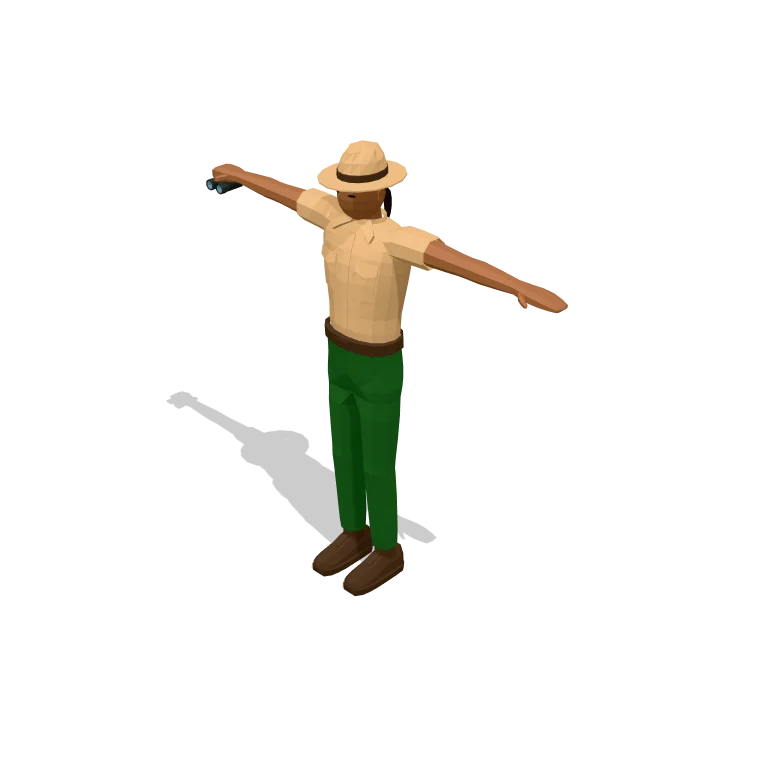
Left rail: colours and the 4 knobs the agent wrote into this model — they rebuild the geometry and go into your download. Bottom: actions for the rigged character — the one you pick plays here and is baked into the download. Right rail: looks for the viewer. Drag to orbit, scroll to zoom. On a desktop, Open in 1DesignTool turns it into a project you can keep editing with your agent.
- Triangles
- 3,620
- Vertices
- 14,358
- Meshes · materials
- 10 · 10
- Size (W × H × D)
- 1.8 m × 1.9 m × 37 cm
- File
- GLB · 559 KB
- Animation
- Static
- Style
- Low-poly
- Collection
- Campground
Palette · named materials
- skin#8a5a3c
- hair#1c1714
- hat#bf9769
- accent#3d2a1c
- top#bf9769
- bottoms#235223
- belt#3d2a1c
- shoes#3d2a1c
- prop#2b302d
- lens#5b7d93
Use it
import { GLTFLoader } from "three/addons/loaders/GLTFLoader.js";

const gltf = await new GLTFLoader().loadAsync(
  "https://assets.stoicsoft.com/1designtool/3d/models/campground-ranger/8924962805/model.glb"
);
scene.add(gltf.scene); // metres, +Y up, front faces +Z
How it was made
The brief given to 1DesignTool's “3D object” template:
A broad-shouldered man in his 40s with warm brown skin, about 1.83 m tall, with a neat black ponytail. Friendly, steady expression. Wearing a canvas-tan wide-brimmed ranger hat, a canvas-tan short-sleeve uniform shirt, dark forest-green trousers with a dark-wood leather belt, and dark-wood boots. Palette (Campground kit, use these exact hex values for the named colours): canvas tan #bf9769, forest green dark #235223, dark wood #3d2a1c. Holding a pair of binoculars in the right hand. Low-poly style, matching the kit's flat-shaded parts. No text, logos, brand names or lettering anywhere.
- Agent: Claude Code · Claude Opus 5.5 in 1DesignTool
- Direction: Low-poly · family characters
- three-check PASS · glb-lint PASS
Named parts · 7
- Body (warm brown skin)
- Black slicked-back hair and ponytail, brows and eyes
- Canvas-tan campaign hat with a dark-wood leather band
- Canvas-tan short-sleeve uniform shirt with chest pockets
- Forest-green trousers with a dark-wood leather belt
- Dark-wood leather hiking boots
- Binoculars
Note: 3,620 triangles in 7 skinned meshes (10 primitives), with 10 flat-shaded materials named by role. The hat band is called accent. There are no textures and no animation clips. The rig is one 25-bone skeleton with Mixamo names. mixamorig:Hips is the root and sits under the model root. three.js drops the colon when it loads the names (mixamorigHips). There are no finger bones: the hands are mittens with a thumb and the right hand is a fist, so only the …Hand bones exist. The bones have identity rest rotations (world-aligned axes, not Mixamo's own bone roll), so retarget Mixamo clips by bone name (Blender, Unity Humanoid, Godot retarget, three.js SkeletonUtils) rather than copying raw local rotations. GLTFExporter writes one glTF skin per mesh, but all 7 skins list the same 25 joints with identical inverse bind matrices, so they load onto one shared set of bones. Height is 1.83 m to the HeadTop_End joint, which sits on the crown of the head under the hat. The hat peaks at 1.89 m. The binoculars are their own mesh, weighted 100% to mixamorig:RightHand. They are compact roof-prism binoculars with the barrels along +Z and the objective lenses forward. The right fist closes over the hinge and the tops of the barrels, so when the forearm bends forward the binoculars swing up as if raised to the eyes. The rig test measured 9e-8 m of drift in hand space. The head, hair, ponytail, brows, eyes and hat are weighted 100% to Head. The Low-poly style allows no mouth or nose, so the eyes and brows live on the hair mesh in the hair material, and the friendly, steady look comes from level almond eyes, straight brows and calm cheekbones. Each vertex has at most 4 normalised influences, with short blend bands at the neck, shoulders, elbows, wrists, hips, knees and ankles. The short sleeves share the upper arm's weights, so the bare arm stays inside them. The shirt is tucked: its tail sits inside the trousers' waistband under the belt, and the shirt, the trouser seat and the belt share one torso weight field. The trouser hem rides on the boot shafts and shares the boots' ankle blend. Rig test pose (arms down 70°, forearms bent 90°, left thigh forward 45°, Spine1 twisted 20°): no seams open, 0.11% of facets collapse and 0.22% fold, all at the inner elbows. Three clothing layers stay nested in the rest pose and in the test pose: the tucked shirt under the trousers and belt, the bare upper arms inside the short sleeves, and the boot shafts inside the trouser hems. A stride, a 70° high step, a 30° leg-back and an 85° sit also leave no vertex through an outer layer. The back-face audit finds only thin slivers (at most 40 px in a 1000 px frame), looking straight down the 2 mm gap between a sleeve lip and the arm and up a raised trouser hem. Known limits: the ponytail is rigid on Head, so tilting the head far back pushes it into the collar. The belt buckle is a raised frame in the same dark leather, because the 10-material cap leaves no slot for metal. The style sets metalness to 0, so the binoculars are matte. glb-lint reports 0 errors and 1 warning: the hair sits inside the body's bounds, which is intended. With glb-requirements.json the verdict is PASS. The preview renders at exposure 0.6, a recorded plan override. Lit facets read close to the kit hex values, and the exported materials carry the exact hex. Params: height scales the whole rig so the soles stay at y = 0 and the crown equals the height. Build changes girth and stomach. Brim sets the hat brim width. Binoculars switches the prop on or off; without it the right hand opens. Every layer keeps its rest clearance across the build and brim ranges (scripts/param-probe.mjs). Exports at 1.75 m lean with a narrow brim, at 1.92 m stocky with a wide brim, and with no binoculars each pass the full rig test.
About the Campground Ranger 3D model
Campground Ranger is a free low-poly 3D model from the Campground set, rigged with a 25-bone Mixamo-compatible skeleton. It measures 1.8 m × 1.9 m × 37 cm (W × H × D) at real-world scale and is built from 3,620 triangles across 10 meshes, with 7 named parts. Download the 559 KB GLB and drop it into three.js, React Three Fiber, Godot or Blender — free for commercial use, no attribution required.
- Is the Campground Ranger 3D model free for commercial use?
- Yes. It is free under the 1DesignTool 3D library license: use it in personal and commercial work — games, apps, websites, renders, ads and client projects — and modify it as you like, with no credit required. What you can't do is re-sell or re-distribute the file on its own or inside a model pack.
- What file format is it, and how big is it?
- A single binary glTF 2.0 file (.glb), 559 KB: 3,620 triangles, 14,358 vertices and 10 materials, modelled in metres at 1.8 m × 1.9 m × 37 cm.
- Is Campground Ranger animated?
- It ships without a baked clip, in its bind pose. It is rigged with a 25-bone Mixamo-compatible skeleton, so it takes retargeted animation.
- Which engines and tools can open it?
- Anything that reads glTF 2.0. three.js, React Three Fiber, Babylon.js, Godot 4 and Blender import the GLB directly; Unity and Unreal Engine load it through their glTF importers. The snippets above show the exact code for three.js, React Three Fiber, Godot and Blender.
- How was the Campground Ranger 3D model made?
- Claude Code (Claude Opus 5.5) generated it inside 1DesignTool's 3D template from a written brief, then the design kit's checks verified the geometry and the GLB before it was published. You can make your own the same way with 1DesignTool.
More like this
All of Campground →
Campground Raccoon
Campground1,940 tris

Bicycle
Campground3,560 tris

Flickering fire
Campground1,840 tris

Camper van
Campground2,556 tris

Firewood
Campground1,583 tris

Signposts
Campground1,538 tris

Canoe
Campground1,988 tris

Fishing gear
Campground1,956 tris
Free under the 1DesignTool 3D library license. Model #47 of 2361.