Glider
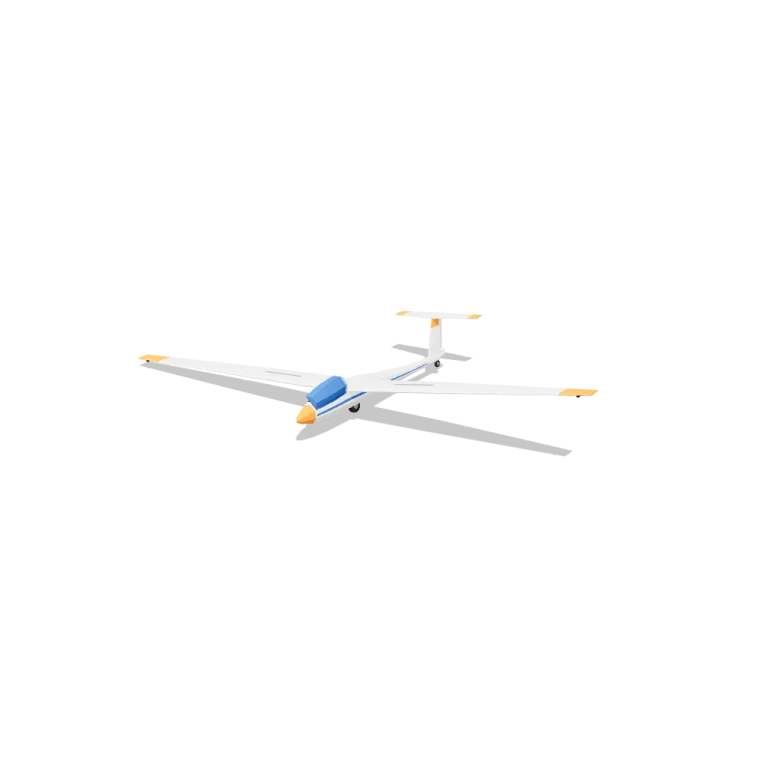
A low-poly 15 m single-seat sailplane parked on the grass the way gliders sit, on its monowheel with one orange wingtip resting on the ground. An 8-second loop opens and closes the bubble canopy, raises the airbrakes and sweeps the ailerons, elevators and rudder.
Left rail: colours and the 4 knobs the agent wrote into this model — they rebuild the geometry and go into your download. Right rail: looks for the viewer. Drag to orbit, scroll to zoom.
- Triangles
- 1,326
- Vertices
- 3,978
- Meshes · materials
- 23 · 23
- Size (W × H × D)
- 15 m × 2.7 m × 7.2 m
- File
- GLB · 148 KB
- Animation
- scene-motion · 8.0s
- Style
- Low-poly
- Collection
- Airfield
Palette · named materials
- body: fuselage, wings, tail and control surfaces (hangar white)#f4f1ec
- accent: nose cone, wingtips, fin and tailplane tips (signal orange)#ff851a
- glass and trim: canopy and fuselage cheatline (sky blue)#2e67b8
- rubber: tyres, wingtip skids, cockpit tub (soot black)#1b1b22
- metal: hubs, tow hook, airbrake paddles and caps (mid grey)#7d828c
Use it
import { GLTFLoader } from "three/addons/loaders/GLTFLoader.js";

const gltf = await new GLTFLoader().loadAsync(
  "https://assets.stoicsoft.com/1designtool/3d/models/airfield-glider/e41eeeba3a/model.glb"
);
scene.add(gltf.scene); // metres, +Y up, front faces +Z

const mixer = new THREE.AnimationMixer(gltf.scene);
gltf.animations.forEach((clip) => mixer.clipAction(clip).play());
// in your loop: mixer.update(delta)
How it was made
The brief given to 1DesignTool's “3D object” template:
Glider for the Airfield kit. Design it as one clear asset at believable real-world scale for that setting (state the size in metres in meta.notes), with its main parts modelled and named, readable at thumbnail size and from every orbit angle. It moves: author a seamless baked loop (2–12 s) with every pivot exactly at its hinge, axle or swivel, and keep the base still. This is one part of the Airfield kit (Low-poly style, flat-lowpoly direction): Small planes on a grass strip. Use ONLY the kit palette, by name: grass green #3a883a, hangar white #f4f1ec, signal orange #ff851a, sky blue #2e67b8, grass green dark #235223, hangar white dark #d7cebc, grass green light #5db15d, hangar white light #f9f8f6, soot black #1b1b22, warm white #f2ede2, mid grey #7d828c, dark wood #3d2a1c. Every material's `name` must be exactly the palette colour it uses — the GLB carries these names so the kit recolours as one; an unnamed material fails delivery. Kit knob: expose a param `era` (0–1, default 0.5) for the kit's "Era" setting wherever it makes sense on this part, and keep that id.
- Agent: Claude Code · Claude Opus 5.5 in 1DesignTool
- Direction: Low-poly · family abstract-kinetic
- three-check PASS · glb-lint PASS
Named parts · 14
- Glider
- Fuselage
- Canopy
- Wings
- Right aileron
- Right airbrake
- Left aileron
- Left airbrake
- Fin
- Rudder
- Tailplane
- Right elevator
- Left elevator
- Monowheel and tail wheel
Note: Size: a 15 m Standard-class single-seat sailplane, about 7.1 m long and 1.5 m to the fin top when level. It is parked rolled about 9° onto its left wingtip skid, as gliders rest on the field, so the raised right wingtip reaches 2.38 m and the footprint is 14.8 m wide. The nose faces +Z, the origin is at the bottom centre, and the monowheel, tail wheel and left tip skid all rest exactly on y = 0. The GLB has 1,326 triangles in 23 meshes (merged per part and colour) and one baked 8 s clip, 'scene-motion', sampled at 30 fps. The canopy swings open about its right-hand sill hinge and closes (0.6–4.2 s). The airbrake paddles slide straight up out of their slots and retract (4.4–7.4 s). The ailerons deflect opposite each other twice, the elevators nod once and the rudder sweeps once, each on a pivot node on its hinge line. The fuselage, wings and wheels never move. The GLB's static node pose is three-check's t = 2 s export frame, so the canopy sits open when no clip plays. Every material is named exactly after its Airfield palette colour. The exporter writes one material per mesh, so names repeat across materials; recolour by name. Normals are baked flat (non-indexed). The canopy is opaque tinted glass over a dark cockpit tub, with no interior. Params are baked at their defaults and only change the model when it is rebuilt in the viewer. era (the kit's 'Era') paints a cream doped-fabric airframe with dark-wood nose and tips below 0.34, white with signal orange in the middle, and a brighter composite white with upturned orange winglets from 0.67 up. wingSpan stretches the tapered outer panels and ailerons, and the parked roll is re-solved so the tip still touches down. canopyOpen and controlSweep change the baked loop's amplitudes. glb-lint: 0 errors, heuristic warnings only: non-indexed flat shading, overlapping patches on the fuselage, hinged surfaces and airbrakes flagged as 'detached', and a loose-bounds 'dips below ground' estimate (exact vertex bounds give min y = 0.000). plan-check passes except its part-id regex, which rejects the hyphen this library's slug-based ids require; the same plan with the slug de-hyphenated passes.
About the Glider 3D model
Glider is a free animated low-poly 3D model from the Airfield set. It measures 15 m × 2.7 m × 7.2 m (W × H × D) at real-world scale and is built from 1,326 triangles across 23 meshes, with 14 named parts and a baked animation (8.0 s). Download the 148 KB GLB and drop it into three.js, React Three Fiber, Godot or Blender — free for commercial use, no attribution required.
- Is the Glider 3D model free for commercial use?
- Yes. It is free under the 1DesignTool 3D library license: use it in personal and commercial work — games, apps, websites, renders, ads and client projects — and modify it as you like, with no credit required. What you can't do is re-sell or re-distribute the file on its own or inside a model pack.
- What file format is it, and how big is it?
- A single binary glTF 2.0 file (.glb), 148 KB: 1,326 triangles, 3,978 vertices and 23 materials, modelled in metres at 15 m × 2.7 m × 7.2 m.
- Is Glider animated?
- Yes — the GLB carries a baked animation (8.0 s), ready to play with any glTF animation mixer.
- Which engines and tools can open it?
- Anything that reads glTF 2.0. three.js, React Three Fiber, Babylon.js, Godot 4 and Blender import the GLB directly; Unity and Unreal Engine load it through their glTF importers. The snippets above show the exact code for three.js, React Three Fiber, Godot and Blender.
- How was the Glider 3D model made?
- Claude Code (Claude Opus 5.5) generated it inside 1DesignTool's 3D template from a written brief, then the design kit's checks verified the geometry and the GLB before it was published. You can make your own the same way with 1DesignTool.
More like this
All of Airfield →


Free under the 1DesignTool 3D library license. Model #13 of 1815.