Hot drink stands
A low-poly timber market booth that serves mulled wine and hot chocolate: an open counter facing the viewer with a faceted drink urn, a kettle and a row of cups, under a snow-laden pine-green gable roof hung with a red-and-gold valance and two lanterns. Built to the Winter Holiday Village palette at 2.2 m wide, 2.37 m deep and 2.93 m tall.
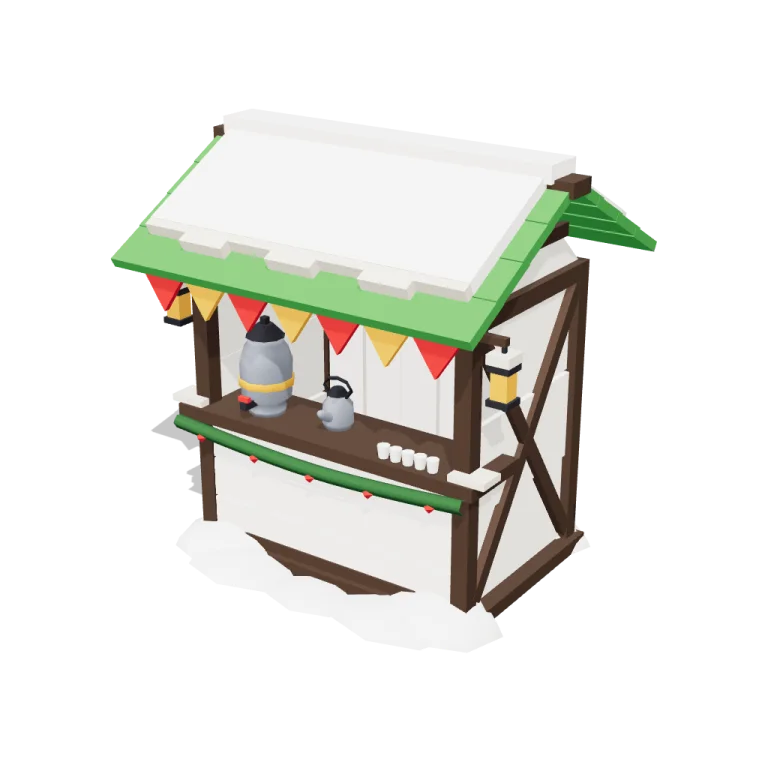
Left rail: colours and the 4 knobs the agent wrote into this model — they rebuild the geometry and go into your download. Bottom: what the model does — the one you pick plays here and is baked into the download. Right rail: looks for the viewer. Drag to orbit, scroll to zoom. On a desktop, Open in 1DesignTool turns it into a project you can keep editing with your agent.
- Triangles
- 2,342
- Vertices
- 3,421
- Meshes · materials
- 33 · 33
- Size (W × H × D)
- 2.8 m × 2.9 m × 2.4 m
- File
- GLB · 161 KB
- Animation
- Static
- Style
- Low-poly
- Collection
- Winter Holiday Village
Palette · named materials
- wood#3d2a1c
- plank#f2ede2
- roof#3a883a
- foliage#235223
- snow#f4f1ec
- drift#d7cebc
- accent#c32222
- glow#da942b
- metal#7d828c
- iron#1b1b22
Use it
import { GLTFLoader } from "three/addons/loaders/GLTFLoader.js";

const gltf = await new GLTFLoader().loadAsync(
  "https://assets.stoicsoft.com/1designtool/3d/models/winter-holiday-village-hot-drink-stands/91fa84ec5f/model.glb"
);
scene.add(gltf.scene); // metres, +Y up, front faces +Z
How it was made
The brief given to 1DesignTool's “3D object” template:
Hot drink stands for the Winter Holiday Village kit. Design it as one clear asset at believable real-world scale for that setting (state the size in metres in meta.notes), with its main parts modelled and named, readable at thumbnail size and from every orbit angle. This is one part of the Winter Holiday Village kit (Low-poly style, flat-lowpoly direction): Snow, lights and a market square. Use ONLY the kit palette, by name: snow white #f4f1ec, pine green #3a883a, red #c32222, warm gold #da942b, snow white dark #d7cebc, pine green dark #235223, snow white light #f9f8f6, pine green light #5db15d, soot black #1b1b22, warm white #f2ede2, mid grey #7d828c, dark wood #3d2a1c. Every material's `name` must be exactly the palette colour it uses — the GLB carries these names so the kit recolours as one; an unnamed material fails delivery. Kit knob: expose a param `snowDepth` (0–1, default 0.5) for the kit's "Snow depth" setting wherever it makes sense on this part, and keep that id.
- Agent: Claude Code · Claude Opus 5 in 1DesignTool
- Generation: 13.36M tokens (97% cached) · ≈ $11.41 at API prices · 5-hour plan +18%
- Direction: Low-poly · family products
- three-check PASS · glb-lint PASS
Named parts · 17
- Hot drink stand
- Base sill
- Timber frame
- Back plank wall
- Side plank walls
- Counter front
- Counter top ledge
- Back shelf
- Shingled roof
- Roof snow cap
- Striped valance
- Drink urn
- Kettle
- Cup row
- Pine garland
- Hanging lanterns
- Snow drift
Note: 2342 triangles, 33 meshes, static (no animation clip). glbLint "PASS" here means 0 blocking errors; the tool's own verdict line reads UNVERIFIED because no requirements contract was supplied, and it raises 5 advisory warnings (material count, duplicate palette materials, the declared embedded joins, detached-looking parts, and the 2.9 m height against the direction's 1 m reference). Metres, +Y up, the counter opening faces +Z, origin at the bottom centre, bounds x ±1.39 / y 0–2.935 / z ±1.187 — it rests exactly on y = 0. Part ids use the prefix `hotdrinkstands.` rather than the full slug: the kit's plan validator requires the first segment of a part id to be letters and digits only, so a hyphenated slug cannot be the id root. Material NAMES are the kit palette colour names exactly (`dark wood`, `pine green`, `snow white`, …) — recolour by material name. Caveat: the viewer's GLB exporter clones materials per mesh, so the file lists 33 material entries drawn from those 10 names; a name-keyed recolour still catches every one, but a uuid-keyed one will not. `snowDepth` changes how thick the roof cap, the eave tongues and the ground drifts are, plus the lantern snow — it does not change how much of the roof the snow covers, and at 0 it leaves a thin dusting rather than a bare roof. `standWidth`, `roofPitch` and `cupCount` rebuild the geometry in the viewer; the downloadable GLB carries the default values. Deliberate embedded joins (flagged as overlaps by lint): the gable panels sink 40 mm into the wall plate, the snow slab settles into the shingle courses, and the lantern body laps its cap and base.
About the Hot drink stands 3D model
Hot drink stands is a free low-poly 3D model from the Winter Holiday Village set. It measures 2.8 m × 2.9 m × 2.4 m (W × H × D) at real-world scale and is built from 2,342 triangles across 33 meshes, with 17 named parts. Download the 161 KB GLB and drop it into three.js, React Three Fiber, Godot or Blender — free for commercial use, no attribution required.
- Is the Hot drink stands 3D model free for commercial use?
- Yes. It is free under the 1DesignTool 3D library license: use it in personal and commercial work — games, apps, websites, renders, ads and client projects — and modify it as you like, with no credit required. What you can't do is re-sell or re-distribute the file on its own or inside a model pack.
- What file format is it, and how big is it?
- A single binary glTF 2.0 file (.glb), 161 KB: 2,342 triangles, 3,421 vertices and 33 materials, modelled in metres at 2.8 m × 2.9 m × 2.4 m.
- Can I animate Hot drink stands?
- It ships as a static mesh. Its 17 named parts are separate nodes, so you can move or animate each one in your engine.
- Which engines and tools can open it?
- Anything that reads glTF 2.0. three.js, React Three Fiber, Babylon.js, Godot 4 and Blender import the GLB directly; Unity and Unreal Engine load it through their glTF importers. The snippets above show the exact code for three.js, React Three Fiber, Godot and Blender.
- How was the Hot drink stands 3D model made?
- Claude Code (Claude Opus 5) generated it inside 1DesignTool's 3D template from a written brief, then the design kit's checks verified the geometry and the GLB before it was published. You can make your own the same way with 1DesignTool.
More like this
All of Winter Holiday Village →
Ice Rink Skater
Winter Holiday Village3,086 tris

Snow Village Child
Winter Holiday Village2,774 tris

Carol Singer
Winter Holiday Village3,960 tris

Winter Market Shopkeeper
Winter Holiday Village3,194 tris

Candles
Winter Holiday Village1,620 tris

Snowmen
Winter Holiday Village1,508 tris

Sleds
Winter Holiday Village1,228 tris

Wreaths
Winter Holiday Village4,188 tris
Free under the 1DesignTool 3D library license. Model #1941 of 2361.