Crayons
An open cardboard box of chunky wax crayons in two staggered rows, its tuck flap standing open, with one loose crayon lying on the floor in front. Flat-shaded low-poly in the Toy Box kit palette, sized as a real children's crayon box.
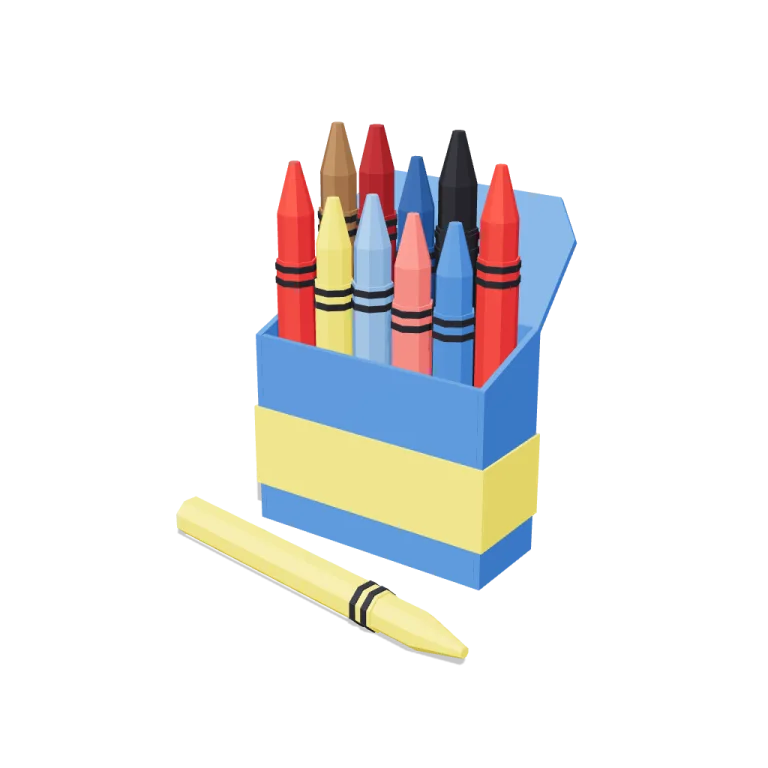
Left rail: colours and the 4 knobs the agent wrote into this model — they rebuild the geometry and go into your download. Right rail: looks for the viewer. Drag to orbit, scroll to zoom.
- Triangles
- 2,076
- Vertices
- 6,228
- Meshes · materials
- 26 · 26
- Size (W × H × D)
- 9 cm × 10 cm × 8 cm
- File
- GLB · 172 KB
- Animation
- Static
- Style
- Low-poly
- Collection
- Toy Box
Palette · named materials
- box#2e67b8
- band#eecd2b
- wrapper_band#1b1b22
- crayon#c32222
- crayon#eecd2b
- crayon#6190d1
- crayon#db5757
- crayon#2e67b8
- crayon#7d5736
- crayon#821717
- crayon#1f457a
- crayon#1b1b22
- box (toyEra < 0.34)#7d5736
- band (toyEra < 0.34)#3d2a1c
- crayon (toyEra < 0.34, adds)#7d828c
Use it
import { GLTFLoader } from "three/addons/loaders/GLTFLoader.js";

const gltf = await new GLTFLoader().loadAsync(
  "https://assets.stoicsoft.com/1designtool/3d/models/toy-box-kit-crayons/9de3c5fb16/model.glb"
);
scene.add(gltf.scene); // metres, +Y up, front faces +Z
How it was made
The brief given to 1DesignTool's “3D object” template:
Crayons for the Toy Box kit. Design it as one clear asset at believable real-world scale for that setting (state the size in metres in meta.notes), with its main parts modelled and named, readable at thumbnail size and from every orbit angle. This is one part of the Toy Box kit (Low-poly style, flat-lowpoly direction): A child's floor seen from toy height. Use ONLY the kit palette, by name: primary red #c32222, blue #2e67b8, yellow #eecd2b, wood #7d5736, primary red dark #821717, blue dark #1f457a, primary red light #db5757, blue light #6190d1, soot black #1b1b22, warm white #f2ede2, mid grey #7d828c, dark wood #3d2a1c. Every material's `name` must be exactly the palette colour it uses — the GLB carries these names so the kit recolours as one; an unnamed material fails delivery. Kit knob: expose a param `toyEra` (0–1, default 0.5) for the kit's "Toy era" setting wherever it makes sense on this part, and keep that id.
- Agent: Claude Code · Claude Opus 5.5 in 1DesignTool
- Generation: 4.77M tokens (96% cached) · ≈ $3.27 at API prices · 5-hour plan +8%
- Direction: Low-poly · family products
- three-check PASS · glb-lint PASS
Named parts · 18
- Crayons
- Box
- Box band
- Back-row riser
- Tuck flap
- Front row
- Back row
- Front crayon 1
- Front crayon 2
- Front crayon 3
- Front crayon 4
- Front crayon 5
- Back crayon 1
- Back crayon 2
- Back crayon 3
- Back crayon 4
- Back crayon 5
- Loose crayon
Note: Real-world scale: the box is 0.065 m wide × 0.024 m deep, with a 0.058 m back wall and a 0.050 m front wall. Crayons are 0.090 m long and 0.00975 m across at the default toyEra. The whole model is 0.102 m tall to the tallest back-row tip. 2076 triangles, 26 meshes, no animation clip. Origin is the bottom centre of the footprint, which includes the loose crayon. The box floor and the loose crayon's wrapper bands rest at exactly y = 0, and the front faces +Z. Material names are the Toy Box palette colour names verbatim (e.g. 'blue' box, 'yellow' band, 'soot black' wrapper bands), so the kit recolours by name; the design role is on material.userData.role. The exporter writes one material copy per mesh, which is why a lint reports 26 materials for 9 distinct colours. All four params are build-time knobs that rebuild the geometry. toyEra switches below 0.34 from a printed blue box with a yellow band and bright crayons to a vintage kraft box ('wood' with a 'dark wood' band) with a muted crayon set, and it continuously grows crayon girth from a slim 8 mm stick (0) to a chunky 11.5 mm toddler crayon (1). perRow sets 3–6 crayons per row (6–12 in the box), and the box width follows it, so per-crayon part ids beyond _f3/_b3 exist only when perRow is high enough. wear shortens and blunts crayons with a fixed seed. flapOpen swings the tuck flap from just past upright (0) to folded well back (1). Part ids use the 'crayons.' prefix because the kit's part-id grammar does not allow hyphens. The viewer's ground disc and lights are staging only and sit outside exportGLB({scope:'model'}). glb-lint reports 0 errors and 6 heuristic warnings, all expected. Material count and duplicate materials come from the per-mesh copies. Non-indexed primitives are deliberate: per-face normals keep the model flat-shaded in every engine. Sibling overlaps are the embedded joins: band on box, riser in box, wrapper rings sunk into sleeves. The 'detached' flap is hinged into the back-wall top as the only child of its pivot group. The 0.1 m height is compared against the flat-lowpoly 1 m reference. The lint's overall verdict reads UNVERIFIED only because no requirements contract was supplied. Known capture artefact: the headless capture renderer draws faint 1 px lines on the box front in the straight-on front view, where crayon and inner-wall edges sit behind the card. It is not geometry (≥ 0.6 mm clearance), not shadows, and not depth precision (all three were ruled out by bisection), and it does not appear in the hero.
About the Crayons 3D model
Crayons is a free low-poly 3D model from the Toy Box set. It measures 9 cm × 10 cm × 8 cm (W × H × D) at real-world scale and is built from 2,076 triangles across 26 meshes, with 18 named parts. Download the 172 KB GLB and drop it into three.js, React Three Fiber, Godot or Blender — free for commercial use, no attribution required.
- Is the Crayons 3D model free for commercial use?
- Yes. It is free under the 1DesignTool 3D library license: use it in personal and commercial work — games, apps, websites, renders, ads and client projects — and modify it as you like, with no credit required. What you can't do is re-sell or re-distribute the file on its own or inside a model pack.
- What file format is it, and how big is it?
- A single binary glTF 2.0 file (.glb), 172 KB: 2,076 triangles, 6,228 vertices and 26 materials, modelled in metres at 9 cm × 10 cm × 8 cm.
- Can I animate Crayons?
- It ships as a static mesh. Its 18 named parts are separate nodes, so you can move or animate each one in your engine.
- Which engines and tools can open it?
- Anything that reads glTF 2.0. three.js, React Three Fiber, Babylon.js, Godot 4 and Blender import the GLB directly; Unity and Unreal Engine load it through their glTF importers. The snippets above show the exact code for three.js, React Three Fiber, Godot and Blender.
- How was the Crayons 3D model made?
- Claude Code (Claude Opus 5.5) generated it inside 1DesignTool's 3D template from a written brief, then the design kit's checks verified the geometry and the GLB before it was published. You can make your own the same way with 1DesignTool.
More like this
All of Toy Box →


Free under the 1DesignTool 3D library license. Model #39 of 701.