Shell on a trailer
A low-poly tiny house on wheels: a cedar lap-clad gable shell with white trim, black-framed windows, a green glazed door with timber steps and a black standing-seam roof, sitting on a black tandem-axle trailer with an A-frame tongue and propane tanks. It is built at real size (8 m long including the tongue, 4.2 m tall) and snaps on a 1 m grid.
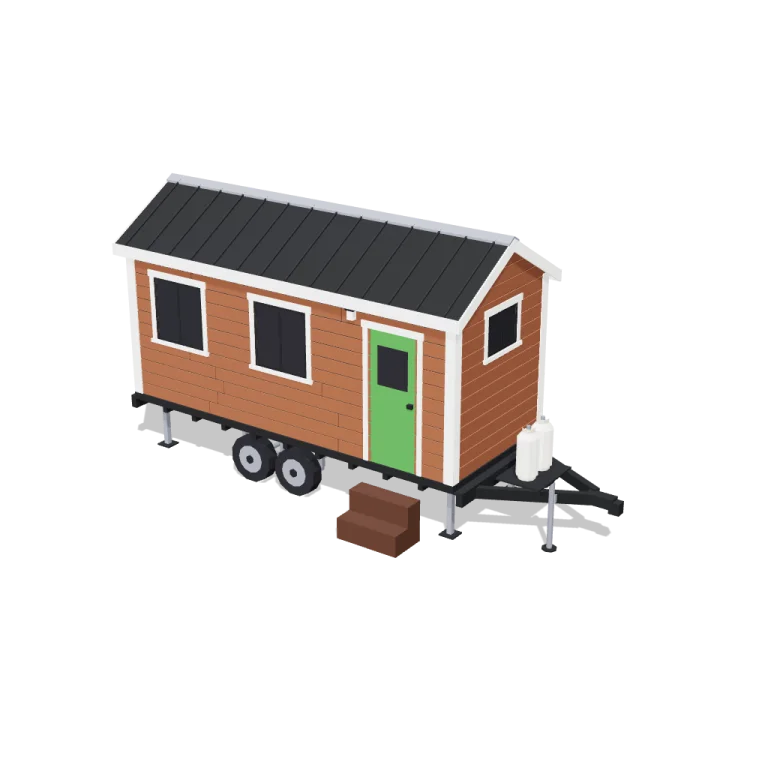
Left rail: colours and the 4 knobs the agent wrote into this model — they rebuild the geometry and go into your download. Right rail: looks for the viewer. Drag to orbit, scroll to zoom.
- Triangles
- 4,344
- Vertices
- 13,032
- Meshes · materials
- 28 · 28
- Size (W × H × D)
- 8.0 m × 4.2 m × 3.2 m
- File
- GLB · 329 KB
- Animation
- Static
- Style
- Low-poly
- Collection
- Tiny House
Palette · named materials
- cedar: lap-board cladding at the default Cladding (body)#814c31
- cedar light: lighter cladding boards when Cladding is below 0.5 (body)#b36e4d
- cedar dark: door steps, and darker cladding boards above 0.5 (body)#4a2b1c
- dark wood: cladding boards near Cladding 1 (body)#3d2a1c
- white dark: cladding boards near Cladding 0, propane tank collars (body)#d7cebc
- white: corner boards, window and door casings, fascia, bargeboards (trim)#f4f1ec
- white light: porch lamp lens (accent)#f9f8f6
- warm white: propane tanks (accent)#f2ede2
- matte black: roof panels, trailer frame and tongue, sill band, window sashes, door lever (base)#151619
- soot black: glass, tyres, roof seams, wall core seen in the board gaps (glass)#1b1b22
- mid grey: ridge cap, wheel rims, axles, springs, jacks (trim)#7d828c
- plant green: door leaf (accent)#3a883a
Use it
import { GLTFLoader } from "three/addons/loaders/GLTFLoader.js";

const gltf = await new GLTFLoader().loadAsync(
  "https://assets.stoicsoft.com/1designtool/3d/models/tiny-house-shell-on-a-trailer/f1c1dc33b6/model.glb"
);
scene.add(gltf.scene); // metres, +Y up, front faces +Z
How it was made
The brief given to 1DesignTool's “3D object” template:
Shell on a trailer for the Tiny House kit. Design it as one clear asset at believable real-world scale for that setting (state the size in metres in meta.notes), with its main parts modelled and named, readable at thumbnail size and from every orbit angle. It is a modular piece that snaps on a 1 m grid: give it a length in whole metres and put the origin at its snapping end, stated in meta.notes. This is one part of the Tiny House kit (Low-poly style, flat-lowpoly direction): A complete home in a small box. Use ONLY the kit palette, by name: cedar #814c31, white #f4f1ec, matte black #151619, plant green #3a883a, cedar dark #4a2b1c, white dark #d7cebc, cedar light #b36e4d, white light #f9f8f6, soot black #1b1b22, warm white #f2ede2, mid grey #7d828c, dark wood #3d2a1c. Every material's `name` must be exactly the palette colour it uses — the GLB carries these names so the kit recolours as one; an unnamed material fails delivery. Kit knob: expose a param `cladding` (0–1, default 0.5) for the kit's "Cladding" setting wherever it makes sense on this part, and keep that id.
- Agent: Claude Code · Claude Opus 5.5 in 1DesignTool
- Direction: Low-poly · family scenes
- three-check PASS · glb-lint PASS
Named parts · 12
- Shell on a trailer
- Trailer frame
- Tandem wheels
- Levelling jacks
- Tongue and hitch
- Propane tanks
- Clad walls
- White trim
- Windows
- Door
- Standing-seam roof
- Door steps
Note: Size: 8.00 m long overall at the default length (a 6.2 m trailer deck plus a 1.8 m A-frame tongue). The walls are 2.4 m wide, and the roof is 2.75 m across the eaves. It is 4.23 m tall at the ridge cap, with the floor at 0.98 m. The footprint runs z = −1.375 to +1.86 because the door steps stand 0.66 m proud of the front wall. Origin and snapping: length is whole metres (6–10). The origin is the snapping end: the rear of the trailer deck at x = 0, on the ground, centred on the walls in z. The piece runs along +X, and the hitch coupler nose ends exactly at x = length, so the next piece's origin goes there. The front (door side) faces +Z. The tyres (on a flat facet), jacks, tongue jack and steps all rest on y = 0. The GLB has 4,344 triangles in 28 meshes. It is static and carries no animation clip. Every material is named exactly after a kit palette colour. The exporter writes one material per mesh, so some names repeat; recolour by name. cladding (the kit's 'Cladding') moves the lap boards along a tone ramp: white dark (painted) → cedar light → cedar → cedar dark → dark wood. Between steps, a seeded share of boards takes the neighbouring tone. At the default 0.5 every board is cedar, so the default GLB carries no cedar light or dark wood material. Params are baked into the GLB at their defaults and change the geometry only when the scene is rebuilt in the viewer. windows is capped by length: a 6 m piece fits at most 2 front and 3 back windows. The defaults passed three-check, and so did two combined extremes (cladding 0 / length 6 / pitch 15 / windows 4, and cladding 1 / length 10 / pitch 35 / windows 1). The shell is closed with no interior; the loft and fit-out are separate kit parts. glb-lint: 0 errors. Its warnings are expected: duplicate materials come from the per-mesh export; geometry is non-indexed to keep hard flat facets; sibling overlap is the wheel tyre, rim and hub nesting; and the scale warning appears because a house is taller than the 1 m reference. plan-check rejects only the hyphenated library part ids (its regex allows no hyphen); the same plan with the slug de-hyphenated passes. three-check and the GLB reload keep all 12 ids.
About the Shell on a trailer 3D model
Shell on a trailer is a free low-poly 3D model from the Tiny House set. It measures 8.0 m × 4.2 m × 3.2 m (W × H × D) at real-world scale and is built from 4,344 triangles across 28 meshes, with 12 named parts. Download the 329 KB GLB and drop it into three.js, React Three Fiber, Godot or Blender — free for commercial use, no attribution required.
- Is the Shell on a trailer 3D model free for commercial use?
- Yes. It is free under the 1DesignTool 3D library license: use it in personal and commercial work — games, apps, websites, renders, ads and client projects — and modify it as you like, with no credit required. What you can't do is re-sell or re-distribute the file on its own or inside a model pack.
- What file format is it, and how big is it?
- A single binary glTF 2.0 file (.glb), 329 KB: 4,344 triangles, 13,032 vertices and 28 materials, modelled in metres at 8.0 m × 4.2 m × 3.2 m.
- Can I animate Shell on a trailer?
- It ships as a static mesh. Its 12 named parts are separate nodes, so you can move or animate each one in your engine.
- Which engines and tools can open it?
- Anything that reads glTF 2.0. three.js, React Three Fiber, Babylon.js, Godot 4 and Blender import the GLB directly; Unity and Unreal Engine load it through their glTF importers. The snippets above show the exact code for three.js, React Three Fiber, Godot and Blender.
- How was the Shell on a trailer 3D model made?
- Claude Code (Claude Opus 5.5) generated it inside 1DesignTool's 3D template from a written brief, then the design kit's checks verified the geometry and the GLB before it was published. You can make your own the same way with 1DesignTool.
More like this
All of Tiny House →


Free under the 1DesignTool 3D library license. Model #13 of 1526.