Fold-out deck
A low-poly fold-out deck for a tiny house on a 4 × 4 m gravel ground tile. A cedar plank deck hinges down from a black steel mount frame and hangs on two chains, with fold-down legs, cedar-slat rails and a box stair up to the front opening.
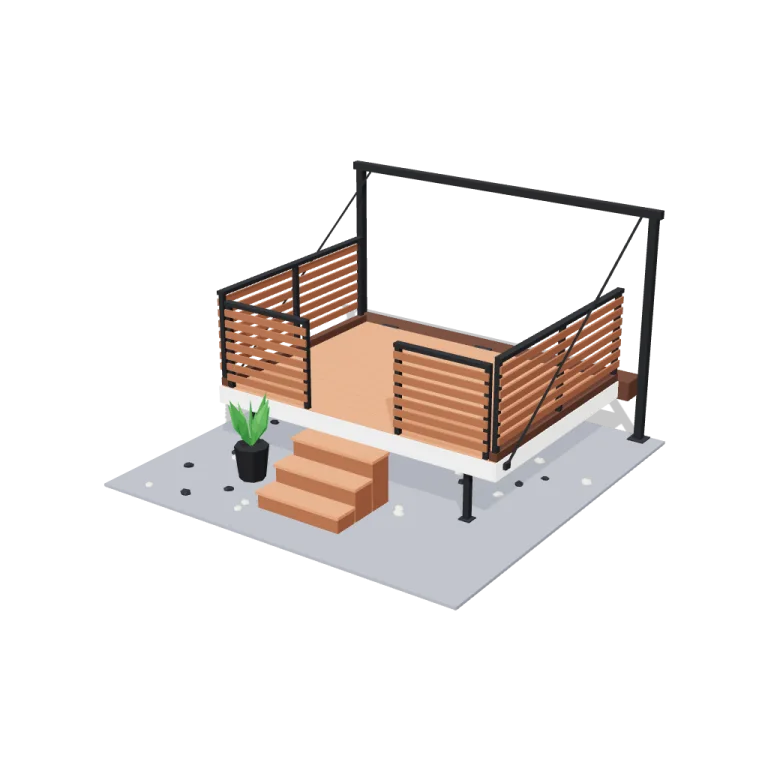
Left rail: colours and the 3 knobs the agent wrote into this model — they rebuild the geometry and go into your download. Right rail: looks for the viewer. Drag to orbit, scroll to zoom.
- Triangles
- 1,904
- Vertices
- 5,712
- Meshes · materials
- 28 · 28
- Size (W × H × D)
- 4.0 m × 2.5 m × 4.0 m
- File
- GLB · 160 KB
- Animation
- Static
- Style
- Low-poly
- Collection
- Tiny House
Palette · named materials
- cedar light — deck boards and step treads (accent)#b36e4d
- cedar — deck frame, rail cladding slats and step boxes (accent)#814c31
- cedar dark — mount ledger and side curbs (trim)#4a2b1c
- white — fascia boards (base)#f4f1ec
- matte black — mount posts and header, chains, rail posts and caps, legs, plant pot (trim)#151619
- soot black — hinges, footings, piers, chain eyes, leg feet, dark stones (trim)#1b1b22
- mid grey — gravel pad (base)#7d828c
- white dark — pale cobbles (base)#d7cebc
- plant green — plant leaves (foliage)#3a883a
- dark wood — potting soil (earth)#3d2a1c
Use it
import { GLTFLoader } from "three/addons/loaders/GLTFLoader.js";

const gltf = await new GLTFLoader().loadAsync(
  "https://assets.stoicsoft.com/1designtool/3d/models/tiny-house-fold-out-deck/2f5522493c/model.glb"
);
scene.add(gltf.scene); // metres, +Y up, front faces +Z
How it was made
The brief given to 1DesignTool's “3D object” template:
Fold-out deck for the Tiny House kit. Design it as one clear asset at believable real-world scale for that setting (state the size in metres in meta.notes), with its main parts modelled and named, readable at thumbnail size and from every orbit angle. Make it a ground piece on an exact 4 × 4 m footprint with flat edges at y = 0 that tile seamlessly with its neighbours in every direction; origin at the tile centre. This is one part of the Tiny House kit (Low-poly style, flat-lowpoly direction): A complete home in a small box. Use ONLY the kit palette, by name: cedar #814c31, white #f4f1ec, matte black #151619, plant green #3a883a, cedar dark #4a2b1c, white dark #d7cebc, cedar light #b36e4d, white light #f9f8f6, soot black #1b1b22, warm white #f2ede2, mid grey #7d828c, dark wood #3d2a1c. Every material's `name` must be exactly the palette colour it uses — the GLB carries these names so the kit recolours as one; an unnamed material fails delivery. Kit knob: expose a param `cladding` (0–1, default 0.5) for the kit's "Cladding" setting wherever it makes sense on this part, and keep that id.
- Agent: Claude Code · Claude Opus 5.5 in 1DesignTool
- Direction: Low-poly · family scenes
- three-check PASS · glb-lint PASS
Named parts · 41
- Fold-out deck
- Gravel pad
- Gravel
- Pebbles
- Dark stones
- Mount frame
- Posts and header
- Ledger
- Footings and piers
- Hinges
- Deck
- Frame and joists
- Fascia
- Deck boards
- Side curbs
- Chain eyes
- Left rail
- Posts and cap rail
- Cladding slats
- Right rail
- Posts and cap rail
- Cladding slats
- Front rail
- Front rail left
- Posts and cap rail
- Cladding slats
- Front rail right
- Posts and cap rail
- Cladding slats
- Fold-down legs
- Leg tubes
- Leg feet
- Chains
- Chain runs
- Steps
- Step boxes
- Treads
- Plant
- Pot
- Soil
- +1 more
Note: Size: exact 4.00 × 4.00 m ground tile, 2.45 m tall to the mount header. The deck is 3.2 m wide × 2.4 m deep (deckDepth), its top at 0.72 m, about a trailer-borne tiny-house floor. Origin is at the tile centre on y = 0. The front, with the steps, faces +Z. The hinge and mount frame run along the back (−Z) edge, where the tiny house parks. A 3 cm gravel pad fills the whole footprint with flat vertical edges from y = 0, so tiles butt seamlessly in every direction. Nothing else crosses the tile edge. 1,904 triangles, counted from the GLB accessors. three-check's figure also includes the viewer's staging ground, which is not exported. Static: no animation clip. cladding (the kit's Cladding setting) changes the height of the cedar rail boards on a fixed 12 cm pitch: 3.5 cm open slats at 0, near-solid 10.5 cm boards at 1. unfold rebuilds the pose and is not an animation. From 1 down to 0.5 the rails fold flat onto the deck. From 0.5 down to 0 the deck swings up against the mount frame, the legs tuck under it and the chains shorten (they are straight rods, as if on a winch). deckDepth changes the deck's depth, and the steps move with its front edge. Every param extreme passed three-check. The deck, rails and legs are hinged groups whose pivots sit on their real hinge lines, so they can be animated in an engine. Every material is named exactly after its Tiny House palette colour. 10 of the 12 are used; warm white and white light are not. three.js's exporter writes one material per mesh, so names repeat (glb-lint warns 28 > 10). plan-check's part-id pattern rejects the hyphenated slug ids the brief requires. The plan passed plan-check with the hyphens removed and is otherwise unchanged. glb-lint: 0 errors. Its warnings are the material count, non-indexed flat-shaded geometry, intended nesting (frame inside fascia, pebbles in the pad), a 'detached' heuristic for the curbs and chains (they rest on the boards and hang from the header, which are separate parts), and scale versus a 1 m reference.
About the Fold-out deck 3D model
Fold-out deck is a free low-poly 3D model from the Tiny House set. It measures 4.0 m × 2.5 m × 4.0 m (W × H × D) at real-world scale and is built from 1,904 triangles across 28 meshes, with 41 named parts. Download the 160 KB GLB and drop it into three.js, React Three Fiber, Godot or Blender — free for commercial use, no attribution required.
- Is the Fold-out deck 3D model free for commercial use?
- Yes. It is free under the 1DesignTool 3D library license: use it in personal and commercial work — games, apps, websites, renders, ads and client projects — and modify it as you like, with no credit required. What you can't do is re-sell or re-distribute the file on its own or inside a model pack.
- What file format is it, and how big is it?
- A single binary glTF 2.0 file (.glb), 160 KB: 1,904 triangles, 5,712 vertices and 28 materials, modelled in metres at 4.0 m × 2.5 m × 4.0 m.
- Can I animate Fold-out deck?
- It ships as a static mesh. Its 41 named parts are separate nodes, so you can move or animate each one in your engine.
- Which engines and tools can open it?
- Anything that reads glTF 2.0. three.js, React Three Fiber, Babylon.js, Godot 4 and Blender import the GLB directly; Unity and Unreal Engine load it through their glTF importers. The snippets above show the exact code for three.js, React Three Fiber, Godot and Blender.
- How was the Fold-out deck 3D model made?
- Claude Code (Claude Opus 5.5) generated it inside 1DesignTool's 3D template from a written brief, then the design kit's checks verified the geometry and the GLB before it was published. You can make your own the same way with 1DesignTool.
More like this
All of Tiny House →


Free under the 1DesignTool 3D library license. Model #10 of 1526.