Alley tiles
A low-poly 4 × 4 m tile of the back alley behind a 1920s speakeasy: dark brick pavers in running bond, a pale granite gutter with an iron drain grate down the middle, and an emerald cellar hatch with gold strap hinges and a velvet-red mat, the club's back way in. It tiles seamlessly in every direction.
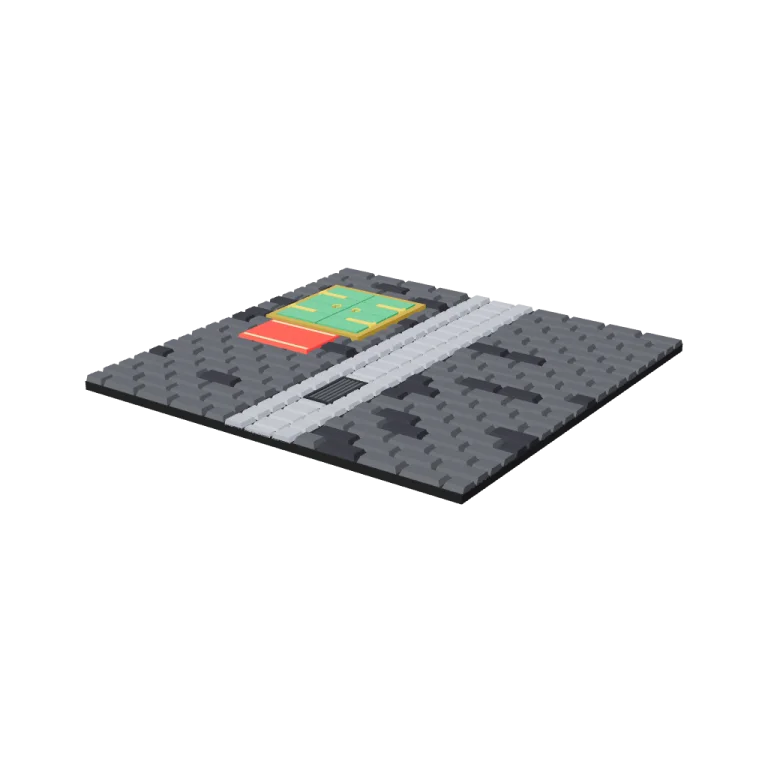
Left rail: colours and the 3 knobs the agent wrote into this model — they rebuild the geometry and go into your download. Right rail: looks for the viewer. Drag to orbit, scroll to zoom.
- Triangles
- 3,344
- Vertices
- 10,032
- Meshes · materials
- 13 · 13
- Size (W × H × D)
- 4.0 m × 17 cm × 4.0 m
- File
- GLB · 246 KB
- Animation
- Static
- Style
- Low-poly
- Collection
- Speakeasy
Palette · named materials
- black light — brick pavers, drain-grate bars (body)#3a3c40
- soot black — oil-stained pavers (earth)#1b1b22
- black dark — soot bed and joints, drain sump (base)#090a0b
- black — drain-grate frame, hatch well (base)#151619
- mid grey — granite gutter setts (body)#7d828c
- emerald — cellar hatch planks (accent)#248f59
- gold — strap hinges, knuckles, ring pulls (accent)#d0a225
- gold dark — hatch frame at luxury ≥ 0.5, ring-pull staples (trim)#8f7019
- velvet red — door mat (accent)#c32222
- gold light — door-mat bands (accent)#debd63
Use it
import { GLTFLoader } from "three/addons/loaders/GLTFLoader.js";

const gltf = await new GLTFLoader().loadAsync(
  "https://assets.stoicsoft.com/1designtool/3d/models/speakeasy-alley-tiles/d7ecc91227/model.glb"
);
scene.add(gltf.scene); // metres, +Y up, front faces +Z
How it was made
The brief given to 1DesignTool's “3D object” template:
Alley tiles for the Speakeasy kit. Design it as one clear asset at believable real-world scale for that setting (state the size in metres in meta.notes), with its main parts modelled and named, readable at thumbnail size and from every orbit angle. Make it a ground piece on an exact 4 × 4 m footprint with flat edges at y = 0 that tile seamlessly with its neighbours in every direction; origin at the tile centre. This is one part of the Speakeasy kit (Low-poly style, flat-lowpoly direction): A hidden jazz club in the 1920s. Use ONLY the kit palette, by name: black #151619, gold #d0a225, emerald #248f59, velvet red #c32222, black dark #090a0b, gold dark #8f7019, black light #3a3c40, gold light #debd63, soot black #1b1b22, warm white #f2ede2, mid grey #7d828c, dark wood #3d2a1c. Every material's `name` must be exactly the palette colour it uses — the GLB carries these names so the kit recolours as one; an unnamed material fails delivery. Kit knob: expose a param `luxuryLevel` (0–1, default 0.5) for the kit's "Luxury level" setting wherever it makes sense on this part, and keep that id.
- Agent: Claude Code · Claude Opus 5.5 in 1DesignTool
- Direction: Low-poly · family scenes
- three-check PASS · glb-lint PASS
Named parts · 7
- Alley tile
- Soot bed and joints
- Brick pavers
- Granite gutter
- Drain grate
- Cellar hatch
- Velvet door mat
Note: Size: exactly 4.00 × 4.00 m footprint, 0.17 m tall at the hatch hardware; paver tops at about 0.13 m. Origin at the tile centre, bottom on y = 0, front faces +Z. How it tiles: a black-dark bed (0–0.08 m) covers the whole footprint. The 20 paver courses of 0.2 m divide the 4 m depth exactly and each course's joints repeat every 4 m in x, so a paver crossing the left/right border is cut flat and the neighbour carries the other half at the same height and tone. The gutter runs front to back at x = 0 and its setts repeat every 4 m in z, so it continues straight into the tiles in front and behind. The hatch (1.16 × 1.2 m) and grate sit fully inside the tile. The GLB has 3,344 triangles in 13 meshes, is static and has no animation clip. three-check's 3,634 also counts the viewer's staging ground, which is not exported. Every material is named exactly after a kit palette colour; 10 of the 12 are used. The exporter writes one material per mesh, so 'black', 'black dark' and 'black light' each appear more than once: recolour by name. All materials have metalness 0, as the direction requires. luxuryLevel (kit 'Luxury level') is how well the club keeps its back door: the share of oil-stained pavers falls from 32% at 0 to 6% at 1; the hatch frame turns gold dark at 0.5 and above; the velvet mat appears at 0.3, gets gold bands at 0.45 and grows slightly with the level. paverLength snaps to an exact divisor of 4 m so tiling holds; gutterWidth widens the outer gutter rows. The GLB is baked at the defaults; params only change geometry when the scene is rebuilt in the viewer. The all-max build (4.0k tris) was also rendered and passed. glb-lint: 0 errors and expected heuristic warnings (duplicate same-named materials, deliberately non-indexed flat facets, overlapping bounds of interleaved per-colour meshes, 'detached' gutter and sump meshes that rest in the bed of a sibling part, and the 0.17 m height against the direction's 1 m reference, because this is a ground tile). plan-check rejects only the hyphenated library part ids, because its regex allows no hyphen. The same plan with the slug de-hyphenated passes, and three-check and the GLB reload keep all 7 ids.
About the Alley tiles 3D model
Alley tiles is a free low-poly 3D model from the Speakeasy set. It measures 4.0 m × 17 cm × 4.0 m (W × H × D) at real-world scale and is built from 3,344 triangles across 13 meshes, with 7 named parts. Download the 246 KB GLB and drop it into three.js, React Three Fiber, Godot or Blender — free for commercial use, no attribution required.
- Is the Alley tiles 3D model free for commercial use?
- Yes. It is free under the 1DesignTool 3D library license: use it in personal and commercial work — games, apps, websites, renders, ads and client projects — and modify it as you like, with no credit required. What you can't do is re-sell or re-distribute the file on its own or inside a model pack.
- What file format is it, and how big is it?
- A single binary glTF 2.0 file (.glb), 246 KB: 3,344 triangles, 10,032 vertices and 13 materials, modelled in metres at 4.0 m × 17 cm × 4.0 m.
- Can I animate Alley tiles?
- It ships as a static mesh. Its 7 named parts are separate nodes, so you can move or animate each one in your engine.
- Which engines and tools can open it?
- Anything that reads glTF 2.0. three.js, React Three Fiber, Babylon.js, Godot 4 and Blender import the GLB directly; Unity and Unreal Engine load it through their glTF importers. The snippets above show the exact code for three.js, React Three Fiber, Godot and Blender.
- How was the Alley tiles 3D model made?
- Claude Code (Claude Opus 5.5) generated it inside 1DesignTool's 3D template from a written brief, then the design kit's checks verified the geometry and the GLB before it was published. You can make your own the same way with 1DesignTool.
More like this
All of Speakeasy →
Spotlight
Speakeasy1,180 tris

Revolving bookcase door
Speakeasy3,228 tris

Ceiling fans
Speakeasy1,652 tris

Vintage car
Speakeasy4,412 tris

Cash boxes
Speakeasy1,120 tris

Card table
Speakeasy1,384 tris

Coat rack
Speakeasy2,676 tris

Bottle shelves
Speakeasy4,568 tris
Free under the 1DesignTool 3D library license. Model #79 of 1378.