Patrol car
A low-poly four-door police patrol sedan in warm white with a sweeping navy band, a roof light bar with two beacons, an A-pillar spotlight and a black push bar. In a seamless 6-second loop the wheels roll, the front wheels steer, the beacons spin and the spotlight sweeps.
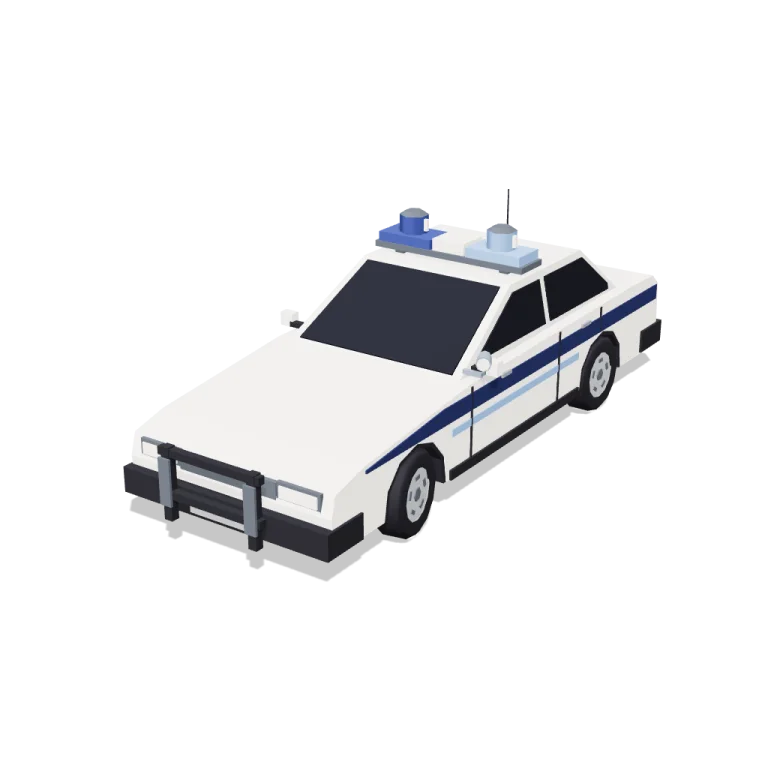
Left rail: colours and the 4 knobs the agent wrote into this model — they rebuild the geometry and go into your download. Right rail: looks for the viewer. Drag to orbit, scroll to zoom.
- Triangles
- 2,284
- Vertices
- 5,500
- Meshes · materials
- 44 · 44
- Size (W × H × D)
- 2.0 m × 1.8 m × 5.2 m
- File
- GLB · 278 KB
- Animation
- scene-motion · 6.0s
- Style
- Low-poly
- Collection
- Police Station
Palette · named materials
- body — body shell, cabin and pillars, mirror housings (warm white; navy in the two-tone style)#f2ede2
- livery — door band and boot band (navy)#1c2a54
- accent — pinstripe, left lens and beacon (pale blue)#7e9fce
- beacon — right lens and beacon (navy light)#344989
- glass — windows, windscreen, rear screen (navy dark)#090d1b
- earth — tyres, bumpers, push bar, sills, door seams, well liners, aerial (soot black)#1b1b22
- trim — grille, headlamp bezels, light-bar base, beacon caps, hub caps, push-bar pads (grey dark)#525860
- hub — wheel covers and blank plates (grey light)#a3a5a8
- metal — spotlight housing and bracket (steel)#7e8c9a
- handle — door handles (mid grey)#7d828c
- light — headlamps, spotlight lens, light-bar centre, beacon reflector fins (warm white)#f2ede2
- tail-light — tail lamps (dark wood)#3d2a1c
Use it
import { GLTFLoader } from "three/addons/loaders/GLTFLoader.js";

const gltf = await new GLTFLoader().loadAsync(
  "https://assets.stoicsoft.com/1designtool/3d/models/police-station-patrol-car/a53074dbbf/model.glb"
);
scene.add(gltf.scene); // metres, +Y up, front faces +Z

const mixer = new THREE.AnimationMixer(gltf.scene);
gltf.animations.forEach((clip) => mixer.clipAction(clip).play());
// in your loop: mixer.update(delta)
How it was made
The brief given to 1DesignTool's “3D object” template:
Patrol car for the Police Station kit. Design it as one clear asset at believable real-world scale for that setting (state the size in metres in meta.notes), with its main parts modelled and named, readable at thumbnail size and from every orbit angle. It moves: author a seamless baked loop (2–12 s) with every pivot exactly at its hinge, axle or swivel, and keep the base still. This is one part of the Police Station kit (Low-poly style, flat-lowpoly direction): Front desk to holding cells. Use ONLY the kit palette, by name: navy #1c2a54, grey #757e8a, pale blue #7e9fce, steel #7e8c9a, navy dark #090d1b, grey dark #525860, navy light #344989, grey light #a3a5a8, soot black #1b1b22, warm white #f2ede2, mid grey #7d828c, dark wood #3d2a1c. Every material's `name` must be exactly the palette colour it uses — the GLB carries these names so the kit recolours as one; an unnamed material fails delivery. Kit knob: expose a param `countryStyling` (0–1, default 0.5) for the kit's "Country styling" setting wherever it makes sense on this part, and keep that id.
- Agent: Claude Code · Claude Opus 5.5 in 1DesignTool
- Direction: Low-poly · family vehicles
- three-check PASS · glb-lint PASS
Named parts · 22
- Patrol car
- Body
- Cabin and pillars
- Windows
- Livery
- Bumpers and grille
- Push bar
- Lamps
- Number plates
- Sills, handles and aerial
- Mirrors
- Light bar
- Left beacon
- Right beacon
- Spotlight
- Wheel wells
- Front left steering knuckle
- Front right steering knuckle
- Front left wheel
- Front right wheel
- Rear left wheel
- Rear right wheel
Note: Size: about 5.24 m long including the push bar (5.09 m bumper to bumper), 1.84 m wide over the bumpers (2.04 m over the mirrors) and 1.80 m tall to the top of the beacons (1.44 m at the roof). It sits on a 2.85 m wheelbase with 0.66 m wheels. The origin is at the bottom centre, the tyres rest on y = 0 and the front faces +Z. The exported model has 2,284 triangles in 44 meshes. Every material is named exactly after a kit palette colour, and 11 of the 12 colours are used (grey is not). The exporter writes one material per mesh, so a colour name appears on several materials: recolour by name. The kit palette has no red or yellow, so the tail lamps use dark wood and the beacons are pale blue and navy light. The lamps are lightly lit by the scene only, not emissive. The baked clip scene-motion (6 s, seamless) moves only parts on their own pivots: the wheels roll three whole turns on their axles, the front knuckles steer on kingpins through the wheel centres, the two beacons spin six turns in opposite directions on their spindles and the spotlight sweeps once on its swivel pin. The body never moves. The GLB's static node pose is the frame the export was taken at (t = 2 s), so the front wheels and the spotlight are turned slightly. Play or reset the clip for the rest pose. Params are baked into the GLB at their defaults and only change the geometry when the scene is rebuilt in the viewer. countryStyling (kit 'Country styling') picks the livery: below 0.34 a navy car with warm-white doors, 0.34–0.67 (default) a warm-white car with a full-length navy band, a pale-blue pinstripe and a boot band, and 0.67 and up a warm-white car with a two-row pale-blue and navy-light chequer between the arches. wheelbase moves the axles and wheel arches inside the fixed body. wheelRadius sets the wheel size, and the arches follow it. pushBar removes the push bar (the part stays registered but empty). At the extremes the model stays under 3,100 triangles and passes three-check. glb-lint reports 0 errors and 5 heuristic warnings: per-mesh materials above the direction default, duplicate same-colour materials, non-indexed flat-shaded geometry, intended overlaps where trim is set into the body, and glass, livery and bumpers flagged as detached because they sit on the body from other groups. Its verdict line reads UNVERIFIED only because no host requirements contract was supplied. plan-check's part-id regex rejects the hyphenated slug ids the library requires, so the plan was validated on a de-hyphenated copy (PASS); three-check accepts the hyphenated ids, and all 22 survive the GLB reload.
About the Patrol car 3D model
Patrol car is a free animated low-poly 3D model from the Police Station set. It measures 2.0 m × 1.8 m × 5.2 m (W × H × D) at real-world scale and is built from 2,284 triangles across 44 meshes, with 22 named parts and a baked animation (6.0 s). Download the 278 KB GLB and drop it into three.js, React Three Fiber, Godot or Blender — free for commercial use, no attribution required.
- Is the Patrol car 3D model free for commercial use?
- Yes. It is free under the 1DesignTool 3D library license: use it in personal and commercial work — games, apps, websites, renders, ads and client projects — and modify it as you like, with no credit required. What you can't do is re-sell or re-distribute the file on its own or inside a model pack.
- What file format is it, and how big is it?
- A single binary glTF 2.0 file (.glb), 278 KB: 2,284 triangles, 5,500 vertices and 44 materials, modelled in metres at 2.0 m × 1.8 m × 5.2 m.
- Is Patrol car animated?
- Yes — the GLB carries a baked animation (6.0 s), ready to play with any glTF animation mixer.
- Which engines and tools can open it?
- Anything that reads glTF 2.0. three.js, React Three Fiber, Babylon.js, Godot 4 and Blender import the GLB directly; Unity and Unreal Engine load it through their glTF importers. The snippets above show the exact code for three.js, React Three Fiber, Godot and Blender.
- How was the Patrol car 3D model made?
- Claude Code (Claude Opus 5.5) generated it inside 1DesignTool's 3D template from a written brief, then the design kit's checks verified the geometry and the GLB before it was published. You can make your own the same way with 1DesignTool.
More like this
All of Police Station →
Cell door
Police Station1,648 tris

Garage barrier
Police Station960 tris

Motorbike
Police Station3,012 tris

Notice boards
Police Station2,090 tris

Barriers
Police Station2,088 tris

Coffee machine
Police Station1,768 tris

Lockers
Police Station1,472 tris

Files
Police Station1,532 tris
Free under the 1DesignTool 3D library license. Model #24 of 1702.