Rovers' charging posts
A rover charging station for the Mars Colony kit: two white charging posts with rust-red heads, blue status screens and tilted solar panels, each with an orange plug docked beside a black cable loop, on a shared pad behind orange bumper bollards.
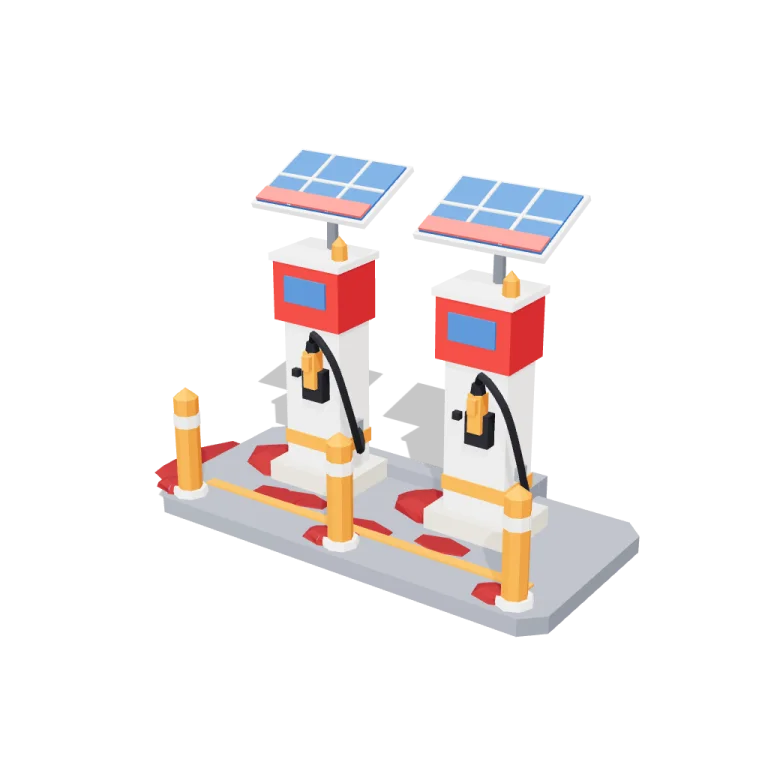
Left rail: colours and the 4 knobs the agent wrote into this model — they rebuild the geometry and go into your download. Right rail: looks for the viewer. Drag to orbit, scroll to zoom.
- Triangles
- 1,972
- Vertices
- 5,916
- Meshes · materials
- 21 · 21
- Size (W × H × D)
- 3.5 m × 2.4 m × 1.6 m
- File
- GLB · 208 KB
- Animation
- Static
- Style
- Low-poly
- Collection
- Mars Colony
Palette · named materials
- body#f4f1ec
- head#c32222
- accent#ed7e1d
- screen#2e67b8
- trim#7d828c
- base#d7cebc
- frame#f9f8f6
- cable#1b1b22
- dustFilm#db5757
- dustGround#821717
Use it
import { GLTFLoader } from "three/addons/loaders/GLTFLoader.js";

const gltf = await new GLTFLoader().loadAsync(
  "https://assets.stoicsoft.com/1designtool/3d/models/mars-colony-rovers-charging-posts/10e590ca09/model.glb"
);
scene.add(gltf.scene); // metres, +Y up, front faces +Z
How it was made
The brief given to 1DesignTool's “3D object” template:
Rovers' charging posts for the Mars Colony kit. Design it as one clear asset at believable real-world scale for that setting (state the size in metres in meta.notes), with its main parts modelled and named, readable at thumbnail size and from every orbit angle. This is one part of the Mars Colony kit (Low-poly style, flat-lowpoly direction): A first settlement on red dust. Use ONLY the kit palette, by name: rust red #c32222, white #f4f1ec, solar blue #2e67b8, hazard orange #ed7e1d, rust red dark #821717, white dark #d7cebc, rust red light #db5757, white light #f9f8f6, soot black #1b1b22, warm white #f2ede2, mid grey #7d828c, dark wood #3d2a1c. Every material's `name` must be exactly the palette colour it uses — the GLB carries these names so the kit recolours as one; an unnamed material fails delivery. Kit knob: expose a param `dustStormLevel` (0–1, default 0.5) for the kit's "Dust storm level" setting wherever it makes sense on this part, and keep that id.
- Agent: Claude Code · Claude Opus 5.5 in 1DesignTool
- Generation: 2.94M tokens (94% cached) · ≈ $2.34 at API prices · 5-hour plan +6%
- Direction: Low-poly · family products
- three-check PASS · glb-lint PASS
Named parts · 18
- Rovers' charging posts
- Pad
- Hazard stripe
- Power conduit
- Plinths
- Post bodies
- Hazard bands
- Heads
- Status screens
- Beacons
- Holsters
- Plugs
- Cables
- Panel masts
- Solar panel frames
- Solar cells
- Bumper bollards
- Regolith dust
Note: Real-world size: 2.38 m tall overall (posts are 1.8 m to the top of the head, with the solar panels on 0.42 m masts above). The shared pad is 3.1 m x 1.5 m x 0.12 m; the power conduit drops to the ground just behind it, and drifts extend about 0.3 m past the left edge. Front (+Z) carries the screens, plugs and bollards. Static asset: the GLB has no animation clip and evaluatePose is a no-op. dustStormLevel (0-1) rebuilds the drift mounds banked on the windward (-X) side of the pad, plinths and bollards, the dust patches on the pad, and a dust strip creeping down the low edge of each solar panel. At 0, the dust parts are left out. postCount (1-3) widens the pad and adds bollards, postHeight stretches the post bodies, and panelTilt tips the panels toward the front. Part ids use the dotted form mars.colony.rovers.charging.posts.* because the kit part-id rule does not allow hyphens. Material names are the exact kit palette colour names (10 used) so the kit can recolour the set. The exporter writes one material copy per mesh (21 in the GLB). Geometry is non-indexed with baked flat normals so it stays faceted in any importer. 1972 triangles in the exported GLB.
More like this
All of Mars Colony →
Cargo lander
Mars Colony2,460 tris

Airlock door
Mars Colony1,528 tris

Rotating dish
Mars Colony1,524 tris

Six-wheel rover
Mars Colony2,076 tris

Flags
Mars Colony884 tris

Sample crates
Mars Colony2,588 tris

Drills
Mars Colony2,040 tris

Antenna masts
Mars Colony2,456 tris
Free under the 1DesignTool 3D library license. Model #20 of 515.