Cargo lander
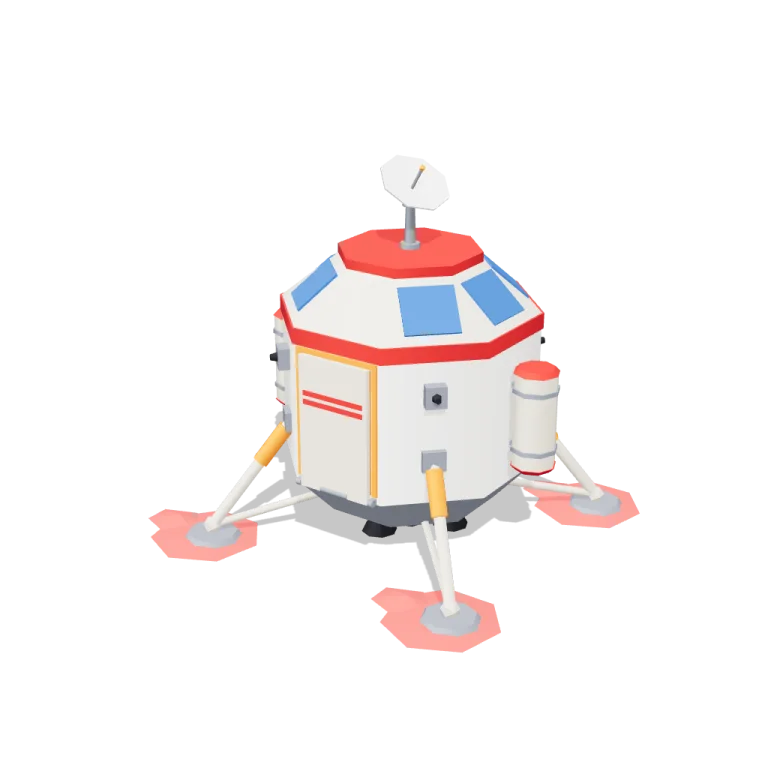
An uncrewed Mars colony cargo lander: a white octagonal cargo module on a grey descent stage with engine bells, four splayed landing legs, strapped side canisters and a solar roof. Its hazard-framed cargo ramp lowers onto the dust and closes again while the roof comms dish swivels, in a seamless 10 s loop.
Left rail: colours and the 4 knobs the agent wrote into this model — they rebuild the geometry and go into your download. Bottom: what the model does — the one you pick plays here and is baked into the download. Right rail: looks for the viewer. Drag to orbit, scroll to zoom. On a desktop, Open in 1DesignTool turns it into a project you can keep editing with your agent.
- Triangles
- 2,460
- Vertices
- 7,380
- Meshes · materials
- 27 · 27
- Size (W × H × D)
- 6.6 m × 6.1 m × 6.2 m
- File
- GLB · 287 KB
- Animation
- scene-motion · 10.0s
- Style
- Low-poly
- Collection
- Mars Colony
Palette · named materials
- base#f4f1ec
- trim#d7cebc
- accent#c32222
- accent#ed7e1d
- water#2e67b8
- trim#7d828c
- trim#1b1b22
- earth#db5757
Use it
import { GLTFLoader } from "three/addons/loaders/GLTFLoader.js";

const gltf = await new GLTFLoader().loadAsync(
  "https://assets.stoicsoft.com/1designtool/3d/models/mars-colony-cargo-lander/1be7cd4b7f/model.glb"
);
scene.add(gltf.scene); // metres, +Y up, front faces +Z

const mixer = new THREE.AnimationMixer(gltf.scene);
gltf.animations.forEach((clip) => mixer.clipAction(clip).play());
// in your loop: mixer.update(delta)
How it was made
The brief given to 1DesignTool's “3D object” template:
Cargo lander for the Mars Colony kit. Design it as one clear asset at believable real-world scale for that setting (state the size in metres in meta.notes), with its main parts modelled and named, readable at thumbnail size and from every orbit angle. It moves: author a seamless baked loop (2–12 s) with every pivot exactly at its hinge, axle or swivel, and keep the base still. This is one part of the Mars Colony kit (Low-poly style, flat-lowpoly direction): A first settlement on red dust. Use ONLY the kit palette, by name: rust red #c32222, white #f4f1ec, solar blue #2e67b8, hazard orange #ed7e1d, rust red dark #821717, white dark #d7cebc, rust red light #db5757, white light #f9f8f6, soot black #1b1b22, warm white #f2ede2, mid grey #7d828c, dark wood #3d2a1c. Every material's `name` must be exactly the palette colour it uses — the GLB carries these names so the kit recolours as one; an unnamed material fails delivery. Kit knob: expose a param `dustStormLevel` (0–1, default 0.5) for the kit's "Dust storm level" setting wherever it makes sense on this part, and keep that id.
- Agent: Claude Code · Claude Opus 5.5 in 1DesignTool
- Generation: 6.12M tokens (96% cached) · ≈ $3.78 at API prices · 5-hour plan +9%
- Direction: Low-poly · family vehicles
- three-check PASS · glb-lint PASS
Named parts · 16
- Cargo lander
- Descent stage
- Engine bells
- Cargo module
- Hull bands
- Roof
- Solar panels
- RCS pods
- Cargo canisters
- Cargo bay
- Ramp hinge
- Cargo ramp
- Landing legs
- Comms mast
- Comms dish
- Dust drifts
Note: Real-world scale: 6.07 m tall to the dish. The hull is 3.8 m across the flats (about 5.3 m including the side canisters), the footpads sit on a 3.2 m radius and the deck is 1.3 m off the ground. Overall footprint is about 6.6 × 6.2 m including the dust drifts; the model rests on y = 0 with the front (cargo door) facing +Z. The GLB has 2,460 triangles and one baked clip, 'scene-motion' (10 s, loops seamlessly). The ramp turns about its hinge pin: it is closed from 0 to 2.5 s, lowers until its tip rests on y = 0 at 5 s, holds, and is closed again by 9.5 s. The dish yaws one full turn about the mast axis. Every other node has constant tracks, so the hull, legs and dust stay still. The GLB's static (unplayed) pose has the ramp closed and the dish turned 72°. Material names are the kit palette colours (white, white dark, rust red, hazard orange, solar blue, mid grey, soot black, rust red light). The exporter clones a material per mesh, so each palette name can appear more than once with identical settings; recolour by matching material name. Part ids use the hyphen-free slug 'marscolonycargolander.*' because the kit's plan checker only accepts [a-z0-9] id segments. Params are build-time remixes: dustStormLevel scales the drifts banked around the footpads and the trailing ridges (0 = swept clean, 1 = after a storm), rampOpen scales how far the baked ramp travels, legSpan moves the footpads and struts, and dishTurns sets whole dish turns per loop (0 = parked). The red regolith disc in the previews is viewer-only staging and is not in the GLB. OBJ export is geometry only. Fix rounds: (1) raised the stance and enlarged the engines and legs, and added side canisters, so it reads as a lander instead of a hut; (2) hero framing; (3) a staging shadow z-fight. A later timing-only change keeps the ramp closed in the exported static pose.
About the Cargo lander 3D model
Cargo lander is a free animated low-poly 3D model from the Mars Colony set. It measures 6.6 m × 6.1 m × 6.2 m (W × H × D) at real-world scale and is built from 2,460 triangles across 27 meshes, with 16 named parts and a baked animation (10.0 s). Download the 287 KB GLB and drop it into three.js, React Three Fiber, Godot or Blender — free for commercial use, no attribution required.
- Is the Cargo lander 3D model free for commercial use?
- Yes. It is free under the 1DesignTool 3D library license: use it in personal and commercial work — games, apps, websites, renders, ads and client projects — and modify it as you like, with no credit required. What you can't do is re-sell or re-distribute the file on its own or inside a model pack.
- What file format is it, and how big is it?
- A single binary glTF 2.0 file (.glb), 287 KB: 2,460 triangles, 7,380 vertices and 27 materials, modelled in metres at 6.6 m × 6.1 m × 6.2 m.
- Is Cargo lander animated?
- Yes — the GLB carries a baked animation (10.0 s), ready to play with any glTF animation mixer.
- Which engines and tools can open it?
- Anything that reads glTF 2.0. three.js, React Three Fiber, Babylon.js, Godot 4 and Blender import the GLB directly; Unity and Unreal Engine load it through their glTF importers. The snippets above show the exact code for three.js, React Three Fiber, Godot and Blender.
- How was the Cargo lander 3D model made?
- Claude Code (Claude Opus 5.5) generated it inside 1DesignTool's 3D template from a written brief, then the design kit's checks verified the geometry and the GLB before it was published. You can make your own the same way with 1DesignTool.
More like this
All of Mars Colony →
Mars Helper Robot
Mars Colony3,133 tris

Mars Colony Botanist
Mars Colony3,442 tris

Mars Colonist
Mars Colony3,738 tris

Airlock door
Mars Colony1,528 tris

Rotating dish
Mars Colony1,524 tris

Six-wheel rover
Mars Colony2,076 tris

Flags
Mars Colony884 tris

Rovers' charging posts
Mars Colony1,972 tris
Free under the 1DesignTool 3D library license. Model #1861 of 2361.