Tunnel walkway
A low-poly walk-through aquarium tunnel module: a faceted glass arch on steel ribs over a plinth, with a moving walkway belt down the middle and kelp or sea fans swaying on the sand beds outside the glass. It snaps end-to-end on a 1 m grid.
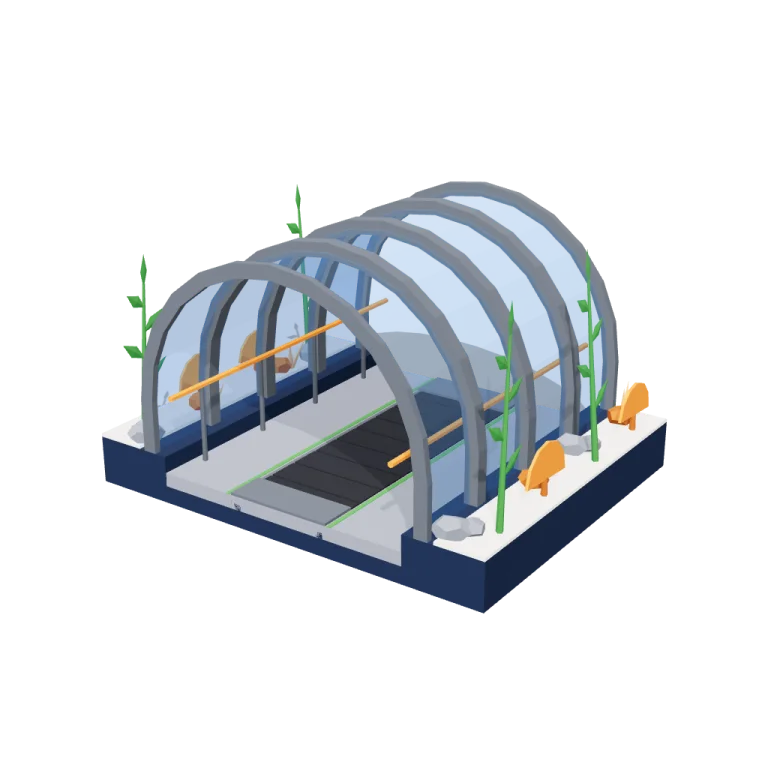
Left rail: colours and the 4 knobs the agent wrote into this model — they rebuild the geometry and go into your download. Right rail: looks for the viewer. Drag to orbit, scroll to zoom.
- Triangles
- 2,104
- Vertices
- 3,789
- Meshes · materials
- 25 · 25
- Size (W × H × D)
- 5.0 m × 3.0 m × 4.0 m
- File
- GLB · 159 KB
- Animation
- scene-motion · 4.0s
- Style
- Low-poly
- Collection
- Aquarium
Palette · named materials
- base#0d223f
- deck#7d828c
- sand#f2ede2
- frame#525860
- glass#2e67b8
- belt#1b1b22
- accent#ed7e1d
- foliage#3a883a
- coral#eea668
- coralShade#af590e
Use it
import { GLTFLoader } from "three/addons/loaders/GLTFLoader.js";

const gltf = await new GLTFLoader().loadAsync(
  "https://assets.stoicsoft.com/1designtool/3d/models/aquarium-tunnel-walkway/f3c74c42f1/model.glb"
);
scene.add(gltf.scene); // metres, +Y up, front faces +Z

const mixer = new THREE.AnimationMixer(gltf.scene);
gltf.animations.forEach((clip) => mixer.clipAction(clip).play());
// in your loop: mixer.update(delta)
How it was made
The brief given to 1DesignTool's “3D object” template:
Tunnel walkway for the Aquarium kit. Design it as one clear asset at believable real-world scale for that setting (state the size in metres in meta.notes), with its main parts modelled and named, readable at thumbnail size and from every orbit angle. It is a modular piece that snaps on a 1 m grid: give it a length in whole metres and put the origin at its snapping end, stated in meta.notes. It moves: author a seamless baked loop (2–12 s) with every pivot exactly at its hinge, axle or swivel, and keep the base still. This is one part of the Aquarium kit (Low-poly style, flat-lowpoly direction): Glass tunnels through blue water. Use ONLY the kit palette, by name: deep blue #1b447e, coral orange #ed7e1d, glow green #3a883a, dark grey #525860, deep blue dark #0d223f, coral orange dark #af590e, deep blue light #2e67b8, coral orange light #eea668, soot black #1b1b22, warm white #f2ede2, mid grey #7d828c, dark wood #3d2a1c. Every material's `name` must be exactly the palette colour it uses — the GLB carries these names so the kit recolours as one; an unnamed material fails delivery. Kit knob: expose a param `seaRegion` (0–1, default 0.5) for the kit's "Sea region" setting wherever it makes sense on this part, and keep that id.
- Agent: Claude Code · Claude Opus 5.5 in 1DesignTool
- Generation: 5.36M tokens (96% cached) · ≈ $3.57 at API prices · 5-hour plan +9%
- Direction: Low-poly · family abstract-kinetic
- three-check PASS · glb-lint PASS
Named parts · 11
- Tunnel walkway
- Plinth and sills
- Walkway deck
- Sand beds
- Glass arch
- Frame ribs
- Handrails
- Landing plates
- Travelator belt
- Coral and rocks
- Swaying plant (one per metre per side, l0…lN / r0…rN)
Note: Size at default params: 5.0 m wide x 3.0 m tall x 4.0 m long, 2,104 triangles (an estimated 4,200 at the 8 m maximum, since geometry scales with length). Interior: a 3.5 m glass span, a 1.2 m moving walkway between two 0.93 m decks, and handrails 0.9 m above the deck. Snapping: the origin is the bottom centre of the front (+Z) snap face. The module runs back along -Z for lengthM whole metres, so the next module's origin goes at z = -lengthM. Frame ribs sit on every metre line and are half depth at both snap faces, so two joined modules form one full rib. Nothing extends past z = 0 or z = -lengthM. Motion: a 4 s seamless baked clip. The walkway belt advances exactly one pallet pitch per loop (about 0.39 m at 4 m length; slower than a real travelator so the loop stays seamless), with the hidden pallet sliding out from under the landing plate. Kelp and sea fans sway on pivots at their holdfasts. The plinth, deck, glass, ribs and rails never move. Sea region (0 to 1) picks the planting per metre bay: low values give a cold kelp forest with rocks, high values give a warm reef with sea fans and coral. Layout is seeded per bay, so changing the length keeps existing bays. Glass is a single double-sided translucent shell (deep blue light, about 32% opacity). Materials are named after the Aquarium palette colours. The runtime exporter writes one material copy per mesh, so several materials share a name: recolour by name, not by index. glb-lint reported 0 errors and only heuristic warnings: per-mesh material copies, plants and deck pieces in their own groups flagged as detached, intentional nesting such as the glass seated in the ribs, and height against a 1 m reference. The kit's plan-check rejects the hyphenated part-id format this library requires; that is its only complaint.
About the Tunnel walkway 3D model
Tunnel walkway is a free animated low-poly 3D model from the Aquarium set. It measures 5.0 m × 3.0 m × 4.0 m (W × H × D) at real-world scale and is built from 2,104 triangles across 25 meshes, with 11 named parts and a baked animation (4.0 s). Download the 159 KB GLB and drop it into three.js, React Three Fiber, Godot or Blender — free for commercial use, no attribution required.
- Is the Tunnel walkway 3D model free for commercial use?
- Yes. It is free under the 1DesignTool 3D library license: use it in personal and commercial work — games, apps, websites, renders, ads and client projects — and modify it as you like, with no credit required. What you can't do is re-sell or re-distribute the file on its own or inside a model pack.
- What file format is it, and how big is it?
- A single binary glTF 2.0 file (.glb), 159 KB: 2,104 triangles, 3,789 vertices and 25 materials, modelled in metres at 5.0 m × 3.0 m × 4.0 m.
- Is Tunnel walkway animated?
- Yes — the GLB carries a baked animation (4.0 s), ready to play with any glTF animation mixer.
- Which engines and tools can open it?
- Anything that reads glTF 2.0. three.js, React Three Fiber, Babylon.js, Godot 4 and Blender import the GLB directly; Unity and Unreal Engine load it through their glTF importers. The snippets above show the exact code for three.js, React Three Fiber, Godot and Blender.
- How was the Tunnel walkway 3D model made?
- Claude Code (Claude Opus 5.5) generated it inside 1DesignTool's 3D template from a written brief, then the design kit's checks verified the geometry and the GLB before it was published. You can make your own the same way with 1DesignTool.
More like this
All of Aquarium →
Info screens
Aquarium1,380 tris

Benches
Aquarium356 tris

Plush toys
Aquarium2,988 tris

Diving gear
Aquarium2,200 tris

Swimming fish schools
Aquarium2,256 tris

Bubbles
Aquarium2,026 tris

Feeding platform
Aquarium1,416 tris

Zip line
Rooftop District1,952 tris
Free under the 1DesignTool 3D library license. Model #20 of 902.