Vintage car
A 1930s open-tourer wedding car in ivory with black wings, a gold radiator, lamps and windscreen, blush-pink seats and a pink ribbon V running from the radiator bow to the windscreen. Low-poly, built for the Wedding Venue kit.
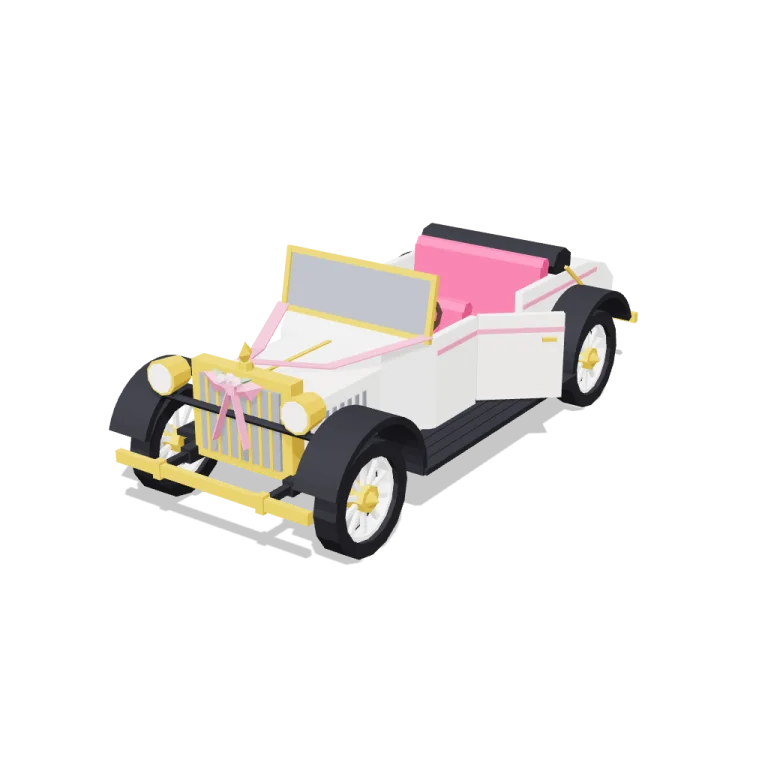
Left rail: colours and the 3 knobs the agent wrote into this model — they rebuild the geometry and go into your download. Right rail: looks for the viewer. Drag to orbit, scroll to zoom.
- Triangles
- 4,028
- Vertices
- 12,084
- Meshes · materials
- 47 · 47
- Size (W × H × D)
- 2.0 m × 1.5 m × 4.4 m
- File
- GLB · 360 KB
- Animation
- scene-motion · 8.0s
- Style
- Low-poly
- Collection
- Wedding Venue
Palette · named materials
- body#f4f1ec
- wings#1b1b22
- trim#d0a225
- seats#d14775
- ribbon#e085a3
- flowers#eec4d2
- leaves#89a178
- glass#7d828c
- wood#3d2a1c
- lens#f2ede2
Use it
import { GLTFLoader } from "three/addons/loaders/GLTFLoader.js";

const gltf = await new GLTFLoader().loadAsync(
  "https://assets.stoicsoft.com/1designtool/3d/models/wedding-venue-vintage-car/2dcf36d487/model.glb"
);
scene.add(gltf.scene); // metres, +Y up, front faces +Z

const mixer = new THREE.AnimationMixer(gltf.scene);
gltf.animations.forEach((clip) => mixer.clipAction(clip).play());
// in your loop: mixer.update(delta)
How it was made
The brief given to 1DesignTool's “3D object” template:
Vintage car for the Wedding Venue kit. Design it as one clear asset at believable real-world scale for that setting (state the size in metres in meta.notes), with its main parts modelled and named, readable at thumbnail size and from every orbit angle. It moves: author a seamless baked loop (2–12 s) with every pivot exactly at its hinge, axle or swivel, and keep the base still. This is one part of the Wedding Venue kit (Low-poly style, flat-lowpoly direction): A garden ceremony and a party. Use ONLY the kit palette, by name: white #f4f1ec, blush pink #e085a3, sage #89a178, gold #d0a225, white dark #d7cebc, blush pink dark #d14775, white light #f9f8f6, blush pink light #eec4d2, soot black #1b1b22, warm white #f2ede2, mid grey #7d828c, dark wood #3d2a1c. Every material's `name` must be exactly the palette colour it uses — the GLB carries these names so the kit recolours as one; an unnamed material fails delivery. Kit knob: expose a param `colourScheme` (0–1, default 0.5) for the kit's "Colour scheme" setting wherever it makes sense on this part, and keep that id.
- Agent: Claude Code · Claude Opus 5.5 in 1DesignTool
- Generation: 4.45M tokens (95% cached) · ≈ $3.39 at API prices · 5-hour plan +8%
- Direction: Low-poly · family vehicles
- three-check PASS · glb-lint PASS
Named parts · 23
- Vintage car
- Chassis
- Front left wheel
- Front right wheel
- Rear left wheel
- Rear right wheel
- Wings
- Running boards
- Bumpers
- Body
- Bonnet
- Radiator
- Headlamps
- Tourer tub
- Right rear door
- Left rear door
- Windscreen
- Seats
- Steering wheel
- Folded hood
- Ribbon
- Bow and posy
- Bow tails
Note: Real-world scale for a 1930s open tourer: about 4.40 m long (bumper to bumper), 1.84 m wide over the wings and 1.51 m tall to the windscreen top. Wheels are 0.76 m across on a 2.95 m wheelbase. Units are metres, +Y is up, the radiator faces +Z, and the origin is at bottom centre with the tyres resting on y = 0. Baked clip 'scene-motion' (8 s, seamless): the sprung body shimmers 4 mm at engine idle, the right rear door swings open on its front hinge (group origin is on the hinge line), holds, then closes, and the bow tails flutter about the knot. Wheels and chassis never move. colourScheme switches between palette sets: 0–0.33 all ivory (white body, white dark wings, blush pink seats); 0.33–0.67 ivory and black (the default); 0.67–1 blush (blush pink light body, white wings, white light ribbon). Material names always match the palette colour in use. doorSwing sets the door's peak angle in the loop. Part ids use the prefix 'weddingvenuevintagecar' with no hyphens, because the kit's part-id rule forbids hyphens. The runtime exporter writes one material copy per mesh, so the GLB repeats the same ten palette-named materials (dedupe by name if needed). The glb-lint warnings are expected: the primitives are non-indexed on purpose for flat facets, the overlaps are tyre/rim/hub nesting and the wings and boards built into the body, and the 'detached' parts are separate groups that meet other groups (seats on the floor, ribbon a few mm above the bonnet). No text, plates or logos; the mascot is an abstract gold finial.
About the Vintage car 3D model
Vintage car is a free animated low-poly 3D model from the Wedding Venue set. It measures 2.0 m × 1.5 m × 4.4 m (W × H × D) at real-world scale and is built from 4,028 triangles across 47 meshes, with 23 named parts and a baked animation (8.0 s). Download the 360 KB GLB and drop it into three.js, React Three Fiber, Godot or Blender — free for commercial use, no attribution required.
- Is the Vintage car 3D model free for commercial use?
- Yes. It is free under the 1DesignTool 3D library license: use it in personal and commercial work — games, apps, websites, renders, ads and client projects — and modify it as you like, with no credit required. What you can't do is re-sell or re-distribute the file on its own or inside a model pack.
- What file format is it, and how big is it?
- A single binary glTF 2.0 file (.glb), 360 KB: 4,028 triangles, 12,084 vertices and 47 materials, modelled in metres at 2.0 m × 1.5 m × 4.4 m.
- Is Vintage car animated?
- Yes — the GLB carries a baked animation (8.0 s), ready to play with any glTF animation mixer.
- Which engines and tools can open it?
- Anything that reads glTF 2.0. three.js, React Three Fiber, Babylon.js, Godot 4 and Blender import the GLB directly; Unity and Unreal Engine load it through their glTF importers. The snippets above show the exact code for three.js, React Three Fiber, Godot and Blender.
- How was the Vintage car 3D model made?
- Claude Code (Claude Opus 5.5) generated it inside 1DesignTool's 3D template from a written brief, then the design kit's checks verified the geometry and the GLB before it was published. You can make your own the same way with 1DesignTool.
More like this
All of Wedding Venue →
Ceremony arch
Wedding Venue2,716 tris

Chapel
Wedding Venue2,332 tris

Marquee
Wedding Venue4,228 tris

Dance floor
Wedding Venue1,624 tris

Garden path tiles
Wedding Venue3,016 tris

Gazebo
Wedding Venue4,448 tris

Chairs
Wedding Venue1,580 tris

Flower arrangements
Wedding Venue4,138 tris
Free under the 1DesignTool 3D library license. Model #69 of 872.