Mud ground tiles
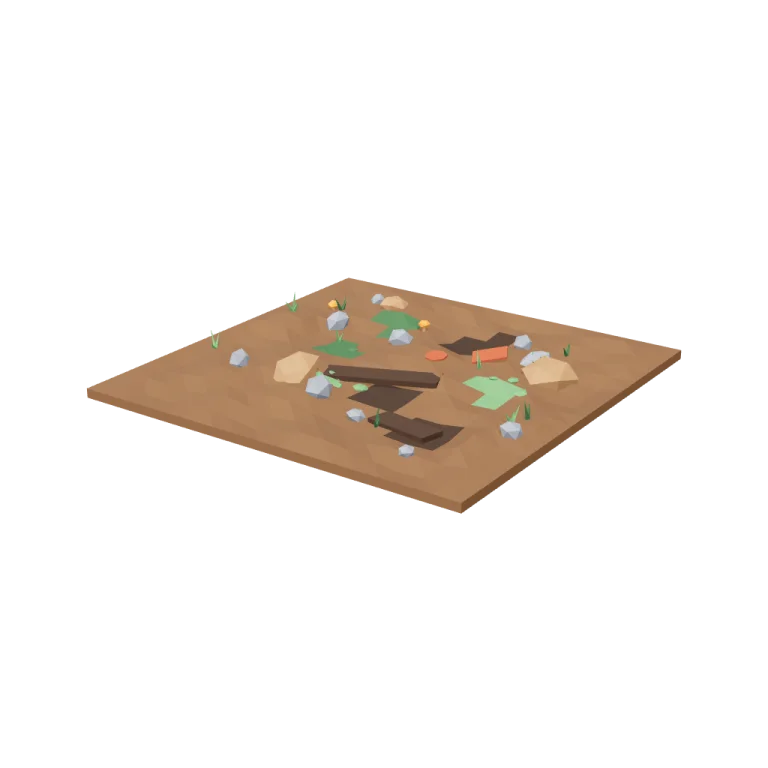
One exact 4 x 4 m flat-shaded mud ground tile for the Goblin Market kit — churned brown earth with recessed puddles, ragged moss patches, scattered rocks, weed tufts, a broken plank, rusted scrap and a few orange toadstools. Built to butt seamlessly with identical neighbours in every direction.
Left rail: colours and the 4 knobs the agent wrote into this model — they rebuild the geometry and go into your download. Bottom: what the model does — the one you pick plays here and is baked into the download. Right rail: looks for the viewer. Drag to orbit, scroll to zoom. On a desktop, Open in 1DesignTool turns it into a project you can keep editing with your agent.
- Triangles
- 1,570
- Vertices
- 4,636
- Meshes · materials
- 16 · 16
- Size (W × H × D)
- 4.0 m × 36 cm × 4.0 m
- File
- GLB · 148 KB
- Animation
- Static
- Style
- Low-poly
- Collection
- Goblin Market
Palette · named materials
- mud brown#6b4a2e
- mud brown light#9b704b
- mud brown dark#362517
- sickly green#528952
- sickly green dark#365936
- mid grey#7d828c
- dark wood#3d2a1c
- rust#9b4427
- lantern orange#ed7e1d
Use it
import { GLTFLoader } from "three/addons/loaders/GLTFLoader.js";

const gltf = await new GLTFLoader().loadAsync(
  "https://assets.stoicsoft.com/1designtool/3d/models/goblin-market-mud-ground-tiles/5c008b373b/model.glb"
);
scene.add(gltf.scene); // metres, +Y up, front faces +Z
How it was made
The brief given to 1DesignTool's “3D object” template:
Mud ground tiles for the Goblin Market kit. Design it as one clear asset at believable real-world scale for that setting (state the size in metres in meta.notes), with its main parts modelled and named, readable at thumbnail size and from every orbit angle. Make it a ground piece on an exact 4 × 4 m footprint with flat edges at y = 0 that tile seamlessly with its neighbours in every direction; origin at the tile centre. This is one part of the Goblin Market kit (Low-poly style, flat-lowpoly direction): A chaotic night market of scrap stalls. Use ONLY the kit palette, by name: mud brown #6b4a2e, sickly green #528952, rust #9b4427, lantern orange #ed7e1d, mud brown dark #362517, sickly green dark #365936, mud brown light #9b704b, sickly green light #7ea97e, soot black #1b1b22, warm white #f2ede2, mid grey #7d828c, dark wood #3d2a1c. Every material's `name` must be exactly the palette colour it uses — the GLB carries these names so the kit recolours as one; an unnamed material fails delivery. Kit knob: expose a param `clutterAmount` (0–1, default 0.5) for the kit's "Clutter amount" setting wherever it makes sense on this part, and keep that id. Material names are the palette colour NAMES listed above (e.g. "leaf green", "dark wood") — never a hex code like "#3d2a1c". meta.json must be valid JSON.
- Agent: OpenCode · longcat-2.5-preview-free in 1DesignTool
- Direction: Low-poly · family scenes
- three-check PASS · glb-lint PASS
Named parts · 9
- Mud ground tile
- Mud slab
- Moss clumps
- Scattered rocks
- Mud clods
- Weed tufts
- Broken plank
- Rusted scrap
- Toadstools
Note: Footprint is exactly 4.00 x 4.00 m; the bottom face sits on y = 0, the four side walls are flat vertical planes at x/z = +/-2.00 m and the top rim is a level band, so identical copies butt seamlessly in all four directions. Origin is at the tile centre. The slab is ~0.22 m of churned mud; the tallest scattered clod reaches 0.36 m, which is why the bounds height is 0.36 m. Materials are flat-shaded MeshStandardMaterials named by Goblin Market palette colour (metalness 0, roughness 0.95), no textures. clutterAmount scales every scattered prop (rocks, clods, weeds, toadstools, plank, scrap); relief deepens the surface; puddleAmount and mossAmount add recessed dark puddles and ragged green patches. Static asset — evaluatePose is a no-op and no clip is baked, so the GLB carries no animation. glb-lint ran without a requirements contract, so its verdict is UNVERIFIED with 0 blocking errors; remaining warnings are expected: the runtime's export clones one material per mesh (16 named palette materials), flat shading makes 70%+ of primitives non-indexed, and the surface/relief groups and seated props register as heuristic sibling-overlap / detached-part candidates.
About the Mud ground tiles 3D model
Mud ground tiles is a free low-poly 3D model from the Goblin Market set. It measures 4.0 m × 36 cm × 4.0 m (W × H × D) at real-world scale and is built from 1,570 triangles across 16 meshes, with 9 named parts. Download the 148 KB GLB and drop it into three.js, React Three Fiber, Godot or Blender — free for commercial use, no attribution required.
- Is the Mud ground tiles 3D model free for commercial use?
- Yes. It is free under the 1DesignTool 3D library license: use it in personal and commercial work — games, apps, websites, renders, ads and client projects — and modify it as you like, with no credit required. What you can't do is re-sell or re-distribute the file on its own or inside a model pack.
- What file format is it, and how big is it?
- A single binary glTF 2.0 file (.glb), 148 KB: 1,570 triangles, 4,636 vertices and 16 materials, modelled in metres at 4.0 m × 36 cm × 4.0 m.
- Can I animate Mud ground tiles?
- It ships as a static mesh. Its 9 named parts are separate nodes, so you can move or animate each one in your engine.
- Which engines and tools can open it?
- Anything that reads glTF 2.0. three.js, React Three Fiber, Babylon.js, Godot 4 and Blender import the GLB directly; Unity and Unreal Engine load it through their glTF importers. The snippets above show the exact code for three.js, React Three Fiber, Godot and Blender.
- How was the Mud ground tiles 3D model made?
- OpenCode (longcat-2.5-preview-free) generated it inside 1DesignTool's 3D template from a written brief, then the design kit's checks verified the geometry and the GLB before it was published. You can make your own the same way with 1DesignTool.
More like this
All of Goblin Market →
Goblin Market Thief
Goblin Market3,367 tris

Ogre Guard
Goblin Market3,317 tris

Goblin Trader
Goblin Market3,246 tris

Spinning prize wheel
Goblin Market1,100 tris

Junk piles
Goblin Market1,446 tris

Mystery jars
Goblin Market2,064 tris

Cooking pots
Goblin Market4,348 tris

Scrap stalls
Goblin Market2,032 tris
Free under the 1DesignTool 3D library license. Model #2143 of 2361.