Track tiles
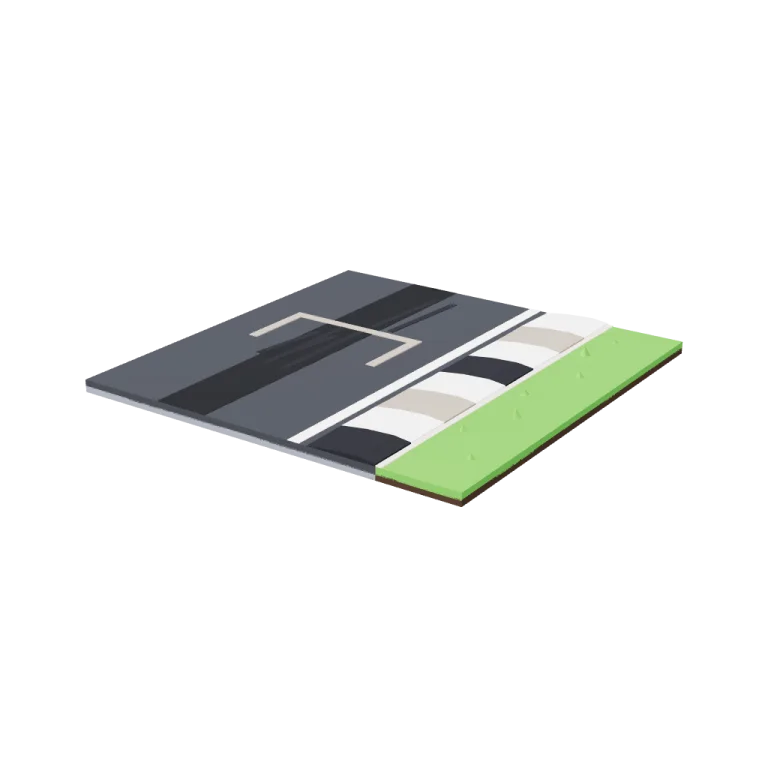
A low-poly 4 × 4 m racing circuit tile at the track edge: dark tarmac with a rubbered racing line, skid marks and a starting-grid slot, a white track-limit line, a striped kerb and a grass verge. Every edge is flat at the same height and the kerb stripes repeat every tile, so copies chain seamlessly along the track.
Left rail: colours and the 4 knobs the agent wrote into this model — they rebuild the geometry and go into your download. Right rail: looks for the viewer. Drag to orbit, scroll to zoom.
- Triangles
- 668
- Vertices
- 2,004
- Meshes · materials
- 13 · 13
- Size (W × H × D)
- 4.0 m × 23 cm × 4.0 m
- File
- GLB · 58 KB
- Animation
- Static
- Style
- Low-poly
- Collection
- Racing Circuit
Palette · named materials
- track surface (tarmac)#34373d
- rubbered racing line (tarmac dark)#101113
- skid marks, plain kerb stripes (soot black)#1b1b22
- kerb white stripes (kerb red and white)#f4f1ec
- kerb footing strip (kerb red and white dark)#d7cebc
- track-limit line (kerb red and white light)#f9f8f6
- team livery kerb stripes and grid slot (flag colours)#988e81
- verge and tufts (grass)#539b3b
- verge soil (dark wood)#3d2a1c
- sub-base under the track (mid grey)#7d828c
Use it
import { GLTFLoader } from "three/addons/loaders/GLTFLoader.js";

const gltf = await new GLTFLoader().loadAsync(
  "https://assets.stoicsoft.com/1designtool/3d/models/racing-circuit-track-tiles/fee34d0134/model.glb"
);
scene.add(gltf.scene); // metres, +Y up, front faces +Z
How it was made
The brief given to 1DesignTool's “3D object” template:
Track tiles for the Racing Circuit kit. Design it as one clear asset at believable real-world scale for that setting (state the size in metres in meta.notes), with its main parts modelled and named, readable at thumbnail size and from every orbit angle. Make it a ground piece on an exact 4 × 4 m footprint with flat edges at y = 0 that tile seamlessly with its neighbours in every direction; origin at the tile centre. This is one part of the Racing Circuit kit (Low-poly style, flat-lowpoly direction): Speed, pit stops and crowds. Use ONLY the kit palette, by name: tarmac #34373d, kerb red and white #f4f1ec, flag colours #988e81, grass #539b3b, tarmac dark #101113, kerb red and white dark #d7cebc, tarmac light #5c5d61, kerb red and white light #f9f8f6, soot black #1b1b22, warm white #f2ede2, mid grey #7d828c, dark wood #3d2a1c. Every material's `name` must be exactly the palette colour it uses — the GLB carries these names so the kit recolours as one; an unnamed material fails delivery. Kit knob: expose a param `teamLiveries` (0–1, default 0.5) for the kit's "Team liveries" setting wherever it makes sense on this part, and keep that id.
- Agent: Claude Code · Claude Opus 5.5 in 1DesignTool
- Direction: Low-poly · family scenes
- three-check PASS · glb-lint PASS
Named parts · 7
- Track tile
- Sub-base and soil
- Tarmac
- Racing line rubber
- Track-limit line and grid slot
- Kerb
- Grass verge
Note: Size: exactly 4.00 × 4.00 m footprint; the tarmac and verge surface sits at 0.12 m, the kerb crown at 0.165 m, and the tallest grass tuft reaches 0.228 m. Origin at the tile centre, bottom on y = 0, the track runs along Z and the front faces +Z. Layout across X: tarmac from the −X edge (2.45 m, with the racing line and a grid slot), a white track-limit line, a 0.75 m stepped kerb, then the grass verge to the +X edge over a dark soil band. How it tiles: every border sits exactly at 0.12 m, and every strip that crosses the tile has the same section at z = ±2. The kerb uses 0.5 m blocks on a 1 m period, so copies along Z continue the stripes. Along X, the −X edge is tarmac and the +X edge is grass. Put a tarmac tile on the −X side to widen the track, put a grass tile on the +X side to continue the verge, or rotate a copy 180° to form the opposite track edge. Two butted copies without rotation also meet flush, but then grass sits next to tarmac. The GLB is baked at the default params: 668 triangles, 13 meshes, static, no animation clip. Every material is named after its kit palette colour, so you can recolour by name. 'soot black', 'flag colours' and 'grass' each appear twice because the exporter writes one material per mesh. Team liveries (the kit knob): this repaints the kerb's four dark stripes in flag colours instead of soot black. At 0 the kerb is plain black and white, at 1 every dark stripe is liveried, and from 0.5 up the grid-slot bracket is also painted in flag colours. Kerb width moves the kerb/verge boundary. Rubber widens the racing line and adds skid marks. Seed reshuffles the skids, verge facets and tufts. These three knobs rebuild the model in the viewer only; the GLB is the default. At the max-param extreme the model is 974 viewer triangles and still passes three-check. glb-lint: 0 errors and 6 heuristic warnings, all expected: 13 exported materials (10 unique palette names, duplicated per mesh); non-indexed flat-shaded geometry; kerb stripes and skids are adjacent or nested by design; paint and kerb strips sit a few mm into the deck, so they register as 'detached'; the height is below the direction's 1 m reference because this is a ground tile. Plan-check rejects the hyphenated library part ids, because its regex allows no hyphen in the first segment. That is its only complaint, and a de-hyphenated copy of the plan passes. three-check and the GLB carry the ids correctly.
About the Track tiles 3D model
Track tiles is a free low-poly 3D model from the Racing Circuit set. It measures 4.0 m × 23 cm × 4.0 m (W × H × D) at real-world scale and is built from 668 triangles across 13 meshes, with 7 named parts. Download the 58 KB GLB and drop it into three.js, React Three Fiber, Godot or Blender — free for commercial use, no attribution required.
- Is the Track tiles 3D model free for commercial use?
- Yes. It is free under the 1DesignTool 3D library license: use it in personal and commercial work — games, apps, websites, renders, ads and client projects — and modify it as you like, with no credit required. What you can't do is re-sell or re-distribute the file on its own or inside a model pack.
- What file format is it, and how big is it?
- A single binary glTF 2.0 file (.glb), 58 KB: 668 triangles, 2,004 vertices and 13 materials, modelled in metres at 4.0 m × 23 cm × 4.0 m.
- Can I animate Track tiles?
- It ships as a static mesh. Its 7 named parts are separate nodes, so you can move or animate each one in your engine.
- Which engines and tools can open it?
- Anything that reads glTF 2.0. three.js, React Three Fiber, Babylon.js, Godot 4 and Blender import the GLB directly; Unity and Unreal Engine load it through their glTF importers. The snippets above show the exact code for three.js, React Three Fiber, Godot and Blender.
- How was the Track tiles 3D model made?
- Claude Code (Claude Opus 5.5) generated it inside 1DesignTool's 3D template from a written brief, then the design kit's checks verified the geometry and the GLB before it was published. You can make your own the same way with 1DesignTool.
More like this
All of Racing Circuit →
Safety car
Racing Circuit2,332 tris

Race cars
Racing Circuit2,288 tris

Waving flags
Racing Circuit2,076 tris

Start lights
Racing Circuit1,576 tris

Podium
Racing Circuit1,692 tris

Fuel rigs
Racing Circuit1,940 tris

Cones
Racing Circuit624 tris

Timing boards
Racing Circuit2,040 tris
Free under the 1DesignTool 3D library license. Model #46 of 1815.