Control tower
A low-poly race control tower for a motor-racing circuit: a glazed podium with an entrance canopy, a slim concrete shaft carrying a vertical timing board, and an octagonal control cab with outward-leaning glass, a wrap-around gallery, a livery-band roof cap and an antenna mast.
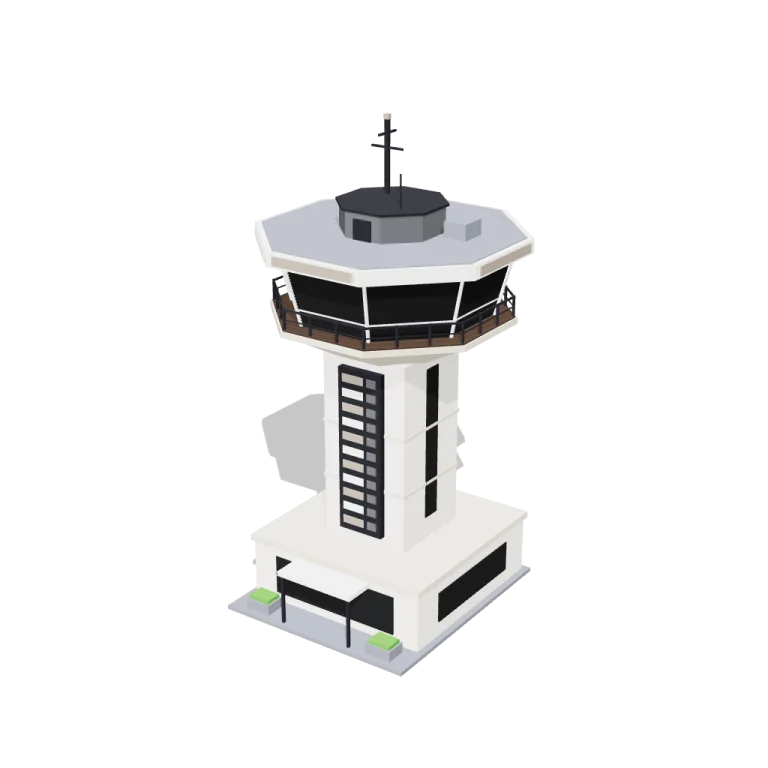
Left rail: colours and the 4 knobs the agent wrote into this model — they rebuild the geometry and go into your download. Right rail: looks for the viewer. Drag to orbit, scroll to zoom.
- Triangles
- 1,576
- Vertices
- 4,728
- Meshes · materials
- 29 · 29
- Size (W × H × D)
- 13 m × 25 m × 13 m
- File
- GLB · 135 KB
- Animation
- Static
- Style
- Low-poly
- Collection
- Racing Circuit
Palette · named materials
- podium walls and shaft (warm white)#f2ede2
- roof cap and entrance canopy (kerb red and white)#f4f1ec
- parapet, floor bands, soffit and cab slab (kerb red and white dark)#d7cebc
- mullions, transom, plain fascia panels and timing rows (kerb red and white light)#f9f8f6
- team livery fascia panels, timing rows and mast beacon (flag colours)#988e81
- glazing (tarmac dark)#101113
- plant room and timing-board gap cells (tarmac light)#5c5d61
- timing board, railings, doors, mast (soot black)#1b1b22
- plinth, planters, roof membrane, vent box (mid grey)#7d828c
- gallery decking (dark wood)#3d2a1c
- planter beds (grass)#539b3b
Use it
import { GLTFLoader } from "three/addons/loaders/GLTFLoader.js";

const gltf = await new GLTFLoader().loadAsync(
  "https://assets.stoicsoft.com/1designtool/3d/models/racing-circuit-control-tower/3e5d866e0a/model.glb"
);
scene.add(gltf.scene); // metres, +Y up, front faces +Z
How it was made
The brief given to 1DesignTool's “3D object” template:
Control tower for the Racing Circuit kit. Design it as one clear asset at believable real-world scale for that setting (state the size in metres in meta.notes), with its main parts modelled and named, readable at thumbnail size and from every orbit angle. This is one part of the Racing Circuit kit (Low-poly style, flat-lowpoly direction): Speed, pit stops and crowds. Use ONLY the kit palette, by name: tarmac #34373d, kerb red and white #f4f1ec, flag colours #988e81, grass #539b3b, tarmac dark #101113, kerb red and white dark #d7cebc, tarmac light #5c5d61, kerb red and white light #f9f8f6, soot black #1b1b22, warm white #f2ede2, mid grey #7d828c, dark wood #3d2a1c. Every material's `name` must be exactly the palette colour it uses — the GLB carries these names so the kit recolours as one; an unnamed material fails delivery. Kit knob: expose a param `teamLiveries` (0–1, default 0.5) for the kit's "Team liveries" setting wherever it makes sense on this part, and keep that id.
- Agent: Claude Code · Claude Opus 5.5 in 1DesignTool
- Direction: Low-poly · family scenes
- three-check PASS · glb-lint PASS
Named parts · 9
- Control tower
- Podium and entrance
- Shaft
- Timing board
- Soffit and gallery
- Control cab glazing
- Roof cap and livery fascia
- Rooftop plant room
- Antenna mast
Note: Size at default params: 12.7 m wide (X) × 13.3 m deep (Z) × 24.6 m tall to the mast tip. The podium is 10 m square and 3.6 m high, the shaft 4.8 m square, the cab floor at 15 m with 3.2 m-high glass, and the roof cap at about 18.6 m. Origin at the bottom centre, resting on y = 0. The pit-lane front (entrance canopy and timing board) faces +Z. Static: no animation clip. The GLB is baked at the default params: 1,576 triangles, 29 meshes, one per part and palette colour. Every material is named after its kit palette colour so the kit recolours by name. Names repeat because the exporter writes one material per mesh. Team liveries (the kit knob) sets the share of roof-fascia panels and timing-board rows painted in flag colours instead of plain kerb white, spread evenly; at 0.5, 4 of 8 panels and half the rows are liveried. Cab floor height stretches the shaft and timing board. Cab glass lean sets how far the glass leans out at the top, and the roof cap grows with it. Cab sides switches the cab, gallery and cap between 6 and 12 facets. Knobs rebuild the model in the viewer only; the GLB is the default build. glb-lint: 0 errors and 6 heuristic warnings, all expected: per-mesh duplicate palette materials, non-indexed flat-shaded geometry, nested trim and windows counted as overlaps, wall-mounted panels counted as 'detached', and a height above the direction's 1 m reference because this is a building. The kit's plan-check rejects the hyphenated library part ids, because its regex allows no hyphen in the first segment. That is its only complaint; a de-hyphenated copy of the plan passes. three-check and the GLB carry the ids correctly. Fix rounds: two for camera framing, and one to bake the footprint-centring shift into the geometry, because the export dropped it as a group offset.
About the Control tower 3D model
Control tower is a free low-poly 3D model from the Racing Circuit set. It measures 13 m × 25 m × 13 m (W × H × D) at real-world scale and is built from 1,576 triangles across 29 meshes, with 9 named parts. Download the 135 KB GLB and drop it into three.js, React Three Fiber, Godot or Blender — free for commercial use, no attribution required.
- Is the Control tower 3D model free for commercial use?
- Yes. It is free under the 1DesignTool 3D library license: use it in personal and commercial work — games, apps, websites, renders, ads and client projects — and modify it as you like, with no credit required. What you can't do is re-sell or re-distribute the file on its own or inside a model pack.
- What file format is it, and how big is it?
- A single binary glTF 2.0 file (.glb), 135 KB: 1,576 triangles, 4,728 vertices and 29 materials, modelled in metres at 13 m × 25 m × 13 m.
- Can I animate Control tower?
- It ships as a static mesh. Its 9 named parts are separate nodes, so you can move or animate each one in your engine.
- Which engines and tools can open it?
- Anything that reads glTF 2.0. three.js, React Three Fiber, Babylon.js, Godot 4 and Blender import the GLB directly; Unity and Unreal Engine load it through their glTF importers. The snippets above show the exact code for three.js, React Three Fiber, Godot and Blender.
- How was the Control tower 3D model made?
- Claude Code (Claude Opus 5.5) generated it inside 1DesignTool's 3D template from a written brief, then the design kit's checks verified the geometry and the GLB before it was published. You can make your own the same way with 1DesignTool.
More like this
All of Racing Circuit →
Safety car
Racing Circuit2,332 tris

Race cars
Racing Circuit2,288 tris

Waving flags
Racing Circuit2,076 tris

Start lights
Racing Circuit1,576 tris

Podium
Racing Circuit1,692 tris

Fuel rigs
Racing Circuit1,940 tris

Cones
Racing Circuit624 tris

Timing boards
Racing Circuit2,040 tris
Free under the 1DesignTool 3D library license. Model #17 of 1785.