Vending wall
A modular low-poly bank of street vending machines for a neon-lit back alley: three 1 m drinks and snack machines with lit display windows, glowing header lightboxes and keypads, under a shared canopy with a neon front edge.
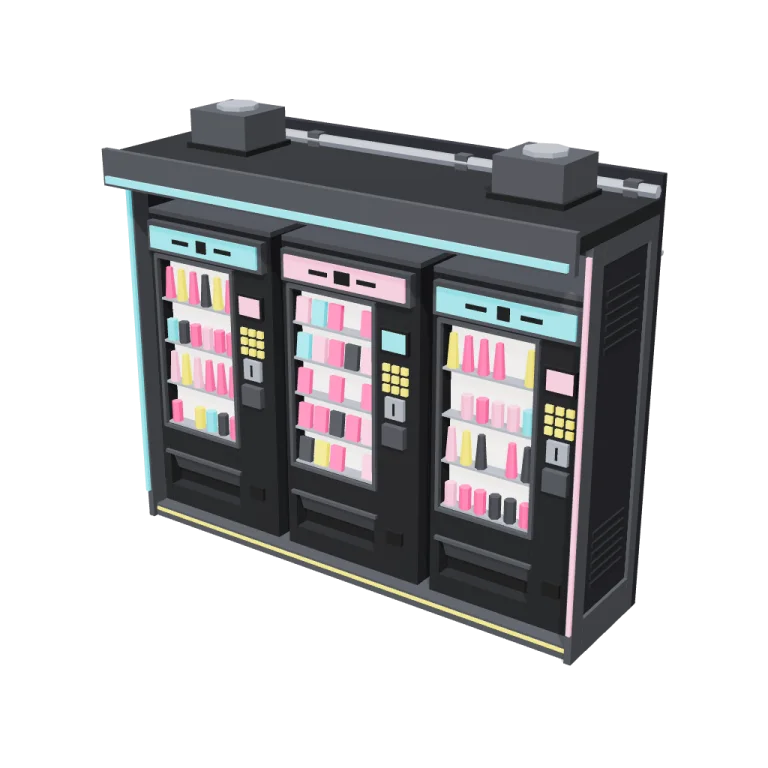
Left rail: colours and the 4 knobs the agent wrote into this model — they rebuild the geometry and go into your download. Bottom: what the model does — the one you pick plays here and is baked into the download. Right rail: looks for the viewer. Drag to orbit, scroll to zoom. On a desktop, Open in 1DesignTool turns it into a project you can keep editing with your agent.
- Triangles
- 3,568
- Vertices
- 6,530
- Meshes · materials
- 38 · 38
- Size (W × H × D)
- 3.0 m × 2.6 m × 1.0 m
- File
- GLB · 213 KB
- Animation
- Static
- Style
- Low-poly
- Collection
- Cyberpunk Alley
Palette · named materials
- body#151619
- interior#090a0b
- trim#3a3c40
- wall#1b1b22
- metal#7d828c
- backlight#f2ede2
- glow#eecd2b
- product#f64c84
- neon-pink#f994b6
- neon-cyan#20c6df
Use it
import { GLTFLoader } from "three/addons/loaders/GLTFLoader.js";

const gltf = await new GLTFLoader().loadAsync(
  "https://assets.stoicsoft.com/1designtool/3d/models/cyberpunk-alley-vending-wall/626af5aa72/model.glb"
);
scene.add(gltf.scene); // metres, +Y up, front faces +Z
How it was made
The brief given to 1DesignTool's “3D object” template:
Vending wall for the Cyberpunk Alley kit. Design it as one clear asset at believable real-world scale for that setting (state the size in metres in meta.notes), with its main parts modelled and named, readable at thumbnail size and from every orbit angle. It is a modular piece that snaps on a 1 m grid: give it a length in whole metres and put the origin at its snapping end, stated in meta.notes. This is one part of the Cyberpunk Alley kit (Low-poly style, flat-lowpoly direction): A rain-soaked back street under neon. Use ONLY the kit palette, by name: black #151619, neon pink #f994b6, cyan #20c6df, sodium yellow #eecd2b, black dark #090a0b, neon pink dark #f64c84, black light #3a3c40, neon pink light #fcdee8, soot black #1b1b22, warm white #f2ede2, mid grey #7d828c, dark wood #3d2a1c. Every material's `name` must be exactly the palette colour it uses — the GLB carries these names so the kit recolours as one; an unnamed material fails delivery. Kit knob: expose a param `neonColours` (0–1, default 0.5) for the kit's "Neon colours" setting wherever it makes sense on this part, and keep that id.
- Agent: Claude Code · Claude Opus 5.5 in 1DesignTool
- Generation: 3.24M tokens (95% cached) · ≈ $2.43 at API prices · 5-hour plan +6%
- Direction: Low-poly · family scenes
- three-check PASS · glb-lint PASS
Named parts · 13
- Vending wall
- Plinth
- Back wall panel
- End caps
- Machine cabinets
- Display windows
- Cans and snacks
- Header lightboxes
- Keypads and coin slots
- Pickup bays
- Canopy
- Neon strips
- Roof vents and conduit
Note: Real-world size: 3.0 m long x 2.6 m tall x 1.0 m deep (three 1 m machines, 1.95 m tall, under a canopy at 2.27 m). Modular piece on a 1 m grid: the length is a whole number of metres, one machine per metre. The origin is the snapping end: the bottom of the left (-X) end, centred in depth. The piece spans x = 0 to 3, z = -0.5 to +0.5 and rests on y = 0, with the front facing +Z. Copies snap end-to-end at whole-metre x offsets. Nothing pokes past that footprint. Static set piece: no animation clip. Every material is named after its Cyberpunk Alley palette colour. 10 of the 12 colours are used: neon pink light and dark wood are not. The exporter writes a separate material copy per mesh, so the GLB has 38 material slots that share those 10 names. Recolour by name. Neon strips, lightboxes, screens, keypads and the display backlight are emissive. Facet normals are baked in, so the model stays flat-shaded in Blender, Godot and Unity. The displays are open lit recesses, with no transparent glass. Params only take effect in the 1DesignTool viewer, and the GLB is exported at the default values. neonColours sets which neon strips, lightboxes and keypad screens glow cyan and which glow neon pink (0 = all pink, 1 = all cyan, 0.5 = mixed). The viewer renders at exposure 0.8 instead of the direction's 1.05 so the neons don't wash out; this is a viewer-only override. Part ids use the hyphen-free root 'cyberpunkalleyvendingwall' because the kit's part-id format does not allow hyphens. glb-lint: 0 errors. Its 5 heuristic warnings are the per-mesh material copies, intended nesting of products in their display recesses, merged parts flagged as detached, and the 2.6 m height compared with the direction's 1 m reference. No text, logos or brand names: the lightboxes carry only a simple can or pack pictogram.
About the Vending wall 3D model
Vending wall is a free low-poly 3D model from the Cyberpunk Alley set. It measures 3.0 m × 2.6 m × 1.0 m (W × H × D) at real-world scale and is built from 3,568 triangles across 38 meshes, with 13 named parts. Download the 213 KB GLB and drop it into three.js, React Three Fiber, Godot or Blender — free for commercial use, no attribution required.
- Is the Vending wall 3D model free for commercial use?
- Yes. It is free under the 1DesignTool 3D library license: use it in personal and commercial work — games, apps, websites, renders, ads and client projects — and modify it as you like, with no credit required. What you can't do is re-sell or re-distribute the file on its own or inside a model pack.
- What file format is it, and how big is it?
- A single binary glTF 2.0 file (.glb), 213 KB: 3,568 triangles, 6,530 vertices and 38 materials, modelled in metres at 3.0 m × 2.6 m × 1.0 m.
- Can I animate Vending wall?
- It ships as a static mesh. Its 13 named parts are separate nodes, so you can move or animate each one in your engine.
- Which engines and tools can open it?
- Anything that reads glTF 2.0. three.js, React Three Fiber, Babylon.js, Godot 4 and Blender import the GLB directly; Unity and Unreal Engine load it through their glTF importers. The snippets above show the exact code for three.js, React Three Fiber, Godot and Blender.
- How was the Vending wall 3D model made?
- Claude Code (Claude Opus 5.5) generated it inside 1DesignTool's 3D template from a written brief, then the design kit's checks verified the geometry and the GLB before it was published. You can make your own the same way with 1DesignTool.
More like this
All of Cyberpunk Alley →
Cyberpunk Android
Cyberpunk Alley2,868 tris

Cyberpunk Hacker
Cyberpunk Alley2,444 tris

Cyberpunk Enforcer
Cyberpunk Alley3,856 tris

Cyberpunk Street Vendor
Cyberpunk Alley2,890 tris

Sliding shutter
Cyberpunk Alley1,460 tris

Flickering sign
Cyberpunk Alley1,992 tris

Delivery drone
Cyberpunk Alley1,796 tris

Hover bike
Cyberpunk Alley1,948 tris
Free under the 1DesignTool 3D library license. Model #1856 of 2361.